
The Silent Golden Hour
Why sleep builds or dissolves plaque while you sleep
One hour can be life or death
Dr. Kevin Ham, MD
I hosted 54 Ham relatives from 7 cities and three countries last week. It was so touching to have four generations of Hams in one place. We spoke from the heart, each of us asked to give their life moments, their experience of this gathering and their life dreams. From my 90 year old father to his four siblings, 88, 86, 83, 74, I was so touched hearing how they struggled through poverty. My oldest aunt was 78 before she was taught to read Korean at her church. That was mind blowing for me to hear. My cousin said he never ate white rice until he was 19. My uncle and his wife had little education. Somehow my father had the courage to venture out of his small hometown of just under 1400 people to a larger village to be trained as a miner. He then got a lottery selection to go to Germany as a miner and for three years worked deep in the mines and watched his fellow miners die from accidents. He decided he needed another job and found his way to Canada, London Ontario and got a job at the Ford factory there. London was where I was born in 1970. My older cousin became an engineer and ended up getting a job in a managerial position at the same Ford factory in London, where he met some of my father’s coworkers from long ago. I went to London to do my medical residency for two years and my daughter was born there. I realized that life is not only a linear story but also circular.
I realized last year after visiting my Ham relatives in my father’s home region, where 20 of us gathered, that time was passing so quickly and so I had an idea to invite all my direct Ham relatives to Vancouver and host them. It would be a once in a lifetime event as many of them are older and reunite my aunts, uncle and father in their old age. My uncle in Toronto had only seen his sister once in 70 years! My father left Korea in 1965. Through God’s grace, and our collective hearts, the Ham gathering was so heart touching and endearing. Each of us touched one another’s hearts and we are eternally grateful for this experience to live, sleep, travel together to Whistler, Victoria and most of all at a camp where we spent three days fully together. I hope each of you reading will have the opportunity to do this with your families and extended families.
I gave a special ad hoc talk on health and how to prevent and reverse heart disease, stroke, cancer and our common metabolic diseases including cancer (gallbladder) which my mom perished from in 2006 at age 68. I asked my older aunts to read the Bible and find the secrets of life within it.
But I am now in Kauai for two weeks, focused on my sleep. I realized that high LDL in the past (186 mg/dL or 4.33 mM) was not my only risk factor. After researching sleep, I realized lack of sleep is an independent risk factor for heart attacks. I knew this but didn’t realize the severe impact it has played in my life.
Since I was a teenager, I didn’t sleep a lot. 4-6 hours. Med school didn’t help while holding three jobs to pay for med school plus helping my father’s dry cleaning businesses. After my carotid plaque reversed, I went back to my old ways of being extremely busy, full of stress and so when I opened my eyes, as a light sleeper, my brain would be thinking of all the things I needed to do. I would average under 6 hours of sleep.
Here is a log of my total sleep, deep sleep and REM in the last two weeks.
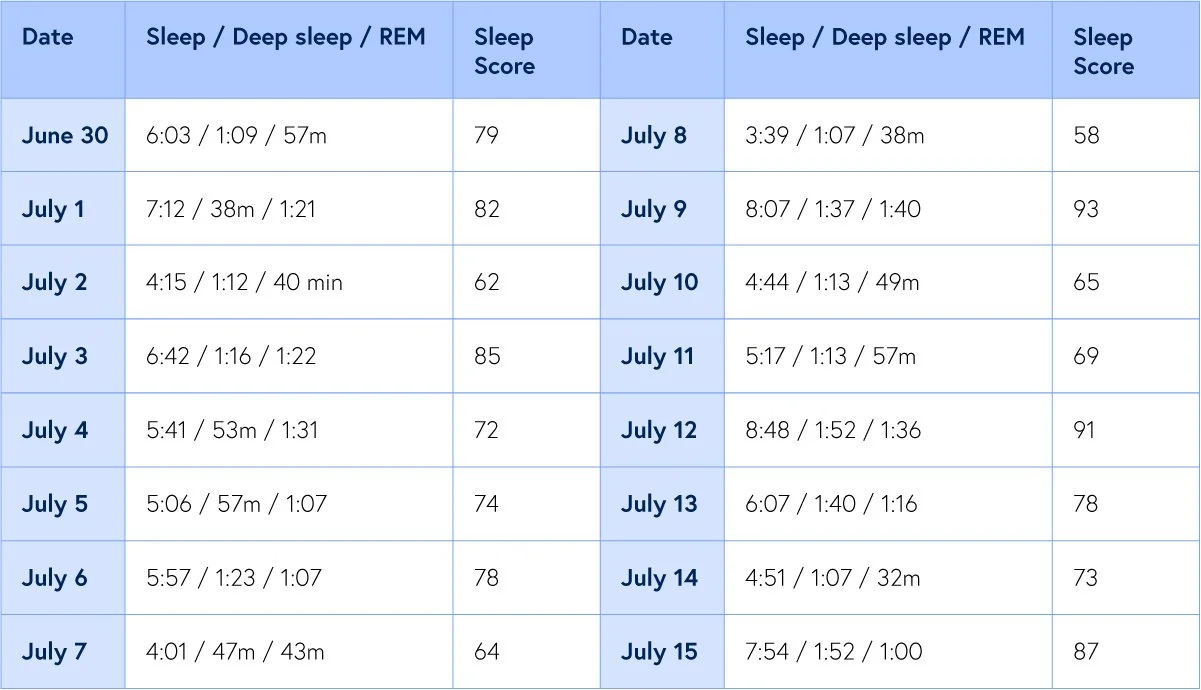
My Sleep Data (Oura ring)
July 3-13 is when my relatives came. July 14 is when I travelled. Today I slept 8:37 with 1:38 of deep sleep and 1:33 of REM. My sleep score? An astounding 94 (only my third time cracking the 90+ score on my Oura ring in six months).
Deep sleep is when the body restores and rejuvenates. REM is when the mind, subsconscious make sense of the world. Heart rate variability is another measure to look at but that’s another topic. My goal is a sleep score above 80, sleep more than 7 hours and 1 hour+ deep sleep and REM.
Let’s dive into how important sleep is to heart disease (and almost any disease including cancer, autoimmune, metabolic disease and psychosocial).
The Golden Lost Hour
“One hour shorter or longer is the chasm between life and death.”
Dr. Kevin Ham
Twice a year, without a consent form or a control group, an entire nation runs a medical experiment on itself. In spring we push the clocks forward and quietly rob 300 million people of a single hour of sleep. The Monday that follows, emergency rooms see more heart attacks. In autumn we hand the hour back, and heart attacks fall. Same people, same diets, same cholesterol, same medications, same everything. The only variable that moved was 1 hour of sleep.
That so slight a thing can tilt so grave an outcome should unsettle us, because it exposes a blind spot the clinic has been slow to admit. We measure cholesterol to the decimal and counsel against tobacco with something close to religious zeal, yet we have long treated sleep as a luxury rather than a lever. It is time to correct the ledger. Sleep is one of the most powerful cardiac interventions you will ever have, and it is free.
We are perhaps the first generation to treat the night as negotiable. The electric bulb, the glowing screen, the always-open economy, each has taught us to borrow against the dark as though it were interest-free. It is not. The arteries keep the account, and they charge, patiently, in plaque.
The Reward We Mistook for a Cause
“The shorter your sleep, the shorter your life span.”
Matthew Walker, Why We Sleep
For most of the modern era we regarded sleep as the reward for a healthy life rather than a cause of one. The evidence has since inverted that belief. The most careful look came from the PESA study, where investigators fitted nearly 4,000 healthy middle-aged adults with motion trackers for 7 nights, measuring not what people claimed but what their bodies actually did, and then imaged their arteries from the neck to the groin. They sorted the sleepers into 4 groups: under 6 hours, 6 to 7, a reference band of 7 to 8, and over 8. The result was sobering. Those sleeping under 6 hours carried roughly 30 percent higher odds of the heaviest plaque burden in the body, and the association survived every adjustment for the usual suspects, the cholesterol and the blood pressure and the rest.
One detail deserves a second look, because it overturns a common comfort. The extra plaque in the short sleepers appeared on ultrasound even when their coronary calcium score read a reassuring zero. A calcium score of zero is widely taken as an all clear. In these men and women it was nothing of the kind. Short sleep was laying down the soft, young, rupture-prone plaque that calcium scans cannot see, the very kind that kills before it ever turns to stone.
Nor is more sleep simply better. Both ends of the spectrum carry risk, a shallow U whose floor sits at 7 to 8 hours of true sleep for most adults. Below 6, plaque and events climb. Beyond 9, risk rises again, though there the long sleep tends to be the shadow of some other illness rather than its author. The number to aim for is not heroic. It is ordinary, and most of us miss it: more than a third of adults routinely sleep less than the 7 hours the heart asks for, which makes this not a fringe risk but a mass exposure, quietly shaping the arteries of tens of millions who believe themselves well.
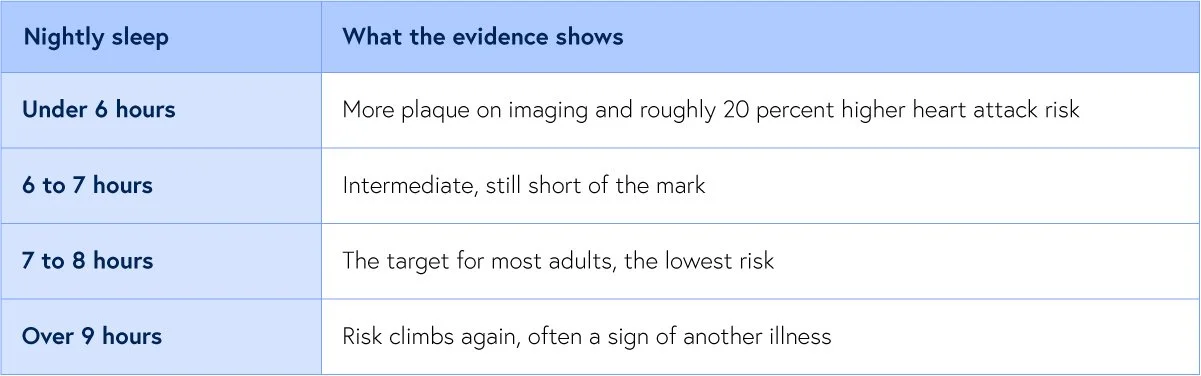
The Sleep Ladder
I wonder whether 7 nights to assess the cardiac plaque is adequate and wondered what a longer term study would show after a month or three months but realize that this is a study that an Oura ring or other study could possibly be used to conduct and then do serial measures of carotid artery ultrasounds or even coronary arteries by CT with contrast after six months and a year.
What the Night Builds
“If sleep does not serve an absolutely vital function, then it is the biggest mistake the evolutionary process has ever made.”
Allan Rechtschaffen
Why should the hours you spend unconscious reach into the wall of an artery at all? The most elegant answer came from a laboratory, where researchers broke the sleep of mice night after night and watched their plaques grow. Tracing the chain backward, they found its first link in the brain. Fragmented sleep lowered a signal called hypocretin, made in the hypothalamus, and the fall in hypocretin instructed the bone marrow to release a flood of inflammatory white cells, the very monocytes that infiltrate the artery wall and build plaque. More broken nights meant more of these cells, and larger lesions. And their cholesterol never moved.
That last fact is the heart of the matter, and it answers a question I am asked often. Can plaque still advance when your LDL is low and your inflammation looks quiet? It can. Sleep does not build plaque by raising your cholesterol; it builds it through the brain and the marrow, along a road that runs parallel to LDL and independent of it. You can do everything right on the lipid panel and still lose ground in the artery if you are stealing from sleep.
In the human body the insults stack higher still. Deprived of sleep, your blood pressure fails to dip at night as it should, your stress nervous system stays switched on, cortisol runs high, blood sugar control frays, and the smooth lining of your vessels loses its ability to relax. And sleep loss lights the same fire we track in the blood: restrict healthy adults to 4 hours in bed for a few nights and their C-reactive protein climbs. So short sleep is not a single risk factor in one disguise. It is a whole cascade, pulling blood pressure, blood sugar, and inflammation in the wrong direction at once.
The metabolic toll compounds the vascular one. A short night loosens insulin control of blood sugar within days, and it scrambles the hormones of appetite, lowering the satiety signal leptin and raising the hunger signal ghrelin, so the sleep-starved eat more and store it, preferentially, as the deep visceral fat that is itself an engine of inflammation. Sleep loss thus feeds the very fire it also ignites, and the two tighten into a loop across the years.
A brief warning here, since many who read this letter also fast. A fast is a mild stress, and it raises cortisol; short sleep raises cortisol too, and lifts inflammation on its own. Layer a fast upon a poor night and you gather all the strain of both with the reward of neither. Fast on your rested days, never on your ragged ones.
These are the cascading effects of lifestyle decisions and I have realized that the right strategies require careful thought and consideration. I’m focused on sleep above 7 hours and removing stress by a default “No, sorry I can’t at this time.” and removing white flour from my diet when I travel. Mostly greens and beans with some fruits and some whole grains.
The Proof in the Clocks and the Genes
“Unhealthy sleep, unhealthy heart.”
Matthew Walker, Why We Sleep
Return to that twice-yearly experiment, because it remains the cleanest natural proof we own. When researchers in Michigan counted heart attacks around the clock changes, the Monday after the spring shift, when the hour is stolen, brought about a 24 percent rise, some 8 additional heart attacks in a single hospital system in a single day. The Tuesday after the autumn shift, when the hour is returned, brought about a 21 percent fall. And here is the tell that rules out coincidence: the total across the whole week did not change. The lost hour did not manufacture new disease. It shoved the already-vulnerable over the edge a little sooner, and the gift of an hour drew a few of them back.
Why should a solitary hour affect the heart so much? The likeliest answer is timing rather than mere quantity. The spring shift does not only shorten sleep; it wrenches the body internal clock out of step with the external one, and that misalignment sends a surge of stress hormones and a rise in blood pressure through the vulnerable early morning, exactly when heart attacks already gather.
This is not an aberration of just one city. Swedish national records, spanning an entire country, show the same spring spike in the first days after the change. More recent data from Indiana find heart attacks elevated for roughly 2 full weeks after the spring transition. Different populations, different decades, one recurring signature: sleep.
But does too little sleep cause heart attacks, or merely travel in bad company? To settle it, researchers turned to nearly half a million adults and used the genes people are born with as a natural experiment, a design that can separate cause from mere association. The arrow pointed at cause. Short sleepers carried about 20 percent higher risk of a heart attack, and the effect held even when nothing else was amiss. Then came the line that should change how you think forever: a healthy sleep duration lowered heart attack risk even among those dealt the very worst genetic hand for heart disease. You cannot choose your DNA. You can choose your bedtime, and your bedtime determines the result.
Where Sleep Sits Among the Giants
How heavy is this lever, set beside the giants of heart disease factors? Honesty requires proportion. Pooling nearly half a million people, short sleep raised the risk of developing or dying of coronary disease by about 48 percent. That is real and it is meaningful, but it is not the magnitude of smoking, which roughly triples the odds of a heart attack, nor of a lifetime of high apolipoprotein B, which by the best global estimates underlies nearly half of all first heart attacks. Sleep belongs in the second rank of cardiac risk, a genuine and modifiable hazard rather than the single largest one.
Yet its rank understates its reach, for two reasons. Much of sleep harm is delivered through the very giants it stands beside, worsening blood pressure, blood sugar, weight, and inflammation, so that mending sleep quietly improves them all at once. And unlike your age or your genes, sleep is a lever you take hold of every single night. In 2022 the American Heart Association formally added sleep duration to its 8 essential measures of cardiovascular health, seating it beside cholesterol and blood pressure, because the weight of evidence had at last earned it the chair.
There is a further reason to take it seriously. Unlike C-reactive protein, which predicts disease powerfully yet appears to be more a marker than a cause, the genetic evidence marks short sleep as a genuine cause of heart attacks. That distinction matters, because a cause is worth changing, and this one begins to change tonight.
Which raises the question I am asked most by the health-conscious. What if sleep is the one thing I get wrong, my diet clean and my numbers pristine, but my nights only 5 hours? The data are unsentimental. Short sleep raised risk even after every other factor was stripped away, so a single broken habit is enough to bend the curve. The consolation rides beside the warning: because sleep is causal, and because it is yours to command, repairing it pays back even a person who has done everything else right.
This is my biggest risk factor and has been for decades. It explains why my wife’s calcium score is 0, my younger brother who I grew up with has a calcium score of just 7. I am in the 96% percentile for my age for calcium score. Not a good thing. I am very high risk. So I need to focus heavily on sleep and stress. Hence the reason I came to Kauai instead of going to Korea for my annual summer Bible pilgrimage, where I would get little sleep, have jet lag and meet a lot of people. I had to weigh the consequences on my heart vessels.
The Ladder, the Apnea, and the Prescription
“Why had I not heard of Vitamin K2 until ten years ago? Dr. Weston Price called it Factor X. How many other marvelous things do I yet not know?”
Dr. Kevin Ham
Duration is only half the story; quality is the other. Fragmented sleep injured the arteries in PESA even when the total hours looked adequate, and the clinic sees the same pattern in its patients. Difficulty falling asleep raises cardiovascular risk by roughly a fifth; unrefreshing sleep and trouble staying asleep carry their own smaller penalties. A night in bed is not the same as a night asleep.
The numbers put colour on this. In pooled studies, nonrestful sleep carried about a 16 percent higher cardiovascular risk, difficulty staying asleep about 14 percent, and difficulty falling asleep about 22 percent. None of these makes a headline, yet layered across decades and across a whole population they sum to a great deal of disease that a better night would have prevented.
I have very little sleep latency and fall asleep easily. Likely because I am already tired and also my exercise routines. But I do get up at night and oftentimes have a hard time falling back asleep. I’ve also doubled to tripled the amount of deep sleep I get. I have some hacks that have shown this consistently but this also is another newsletter topic.
The clock also cares about consistency as much as quantity. Newer work suggests that an irregular schedule, the bedtime that wanders by hours from one night to the next, predicts cardiovascular trouble on its own, apart from how long you sleep. The body is a creature of rhythm, and it pays a tax on chaos.
And there is a thief of quality that hides in plain sight: obstructive sleep apnea, in which the airway collapses and breathing stops dozens of times an hour, all night, every night. It is broken sleep and starved oxygen in the same stroke, and it drives high blood pressure, atrial fibrillation, and coronary disease. Its prevalence among people who carry those very conditions runs as high as 40 to 80 percent, and far too much of it goes undiagnosed. If you snore, gasp, wake unrefreshed, or carry stubborn high blood pressure or a fib, be tested. Treating apnea may be the single highest-yield sleep intervention a cardiac patient can make.
The prescription, then, writes itself, and none of it is exotic. Aim for 7 to 8 hours actually asleep, which means a little more than that in bed. Hold a steady wake time, weekends included, because regularity may matter as much as duration. Court morning light, keep the bedroom cool and dark, and move alcohol well away from bedtime, since it is among the most reliable fragmenters of sleep there is. And around the spring clock change, protect that vulnerable week by shifting your bedtime earlier for several nights, so you do not hand your heart the lost hour all at once.
I’ve added dark out curtains instead of just blinds in the bedroom. A very dark room and not too hot enables better sleep.
Guarding the Night
Measure it, too, because what is tracked improves. A wearable that estimates your sleep and your resting heart rate will not be perfect, but it will tell you the truth your memory flatters over: how often the night is broken, how the late glass of wine shortens deep sleep, how a hard block of training or a bright screen delays it. The number on the band is a mirror, and mirrors change behavior.
I am trying to guard my own sleep the way I guard a hard training session, because I have come to see them as the same discipline. Every night the wall of every artery is being either built or cleared, and while I sleep that ledger is being written without me. I have failed to protect my sleep and in the first few months, when I did, I saw a huge payoff, but in the last year, as I let sleep fall, its affected both my mental and physical resilience. I am back on track, learning the life lessons through experience rather than wisdom.
So I urge you to protect your sleep. Not because a physician instructs you to, but because the quietest hours you will ever spend are doing the loudest work you will ever ask of your body and your mind. Sleep long enough, sleep deeply enough, and sleep on a schedule, and let the mending that only darkness permits do, one night upon the next, what no pill can fully replace.
A Request
Each Friday, I upload a new YouTube video. Please like, comment and subscribe so I can help many others in your network and beyond. It’s my mission to help people avoid the same fate as Rob, the same fate as I could have had. Heart attack, stroke or sudden death.
https://www.youtube.com/@DrKevinHam
During the summer, I am only writing two newsletters a month and posting one video a week. I find it is a great cadence for myself. How is this cadence for you?
What to Start Now
Set some rules for your sleep. Bedtime, presleep routine, wake up, hours in bed, target sleep hours.
Get things off your plate that cause you the most stress. How can you do that?
Default to the important and urgent matters and be okay with the sandwich matters of life to settle.
A Question & Action For This Week
Questions worth exercising with
For yourself. For someone you love. Answer this question in the quietness of your day.
What changes will you do to ensure a consistent night of deep rejuvenating sleep? Let me know. Especially if you are great at sleeping.
For Someone You Love
There is someone in your life running and falling. You thought of them. Send this to them. Your loved ones just need the information to act and a guide to help them.
Keep going. The race is long, the road is beautiful, and the body was built to heal.
MORE READINGS YOU’LL ENJOY
Health
Reversing My 77% Heart Plaques
Stats Say You Likely Have Heart Plaque
The Healing Power of Food: Nitric Oxide
Meaning
I pray you unlock your heart to reach the height of your full potential by discovering your calling.
Kevin Ham, MD
Appendix: Sources
Dominguez F, Fuster V, et al. Sleep Duration and Quality With Subclinical Atherosclerosis (PESA). J Am Coll Cardiol 2019;73:134.
In nearly 4,000 adults measured by actigraphy, sleeping under 6 hours or fragmented sleep was independently linked to more atherosclerotic plaque, present even when the calcium score was zero.
https://www.jacc.org/doi/10.1016/j.jacc.2018.10.060
McAlpine CS, et al. Sleep modulates haematopoiesis and protects against atherosclerosis. Nature 2019;566:383.
Fragmented sleep lowered brain hypocretin, drove the marrow to release inflammatory cells, and grew larger plaques in mice, with no change in cholesterol.
https://www.nature.com/articles/s41586-019-0948-2
Cappuccio FP, et al. Sleep duration predicts cardiovascular outcomes: a systematic review and meta-analysis. Eur Heart J 2011;32:1484.
Pooling about 475,000 people, short sleep raised coronary heart disease risk about 48 percent, and long sleep about 38 percent, a U-shaped relationship.
https://academic.oup.com/eurheartj/article/32/12/1484/502022
Daghlas I, et al. Sleep Duration and Myocardial Infarction. J Am Coll Cardiol 2019;74:1304.
In 461,347 adults, short sleep raised heart attack risk about 20 percent, genetic analysis supported cause, and healthy sleep lowered risk even at the highest genetic risk.
https://www.jacc.org/doi/10.1016/j.jacc.2019.07.022
Sandhu A, et al. Daylight savings time and myocardial infarction. Open Heart 2014 (ACC report).
Heart attacks rose about 24 percent the Monday after springing forward and fell about 21 percent the Tuesday after falling back, with the weekly total unchanged.
https://www.acc.org/About-ACC/Press-Releases/2014/03/29/09/16/Sandhu-Daylight-Saving
Janszky I, Ljung R. Shifts to and from Daylight Saving Time and Incidence of Myocardial Infarction. N Engl J Med 2008;359:1966.
Swedish national data showed heart attacks increased in the first days after springing forward and decreased after falling back.
https://www.nejm.org/doi/full/10.1056/NEJMc0807104
Sleep and Cardiovascular Health. American College of Cardiology, 2025.
A clinical review linking short sleep, insomnia symptoms, and obstructive sleep apnea to hypertension, atrial fibrillation, and coronary disease.
Redefining Cardiovascular Health to Include Sleep (MESA Sleep Study). J Am Heart Assoc 2022.
Support for sleep as an eighth pillar of cardiovascular health, consistent with the American Heart Association adding sleep duration in 2022.
https://www.ahajournals.org/doi/10.1161/JAHA.122.025252
Subscribe to my Compounding Wisdom newsletter and start transforming your life. ham.com
Subscribe to my YouTube channel @DrKevinHamfor videos on how I reversed my clogged arteries in 3 months, the top foods that clear your arteries, and the first principles of health that can save your life. Like, share and subscribe — it could save the life of someone you love.
