
Which Diet Actually Reverses Plaque?
Mediterranean Diet vs Low-Fat Vegan (Whole Food Plant-based)
Dr. Kevin Ham, MD
People are asking me “What about olive oil? What about nuts? What about the Mediterranean diet? The portfolio diet? The carnivore, the ketogenic diet? The vegan diet. Can I eat eggs, dairy, fish, meat?
One expert says this, another says that. Sure there are exceptions. But what do the studies show and what do the population studies show?
I used to pour olive oil on everything. I used to eat a lot of nuts. A lot of dairy, meat, seafood.
Now that I have heart disease, I’ve stopped all that. Here’s what I’ve found what each of these diets do and what actually reverses heart disease. Let the evidence speak for themselves.
PREDIMED: The Study that Built the Myth
“The Mediterranean diet is good for everyone. 95% of the population can benefit from it.”
Dr. Ramon Estruch, MD
PREDIMED (Prediction of Diet of Mediterranean) is the most cited diet trial ever run. More than 7,000 people across Spain, all at high cardiovascular risk, were sorted into 3 groups.
One ate a Mediterranean diet enriched with extra virgin olive oil, close to a liter a week.
One ate the same diet enriched instead with a daily handful of nuts.
The third was asked, in the original design, to eat low fat.
The trial ran for years, and the result became scripture. The two Mediterranean groups had about 30 percent fewer heart attacks and strokes than the control. Olive oil, the headlines decided, saves lives. Compared to the control diet.
Read the fine print and a quieter story appears. PREDIMED counted events. Heart attacks, strokes, deaths. It did not, in its main result, measure plaque. And when you lay the actual events side by side, the famous victory is smaller than it sounds.
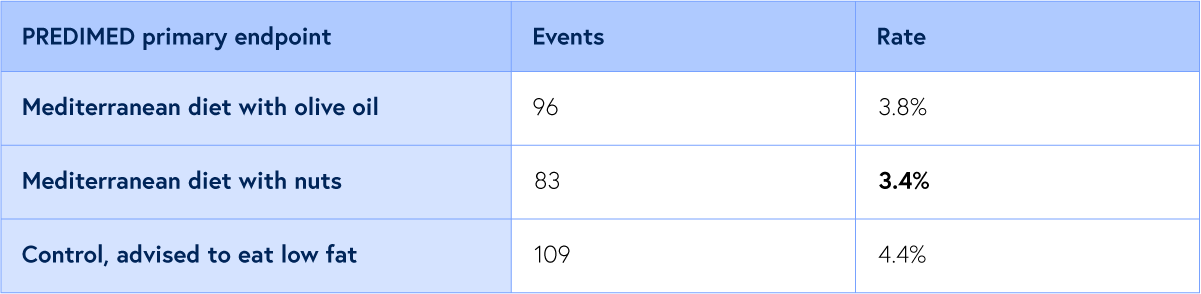
288 primary endpoint events in total. The celebrated result is the gap between 4.4 and 3.4 percent.
This data scares me. This is what people depend on for the proof that the Mediterranean diet prevents death from heart attacks and strokes? Just 1% reduction in severe adverse events?
It means heart disease progressed and is progressing, although at a slower rate than controls. It did not answer the definitive question of whether the Mediterranean diet arrested or reversed heart disease. Just decreased cardiac events and deaths.
That gap, 4.4 percent down to 3.4 percent, is about 1 person in 100 spared an event across roughly 5 years.
It is real, and it is worth having. But it is a difference in events, not in the disease. No one threaded a camera into these arteries or imaged these arteries and watched the plaque retreat. When researchers finally did look, tracking the neck arteries with ultrasound, (not coronary heart arteries) the three diets came apart in a way the event tally had hidden.
In the olive oil group, the artery wall did not shrink. It sat exactly where it had started.
In the nut group, the wall regressed… slightly. The plaque, measurably, grew smaller. Same Mediterranean plate. The only variable was nuts in place of oil, and only the nuts moved the disease slightly backwards.
The Low-Fat Vegan (Whole Food Plant-Based) Diet
“Our bodies often have a remarkable capacity to begin healing.”
Dr. Dean Ornish, MD
To watch an artery heal, you have to leave PREDIMED and return to two stubborn American physicians who used a harder instrument: a camera threaded into the heart itself.
In the 1990s, Dean Ornish took a small group of patients with established coronary disease and put them on a diet most cardiologists called extreme.
About 10 percent of calories from fat.
No added oil at all, not even olive.
Whole food, plant based,
Paired with exercise and
Daily practice of calming the nervous system.
Then he filmed their coronary arteries, and filmed them again 5 years later.
In the treated group the narrowing reversed, the arteries opening by close to 8 percent.
In the control group, following standard heart healthy advice, the narrowing worsened by nearly 28 percent.
The treated patients had less than half the cardiac events.
Caldwell Esselstyn carried the same idea across decades.
In his 2014 series, of 198 patients who held to an oil free, plant based plan,
99.4 percent avoided a major cardiac event over years of follow up.
Not 30 percent fewer events. Almost none at all.
Set the two kinds of study beside each other and the difference in ambition is the whole point.
PREDIMED nudged an event rate by a single percentage point and was crowned.
Esselstyn reversed the plaque on film and almost completely abolished the events.
Same disease. Different finish lines. Different leagues entirely.
The Diet They Actually Ate
“I want patients to eat leafy greens 6 times a day, and no oil.”
Dr. Caldwell Esselstyn, Jr., MD
These three studies get cited in the same breath, as if they tested one idea. They did not. The plates were profoundly different, and so were the lengths of time the patients held to them. Here is exactly what each asked of its people, and for how long.
PREDIMED. Two Mediterranean plates against a low fat control.
PREDIMED ran 3 arms, with no calorie counting and no exercise prescription.
The first group ate a Mediterranean diet built around:
extra virgin olive oil, and was told to use at least 4 tablespoons a day, roughly 50 milliliters. Each household was given 1 liter of free oil a week to make sure they did.
The second group ate the same Mediterranean pattern but traded the oil emphasis for a daily 30 gram packet of mixed nuts,
15 grams of walnuts,
7.5 grams of almonds, and
7.5 grams of hazelnuts, supplied free.
Both Mediterranean groups were coached to
eat vegetables at least twice a day,
fresh fruit 3 or more times a day,
fish or seafood at least 3 times a week,
legumes at least 3 times a week,
white meat in place of red,
a tomato and onion sofrito, and,
for the wine drinkers, a glass with meals.
They were told to steer clear of soda, commercial baked goods, spread fats, and red and processed meat.
The third group, the control, was the quiet flaw in the design. At the start they were simply handed advice to cut all kinds of fat, plus small nonfood gifts, with none of the coaching or free food the other two received. A proper low fat checklist was not even added until about 3 years in. The trial ran for a median of 4.8 years before it was stopped early for benefit.
Ornish. 10% fat, and lifestyle modifications: exercise, stress and support sessions.
The Lifestyle Heart Trial asked far more than a change of groceries. The diet was a
whole food vegetarian plan with about
Fruit, vegetables, whole grains, legumes, and soy filled the plate.
10% of calories from fat,
70 to 75% from complex carbohydrates, and
cholesterol held under 10 milligrams a day.
No added oil.
No meat, poultry, or fish.
The only animal foods allowed were
egg whites and a single cup of nonfat milk or yogurt a day, which is what keeps it from being strictly vegan.
Nuts, seeds, avocados, olives, and caffeine were out, all of them too fatty.
The food was only 1 of 4 pillars. Patients also did about 3 hours of aerobic exercise a week, an hour a day of stress management through yoga, breathing, and meditation, stopped smoking, and met twice a week for 4 hour group support sessions. The program opened with a week long residential retreat. Their coronary arteries were filmed at the start, again at 1 year, and a final time at 5 years.
Esselstyn. No oil, and greens 6 times a day.
Esselstyn was the strictest of the three.
No oil of any kind, not a drop, not even olive.
No meat, fish, poultry, eggs, or dairy, and no refined grains.
He kept nuts, seeds, and avocados off the plate for patients with disease, not because he thinks them unhealthy but because their fat makes a low fat diet hard to hold,
What remained was vegetables, fruit, whole grains, legumes, and leafy greens, which he asked heart patients to eat 6 times a day.
Essential fats instead from a tablespoon or two of ground flaxseed.
Salt, sugar, and caffeine were kept to a minimum.
When diet alone could not pull total cholesterol under 150, he added a cholesterol lowering drug.
His first study, published in 1995, followed 24 severely ill patients, 5 of whom had been told they had less than a year to live. He tracked them past 12 years and reviewed them beyond 20, making it one of the longest studies of its kind.
His 2014 report followed 198 seriously ill patients. Among the 177 who held to the plan, over a mean of 3.7 years, 99.4 percent avoided another major cardiac event, all while staying on their prescribed heart medications.
One contrast is worth marking before the table. The Mediterranean arm that actually shrank plaque leaned on a daily handful of nuts, while both reversal diets, Ornish and Esselstyn, banned nuts outright as too fatty. The same food sits on opposite sides of the line, depending on whether the goal is a lower event rate or the lowest possible fat load. These were never the same experiment wearing 3 hats.
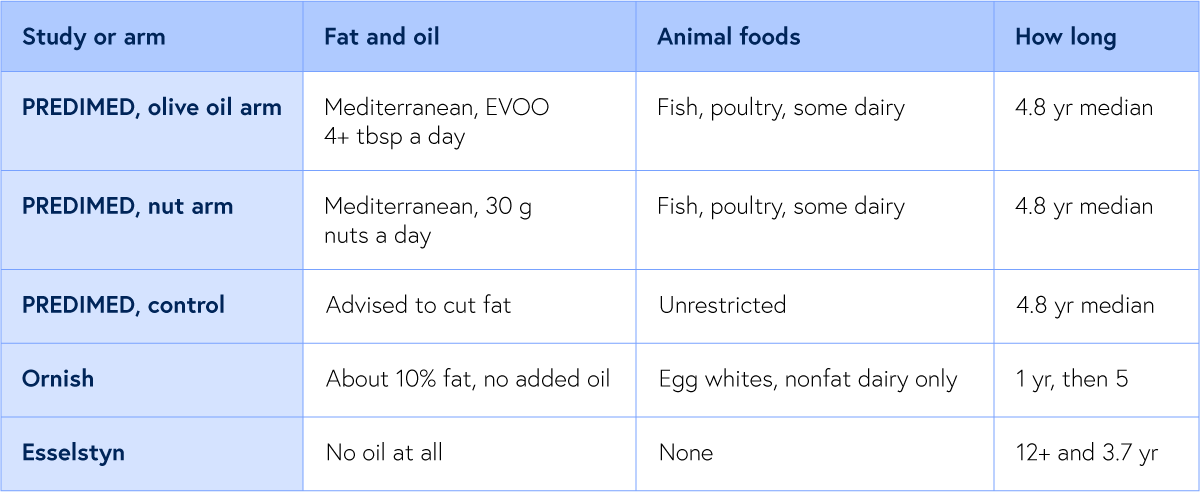
3 studies, 4 plates, very different lengths of time. Only the oil free, near vegan plates were ever filmed reversing disease.
But what did they actually do to the carotid artery in the neck? Below are the exact CIMT measurements, the gold standard ultrasound marker of atherosclerosis, from the same trials.
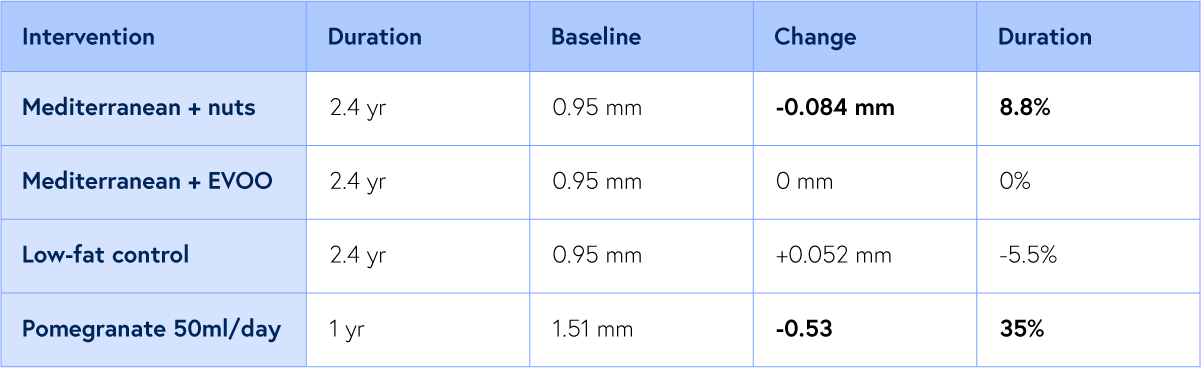
Sala-Vila 2014 (PREDIMED): Internal carotid mean IMT, n=187, 2.4 year median follow up. Aviram 2004: Common carotid IMT, n=10 treated and n=9 control with carotid stenosis, 1 year follow up.
Ornish and Esselstyn measured plaque in the coronary arteries. Predimed did a followup substudy to see the effect of nuts vs olive oil in the Mediterranean diet using the carotid artery wall thickness, which is a more immature plaque. I show what even a single food like pomegranate juice can do reversing CIMT 35% in a year vs Mediterranean diet plus nuts at 8.8% in 2.4 years. Imagine what the Low fat WFPB would reduce.
In fact my own CIMT reduced 53% in just 3 months on Esseltyn’s diet.
Why the Oil Fails to Reverse: The Mechanism
“Oil injures the endothelium, and that injury is the gateway to vascular disease.”
Dr. Caldwell Esselstyn, Jr., MD
Here is the uncomfortable part. It is not only that olive oil fails to shrink plaque. There is evidence, in animals and in the laboratory, that the oil can push in the wrong direction.
At Wake Forest, monkeys fed for 5 years on the monounsaturated fat (oleic acid) that dominates olive oil developed as much coronary atherosclerosis as monkeys fed saturated fat, even though their cholesterol numbers looked better. The fat enriched their LDL particles with a form of cholesterol that settles readily into the artery wall.
In a separate human experiment, a single meal of olive oil dropped the arteries’ ability to relax by about 31 percent within hours.
Fairness demands the caveats, and they are real. Those are monkeys on punishing diets, and a single meal, not years of human imaging. No human imaging trial has shown olive oil growing plaque in people, and over a lifetime olive oil plainly beats butter and beats the refined junk it so often replaces. Olive oil is not poison.
But return to the press. The oil cuts risk because the few polyphenols it retains calm inflammation and slow the oxidation that makes plaque rupture. It makes the plaque quieter. It does not make it smaller, because it is still concentrated liquid fat with the fiber gone and most of the medicine left behind in that bitter water.
A daily pour carries the fat of roughly 100 olives (50g of fat) and only a sliver of their hydroxytyrosol. You are keeping the part that clogs and discarding the part that heals. So eat the olive. The whole fruit holds its polyphenols in the flesh, where some ripe olives carry many times the hydroxytyrosol of the oil. Eat the olive, and leave the bottle for the pan you were going to grease anyway.
Why the Nuts Help Reverse: The Mechanism
“Eating a handful of walnuts every day is a simple way to promote cardiovascular health.”
Dr. Emilio Ros, MD
If the oil is the wrong half of the olive, what is the right prescription?
PREDIMED, read honestly, already named part of it. The nuts.
The trial used an exact recipe, 30 grams a day.
15 grams of walnuts, about 7 walnut halves.
7.5 grams of almonds, about 6 almonds.
7.5 grams of hazelnuts, about 6 hazelnuts.
One small handful, and each carries a different gift.
Walnuts. The highest plant omega 3 of any nut, polyphenols in the papery skin that the gut turns into artery protectors, and the raw material the body uses to make nitric oxide, the molecule that keeps a vessel open. Of more than 1,000 foods once tested for antioxidants, walnuts ranked second. Their deepest work is at the first step of reverse cholesterol transport. In the laboratory, walnut oil raised cholesterol efflux from arterial foam cells by 35 percent, the act of pulling cholesterol back out of the plaque and loading it onto HDL for the trip home. This is the Activate step, where the artery first begins to empty.
Almonds. Vitamin E, magnesium, fiber, and arginine, and a proven drop in LDL and ApoB, the very particles that build the plaque. In a controlled feeding trial, a daily handful raised the mature alpha 1 HDL particles and improved the blood’s capacity to accept cholesterol from cells. This is the Carry step. Almonds give the bloodstream better trucks to haul away the cholesterol the walnuts pried loose, and the vitamin E rides along to keep that cargo from oxidizing on the way to the liver.
Hazelnuts. Plant sterols that sit at the gut wall and compete with cholesterol for the door, blocking its reabsorption so it leaves the body instead of cycling back into the blood. They lower LDL and drop the oxidized cholesterol that tears into the artery. This is the Transfer step, the final out. Hazelnuts show the cholesterol the body delivers to the gut the exit rather than letting it back in, closing the loop the other two nuts opened.
The catch with all three is honest. The benefit fades within a month of stopping. These are not a cure you take once. They are a practice.
One warning belongs here, because more is not better. The dose that shrank plaque was 30 grams, not a bowl. That single handful already carries about 18 grams of fat and close to 190 calories. Double it to 60 grams and you take in roughly 36 grams of fat from nuts alone, which is more than an entire day’s fat allowance on the kind of very low fat diet that actually reverses an active plaque.
This is exactly why Esselstyn keeps nuts off the plate for his heart patients. He is not against the nut. He is against the fat load that rides in with it. Once you are holding total fat under 10 percent of calories to melt a plaque you already have, even one honest handful can quietly push you over the line, and a double handful blows straight past it. So weigh the 30 grams. Treat it as a dose, not a snack.
And then there is the long shot, the food with the largest number on the board. In a small trial, 50 milliliters of pomegranate juice a day, about 2 tablespoons, shrank carotid wall thickness from roughly 1.5 millimeters toward 1 over a single year, a fall near 35 percent, while the untreated arteries thickened. That is several times the effect the nuts produced, in less time. The honesty tax is steep. The study was tiny, only 10 treated patients, and a larger trial came back neutral. The nuts are the sure thing, drawn from thousands. The pomegranate is the long shot.
What do I add to my diet from this?
The 50 ml pomegranate juice. It worked for me.
And after speaking to Dr. Esselstyn a couple of months about the walnuts, I’ve added 2-3 walnuts per day. I put them on my organic sourdough natto arugula sandwich. Delicious!
Moderation Kills: The Case for an Extreme Diet
“Moderation kills.”
Dr. Caldwell Esselstyn, Jr., MD
Dr. Caldwell Esselstyn wrote the most uncompromising book in this entire literature, Prevent and Reverse Heart Disease, and he refused to soften its central sentence.
Moderation kills. Once the disease is in your arteries, he argues, the advice we have all absorbed, a little olive oil, lean meat now and then, everything in moderation, is not a smaller version of the cure. It is a slower version of the disease. Every meal of oil, dairy, or flesh injures the thin layer of cells that lines the artery, the same layer that makes the nitric oxide that keeps the vessel open. Moderation simply relights that injury, a little at a time. In his words, you have to stop pouring gasoline on the fire.
This is not a small claim, because the disease is not a small thing. Cardiovascular disease is the number 1 killer on earth, taking close to 20 million lives a year, near a third of all human death. Our usual answer is mechanical. Around 650,000 stents and bypasses are threaded and stitched into American chests every year, and still the disease holds its place at the top of the list, because a stent reopens a single pipe without touching the illness that clogged it. Moderation, drugs, and surgery, in Esselstyn’s reading, mostly slow a disease that still goes on to claim most of the patients it touches.
His own work points the other way. He took patients with severe, advanced coronary disease, people for whom cardiology had nearly run out of moves, and put them on a plan with no oil, not a drop, no meat, no dairy, no eggs, and leafy greens many times a day.
Their angina faded. Their cholesterol fell. On the follow up angiograms, the blockages visibly reversed.
Hence his favorite line, that heart disease is a toothless paper tiger that need never exist, and if it does exist, need never progress, nothing more than a benign foodborne illness. That is the whole of it. No one need perish from this disease. The control was never in the pill or the operating room. It was on the plate all along.
A Request
Each Friday, I upload a new Youtube video. Please like, comment and subscribe so I can help many others in your network and beyond, it’s my mission to help people avoid the same fate as Rob, the same fate as I could have had. Heart attack, stroke or sudden death.
https://www.youtube.com/@DrKevinHam
My latest video is going viral :) My #1 meal to unclog arterial plaque. Thank you.
What to Start Now
If you are reading this with a calcium score above zero, or a family history that worries you, or a friend who suffered what Rob did
1. CAST. Cut out the harmful foods that harm your endothelium
No oils. No saturated fats. No cholesterol. No avocados. No eggs. No dairy. No meat. No seafood. No nuts except a few walnuts and perhaps almonds and hazelnuts.
No refined sugars (white flour/bread/pastries/white rice etc)
2. Add the foods that heal your endothelium cells of your arteries
Greens 6x/day (a handful)
Two to three Whole food Plant-based meals: veggies, whole grains, fruits, beans.
This is how plaque reverses. This is how compounding pays out on the side of life.
Your Question
Questions worth exercising with
For yourself. For someone you love. Answer them in the quietness of your day.
What changes will you make starting today?
For Someone You Love
There is someone in your life running and falling. You thought of them. Send this to them. Your loved ones just need the information to act and a guide to help them.
Keep going. The race is long, the road is beautiful, and the body was built to heal.
Grace, strength and love to you.
MORE READINGS YOU’LL ENJOY
Health
Reversing My 77% Heart Plaques
Stats Say You Likely Have Heart Plaque
The Healing Power of Food: Nitric Oxide
Meaning
I pray you unlock your heart to reach the height of your full potential by discovering your calling.
Kevin Ham, MD
Appendix
The summary of the referred exercise studies:
1. Estruch R, et al. Primary prevention of cardiovascular disease with a Mediterranean diet. N Engl J Med. 2013, and 2018 reanalysis.
More than 7,000 high risk Spaniards in 3 arms. Both Mediterranean arms cut events about 30 percent. Primary endpoint events: olive oil 96 (3.8 percent), nuts 83 (3.4 percent), control 109 (4.4 percent), 288 in total. The trial measured events, not plaque.
2. Sala-Vila A, et al. Changes in ultrasound assessed carotid intima media thickness and plaque with a Mediterranean diet. Arterioscler Thromb Vasc Biol. 2014;34:439 to 445.
In the long carotid substudy, the nut arm regressed internal carotid IMT and plaque height while the olive oil arm did not change. Same diet, only the nuts moved the wall.
3. Ornish D, et al. Lifestyle Heart Trial. Lancet. 1990;336:129 to 133. Follow up: JAMA. 1998;280:2001 to 2007.
A 10 percent fat whole food plant based program with no added oil. Coronary stenosis regressed about 8 percent in the treated arm while controls worsened nearly 28 percent. Controls had more than twice the cardiac events. The only diet ever filmed reversing a coronary.
4. Esselstyn CB, et al. A way to reverse coronary artery disease. J Fam Pract. 2014;63:356 to 364.
198 patients who adhered to an oil free plant based plan. 99.4 percent avoided a major cardiac event over years of follow up.
5. Esselstyn CB. Prevent and Reverse Heart Disease. Avery, 2007.
Source of the moderation kills and toothless paper tiger framing, and the case that half measures slow a disease that still claims most patients.
6. Rudel LL, et al. Dietary monounsaturated fat and coronary atherosclerosis in African green monkeys. Arterioscler Thromb Vasc Biol. 1995, with the cholesteryl oleate mechanism, J Clin Invest. 1997.
Over 5 years, the monounsaturated fat that dominates olive oil produced coronary atherosclerosis comparable to saturated fat despite better cholesterol, by enriching LDL with cholesteryl oleate. The strongest animal evidence that the oil can promote plaque.
7. Vogel RA, Corretti MC, Plotnick GD. Postprandial effect of components of the Mediterranean diet on endothelial function. J Am Coll Cardiol. 2000;36:1455 to 1460.
A single olive oil meal reduced flow mediated dilation by about 31 percent within hours. An acute mechanistic signal, not a measure of plaque.
8. Aviram M, et al. Pomegranate juice consumption and carotid intima media thickness. Clin Nutr. 2004;23:423 to 433.
50 milliliters a day shrank common carotid IMT by roughly 30 to 35 percent over a year in 10 treated patients, while controls thickened. A dramatic but small signal. A larger trial was neutral.
Subscribe to my Compounding Wisdom newsletter and start transforming your life. ham.com
Subscribe to my YouTube channel @DrKevinHamfor videos on how I reversed my clogged arteries in 3 months, the top foods that clear your arteries, and the first principles of health that can save your life. Like, share and subscribe — it could save the life of someone you love.
