
Sudden Heart Attack
Why normal people suddenly die
Kevin Ham, MD
All of a Sudden
“Create in me a clean heart, O God, and renew a right spirit within me. Cast me not away from your presence, and take not your Holy Spirit from me.”
Psalm 51, written after Nathan said: you are the man
Some of you have heard this story. Many of you have not. For me, I often replay the scenes in my head as I reflect. It’s almost become like a gospel of the heart to me now. There are some stories that we care about more than others, and some that catch our fancy and then pass like the wind. I pray that this story gets caught in your heart, because for me it did, by force, to shake me and tell me to open my eyes and, really, simply ask, “Why?”
On the morning of February 10, 2025, my friend Rob Thompson got up at dawn. It was a beautiful morning. He was excited to come and see me in Vancouver. The sun rose to greet him at home in San Francisco as he made his favourite black tea, part of a Christmas gift basket I sent him every year. I always sent him a gift of healthy teas. Then he went to his home gym to train for his next European mountain summit. He had attempted to summit the Matterhorn twice, abandoning both times due to bad conditions, until he finally reached the summit on his third attempt. He was so proud. He had trained so hard. I could only imagine his grip strength and the intensity of his training.
I once tried rock climbing, which looked so easy as I watched children climb almost effortlessly, like spiders. But I had only gotten halfway, and my hands and my legs were petrified and shaking, and helplessly, I had to let go. I looked at Rob basking in his glory and understood all of the sacrifices he and his family had made for him to reach the peak. I saw the powerful physique of a mountain climber; he looked like a teenager by comparison. He was 58 years old, just three years older than me. A 35-year veteran at Goldman Sachs. He taught me much about life and his philosophy on wealth.
He died on the elliptical that morning. So suddenly it didn’t even look like he had time to break his fall. He was supposed to fly to Vancouver that day to visit me. February 10, 2025. Lunch at Sushi Nori at 12-ish. See you tomorrow, we texted the evening before, excited.
I met Rob in 2011. He had come to meet me as a potential client of Goldman Sachs. We never got to the business of banking. We became good friends instead, over years of conversations that ranged far beyond finance, the kind of friendship that accumulates compound interest quietly over time. A week before he died, Rob had invested a sizable amount in my AI company. We jested that if I had become a client of his, he would not have been able to invest due to conflict. I told him I will become his client in due time. I just believed I would have better returns investing myself, but in my 60s, we will finish what brought us together. We had been talking about what we were going to build together. That was the sentiment between us: that the best was still ahead. That we would work together. That there was time.
Rob had no warning. No prior cardiac event. No alarming stress test. He was brilliant, vigorous, and by every external measure the picture of a man with decades ahead of him. He died of a heart attack, which is to say he died of a process that had been operating inside his arterial walls for forty years with all the discretion of a well-kept secret, accumulating silently, asymptomatically, inexorably, until it declared itself, all of a sudden.
I asked God, “Why? Why now? Why Rob?”
Silence.
Inside every blood vessel you have is a single cell layer called the endothelium. One cell thick. Eight tennis courts of surface area. It produces a molecule called nitric oxide, and that molecule is what stands between a healthy arterial wall and a diseased one. When the endothelium is functioning, LDL cannot oxidize inside its walls, platelets cannot aggregate, inflammation cannot adhere, and plaque cannot start. When the endothelium is suppressed or damaged, all four protections fail simultaneously. This is where the disease begins. Not in the cholesterol number on your lab report. In this one cell layer, in this one molecule, decades before any scan would show anything at all. This is the biology that was operating in Rob, and in my father, and almost certainly in you, right now. The rest of this story is about what I’ve discovered and what that means to not only me, but more importantly, you and your loved ones. This is my gospel of the heart.
“The first clinical presentation of coronary artery disease is sudden death. In 63.5% of those who die suddenly from a cardiac cause, there is no prior diagnosis of heart disease.”
ARIC Study. Atherosclerosis Risk in Communities, 4 US communities, 1987 to 2004
The Heart of ENOS
“These men had been exposed to atherogenic factors for most of their short lives. It is no wonder that at the time of death the process was far advanced. Of 300 American soldiers killed in Korea, average age 22, 77% showed gross evidence of coronary artery disease at autopsy.”
Enos, Holmes and Beyer, JAMA, 1953
When I was in medical school, I read a study which was seared into my heart and my brain. The nature of this disease, as well as what these young soldiers did for the country in which my parents were born and raised. This study changed what cardiology believed about heart disease in the young.
Korea, 1950. An Army pathologist named William Enos is conducting autopsies on 300 soldiers killed in combat. The men are young, with an average age of 22. Too young. This was my parents’ country. My father, from a small village of just 1300 people in the eastern countryside, migrated from the poverty-stricken nation in the 60s through mining, and my mother through nursing. These young men had fought for the freedom of a people they did not know, and so I am here in Canada, grateful and forever indebted not only to my parents but also to all the soldiers who fought in the war. God bless their souls. God bless their parents. I can only imagine…
They were healthy enough to fight a war just three weeks prior. What was going through their young minds, what was in their hearts? I am heartbroken just at the thought of them. There is, by every expectation of mid-century cardiology, nothing interesting to find in their coronary arteries.
Enos opens the first vessel. He sees something that should not be there. He opens another. There it is again. He keeps going, with the methodical patience of a man who understands that what he is looking at must be documented precisely because no one will believe it. 300 autopsies. Gross atherosclerosis in 231 of them. Visible to the naked eye. In the coronary arteries of 22-year-olds?!
The finding was published in JAMA on July 18, 1953. The medical establishment responded as establishments typically do when confronted with data that would require reconsidering everything they believe: they suggested an error. They proposed artifacts of the Korean diet, the cold, and the conditions of the autopsy field. What they could not propose was an alternative explanation for 231 diseased hearts in men whose average age was 22. Because there was none. It was true then.
Every study conducted since has confirmed it. The disease does not wait for age. It does not wait for symptoms. It does not wait for your annual physical to suggest that something might be wrong.
I had seen this study in medical school, and I knew instantly that I would also have coronary plaque, likely lots, for I ate the American or Western diet. I like the acronym for Standard American Diet: SAD.
But that knowledge just passed into the void of my mind. I assumed that if I ate organic, exercised regularly, it would be fine. No deep thought given, and like the Vancouver rain, just dissipated into the sewers of my mind.
William Enos, back in 1953. Enos would become a significant word for me.
Then recently, I saw a few other studies, and I could no longer unsee or erase them. They stuck, just like the plaque that is in almost everyone over the age of 50.
In coronary arteries that measure just 1.5 mm to 6.0 mm:
85% have 0.5 mm plaque
91% have 0.3 mm plaque
Then I found other studies that were even more alarming.
The PESA study (Progression of Early Subclinical Atherosclerosis) followed 4,184 middle-aged employees. all with no conventional risk factors by clinical definition. Researchers imaged every arterial territory in the body. What they found:
49.7% had measurable atherosclerotic plaque in people the system had already cleared
Even in the most pristine subgroup (BP < 120/80, cholesterol < 200), plaque was still present
LDL within the “normal” range was independently associated with plaque presence and extent
The damage begins at 120/80. The prescription starts at 140/90. In between: years of silent endothelial injury.
But what was even more alarming:
Arterial plaque didn’t just affect the middle-aged and older; it started in childhood. The McDonald’s, Tim Hortons, fast food. The SAD diet was truly that. No wonder heart disease is the worldwide #1 killer.
Plaque Reversal
“Let food be thy medicine, and medicine be thy food. Every time we eat, we are choosing either to feed disease or to fight it. The kitchen is the most powerful pharmacy ever built. We simply stopped treating it as one.”
Caldwell B. Esselstyn Jr., MD
Prevent and Reverse Heart Disease, 2007. 20-year Cleveland Clinic study
I had read his book 11 years before I found out I had severe arterial plaque. I too set it aside, but it also resonated and echoed that I had considered trying his, what I thought was a very challenging low-fat, whole-food, plant-based diet (WFPB). But I was quickly talked out of it by friends, much too easily. I wish I had followed my intuition back then. Perhaps I would have no plaque at all, as I was only 45 then.
I had always had so many questions for its author, Dr. Esselstyn. I had never thought plaque reversal was possible until I saw the angiograms, before and after, showing how a 100% obstructed LAD had 100% blood flow just 32 months later. Dr. Joe Crowe had had a heart attack at age 44. No risk factors. Exercised. Fit. Normal labs. Normal bp. He was a fellow surgeon working together with Dr. Esselstyn at the renowned Cleveland Clinic, known for its cardiovascular department. Cleveland Clinic pioneered the first coronary bypass surgery. In fact, the doctor who performed it in 1967, Dr. Rene Favarolo, shared a surgical locker with Dr. Esselstyn.
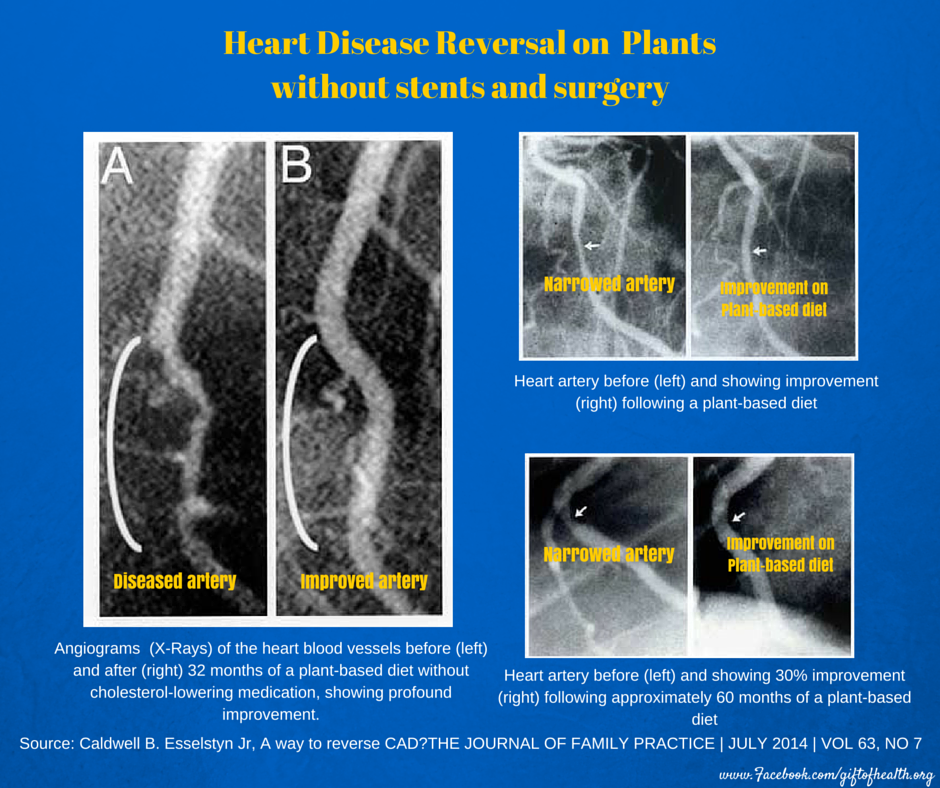
I never felt quite ready to speak with Dr. Esselstyn. Why? I felt my questions would either be too elementary or too foolish. Why not walnuts? Why not olive oil? Why not avocados? I had seen studies that show they reduce LDL. I wanted to understand more before I would ask my plethora of questions. But in the past two weeks, I really wanted to speak with him.
My friend Paulo, a former professional triathlete, had competed together with Dr. Esselstyn’s son, Rip. Paulo connected us by email. I had a great chat with Rip. Wow. He’s built a food line that espouses his father’s low-fat WFPB called Plant Strong. In all the Whole Foods and some Walmarts.
The following week, just a week ago now, I was on a Zoom call with Dr. Caldwell Esselstyn Jr. Except he wasn’t so junior anymore. 92, fit and sharp, just as he was in all the videos I watched. I devoured so many of his talks. He logically and elegantly laid out how to reverse heart disease in the most severe patients at the Cleveland Clinic. With 70 cardiologists there, he asked them for patients they could no longer treat medically or surgically. In other words, they were hopeless causes at the end of their life. So much so that some could not even endure the exertion of shaving, which could induce angina and a potential heart attack. Most could not walk a few feet without experiencing angina or claudication, pain in the legs due to plaque obstruction in the leg arteries. This was how severe their heart disease was. They also had many co-morbid diseases. The metabolic syndrome. Hypertension, diabetes, obesity, and maxed out on all the meds and already had so many bypasses and stents that their heart vessels were full of metal alloys.
His oldest patient was Stanley, an 87-year-old man who desperately needed a bypass, but the surgery for the bypass could also end his life. He elected to go to Dr. Esselstyn with a faint hope. Within days of starting the Esselstyn diet and WFPD, he was feeling better. By the end of one month, he was hopeful.
He called Dr. Esselstyn. I just wanted to thank you. I never thought I’d live to be 100. He would call each year. This year, he called. 103 years old. Now 11 years older than Dr. Esselstyn.
It was the most hopeful and miraculous story I have heard in medicine in a long time. Direct from Dr. Esselstyn. I knew I was in the presence of a very wise and great healer.
I told him my story. My multi-vessel arteries with severe plaque obstructions. He listened. I told him how I decided on May 9, 2025, after seeing the results of my CT Calcium heart scan, a shocking score of 505, putting me in the worst 90% percentile risk for a heart attack in the next 2 to 5 years, that I recalled his book from a decade prior and decided to start on his diet the very next morning. And in just 3 months, my LDL cholesterol dropped to 61, a 64% reduction, and my apoB 45, a particle measure of the potential for atherogenic lipoprotein, put me in plaque reversal mode. All of my carotid plaque: All gone! Seemingly just melted away. The word my doctor friends use is “Unbelievable.” But what I realized was that they really meant “I don’t believe it.” No curiosity. No interest in applying it to their own heart patients. And no interest in wondering if they might have heart disease.
He smiled and then started to talk. I immediately thought, I have heard this dozens of times in his videos. It almost seemed as if he was on autopilot, rehearsing a script he had told thousands of times. I was about to tell him I knew what he was going to say, but something deep down told me to just listen.
The Endothelium
“The endothelial cell is the ultimate regulator of vascular homeostasis. Its dysfunction is not merely a marker of cardiovascular disease. It is the initiating event.”
Salvador Moncada, FRS B. Esselstyn Jr., MD
Discoverer of endothelial nitric oxide.
Enos. Yes, William Enos, the pathologist. But this word would hold even more significance for you. Not only that, you may have been silently laying down the layers of plaque since your teenage years, but eNOS can also save you. This is the word he would stress. Endothelial Nitric Oxide Synthase. eNOS. The enzyme that makes this miracle transient gas we call nitric oxide. The discovery of how nitric oxide does this was awarded the Nobel Prize to three scientists I wrote in depth about, and it may be one of the most important things you read this year.
The Healing Power of Food: Nitric Oxide.
The blood vessels have an inner lining called the endothelium. It produces the most wonderful gas called Nitric Oxide. This protects, heals and supports the blood vessel wall in the smooth muscle layer. It is what allows the blood vessel to expand and allow more blood flow.”
Yes, I knew all this. He looked me directly in the eyes, leaning forward. You need to revive your endothelium. How you do that is by eating the following. He started listing off swiss chard, arugula, kale, spinach, and other foods from his whole-food, low-fat, plant-based diet. Then what not to eat. This is where he hit me hard.
No oils. No oils of any kind. Not in a cracker, not in bread, not in any food, no canola oil, sunflower oil, coconut oil, no olive oil. No oil in an animal. No oil in seafood. No oil from eggs or dairy. No oil from avocados, coconut or nuts of any kind. Do you eat oils, Kevin?
I was surprised. I did not expect him to ask me directly. I thought for a second, then declared, “No, sir.” while trying to recall the few times I ‘cheated’, thinking, ‘How could some little oil harm me?’
My patients were so sick that if they had a drop of oil, it could trigger a heart attack. No oils.
I recalled how I respected the famous coach John Wooden, winning 10 NCAA championships in just 12 years. He would get the best graduating high school players in the country. When they came to their first practice, he would get them to take off their shoes and socks and teach them how to put them on properly. Then he said lateness is not tolerated. The bus will leave on time, with or without you.
Dr. Esselstyn was the coach of heart disease. He was my coach and mentor. I had read his book multiple times and watched so many of his videos. But having him teach me to put my socks and shoes on and not show up late for my heart and my food was … well, humbling, and I was deeply grateful.
I decided I would rededicate myself to following his dietary protocol as best as I could. There were still so many questions I wanted to ask him. It was not yet time to ask them.
What damages the endothelium? He went on in his great talk.
Then he said that there was something new. I perked up. He learned that people recovered faster when they ate greens 6 times a day. A handful or cupful in boiled water for 5 and a half minutes. And liberal amounts of balsamic vinegar.
Greens 6 times a day? I had heard this in his videos. Hmmm, I wanted to intermittent fast, that is, not to eat for 18 hours and eat my two big meals at noon and 6. This would break my fast, the breakfast. He went on to explain that it was so important to chew my greens, as the nitrates in them would be converted to nitrites by the bacteria in my mouth. I need to remove mouthwash, fluoride in my toothpaste, and any antacids, as the stomach acid converts the nitrites to nitric oxide. This occurs for hours. So greens 6x per day. All day long, so your blood vessels are anointed with nitric oxide. It made so much sense. The vinegar would enhance the nitric oxide from the food.
I need to do this. I need to sacrifice my intermittent fasting and do this.
In the am, mid morning, lunch (big salad), mid afternoon, dinner (big salad), and he said it would make him really happy if I could have a handful of greens a few hours after dinner.
I thought that was a no-no… to eat too close to bedtime. But he proved it in the worst heart patients. I was not as bad as they were, but I did have a 77% blockage.
I still ride my bike up mountains. No symptoms. My latest CT angiogram showed an 80% FFR, down from 75% five months prior. This is now normal blood flow. Low normal but normal. My carotid plaques were long gone. No more low-attenuated plaque, the dangerous plaque that can burst.
I’m going to do it.
The Ostrich in the Room
“Coronary artery disease need not exist, and if it does exist, it need not progress. With rigorous cholesterol reduction and a plant-based diet, we have documented not merely the arrest but the reversal of this disease in human beings.”
Caldwell B. Esselstyn Jr., MD 20+ years of outcomes data. American Journal of Cardiology
What has been silently and slowly building from childhood starts to declare itself on lab tests, on scans starting in your 40s, progressing into your 50s and typically declaring its coming of age debut as a disease in your 60s for men and 70s for women.
It often seems all of a sudden. It was declarative for Rob. It was shocking for me, and I had learned this as a doctor. Yet the brutal reality of what is happening and how long it has been happening is almost hard to believe. Unbelievable.
At Rob’s memorial, an impressive hall for the Freemasons in downtown San Francisco, there were thousands gathered to pay their respects. We stood in line, waiting to sign the book with our heartfelt wishes to Rob and his family. A line full of suits, and you could tell professional, wealthy and their families. This was the impact Rob had. His Goldman clientele, as he managed the wealthiest people on the West Coast, including the epicentre of tech, Silicon Valley.
I saw the self-driving taxis ushering people to the memorial. No driver seen. It was uncanny. It was like I was now living in the age of the Jetsons.
Anita, Rob’s wife, came to the stage, and the room was hushed, waiting for her heart to speak. It was one of the most impactful talks I have listened to. Then she said, “Let’s speak about the elephant in the room. Rob had a stress test every day. Every workout, every climb was more than a stress test, and he passed it every day. He had more energy and fitness than anyone in this room. He had 90% blocked arteries, and he would pass any ECG stress test. He had slightly elevated LDL cholesterol that was brought to the normal range by a statin. There was nothing to indicate that he would die of a heart attack. Many of you may be the same. I ask each of you to go and get a CT calcium heart scan. It will tell you if you have plaque and your risk of a heart attack.”
So my wife and I both got one. You know the story. Wife: score 0. No calcified plaque. Me: score 505. Severe calcified plaque. Later, I found out that it was in every heart vessel and every branch. 77%, 55%, 45%, 29%, 28%, 21%, 20% etc. Everywhere. I could be dead, all of a sudden, riding up the mountain in 1 to 5 years if I had not known. Now I do, and I am reversing my plaque.
The elephant is a powerful analogy. It’s a big thing, but no one is actively talking about it. But I also think there is a world full of ostriches. They don’t want to even think about it, let alone discuss it. The elephant everyone thinks about. But the ostrich buries its head to escape the predator. So many people I speak to don’t want to discuss even the possibility that they might have plaque. But whether you bury your head in the sand, biology follows the laws of health. When these laws are transgressed, that health unravels, slowly but surely. It’s better to know earlier rather than all of a sudden. I am glad I know I have clogged arteries. I was surprised all of a sudden with wet macular degeneration. To me, they are the same disease, just different organs. Same with diabetes, high blood pressure and metabolic diseases. Just different organ systems. I’m reversing both, so help me God.
Here is a picture of how a plaque in the carotid artery in the neck builds up over ten years, from age 45 to 55. A seemingly healthy person. Normal lipids: Cholesterol 165 mg/dL, HDL 71, Triglycerides 64. Normal blood pressure. No symptoms. At 45 years old, he had a small plaque, 1.3 mm. Ten years later, at age 55, he had a type 5 plaque, a thin-cap fibrous plaque indicating a high risk of plaque rupture, that could result in an embolic stroke. His risk of a heart attack due to similar plaque in the heart would be high as well. All of a sudden.
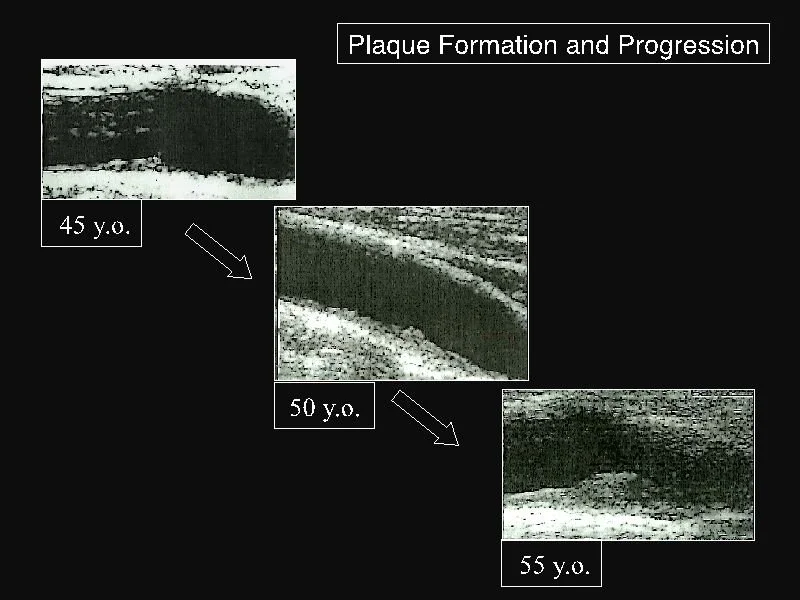
Plaque formation and progression in the carotid artery.
Ultrasound imaging of the left carotid artery in a long-axis during a 10 years period follow-up (1998-2008) in a healthy man from 45 to 55 years of age.
And below are the six types of plaque and their progression. My plaque is in stages 4-6. The later the stage, the more difficult to reverse. I am not sure the calcified plaque can be reversed, but my thought is that if bone can demineralize, what we call osteoporosis, why can’t diseased calcified plaque be demineralized? I have some really good leads on how the body can do this if you set the right healing conditions.
What goes up must come down. What has been building in me for 40 years can reverse in as little as 3 years. I do not know if I can attain the full 100% blood flow that Dr. Joe Crowe experienced in his mid to late forties. I believe I can. Might take longer to break down the more mature plaque.
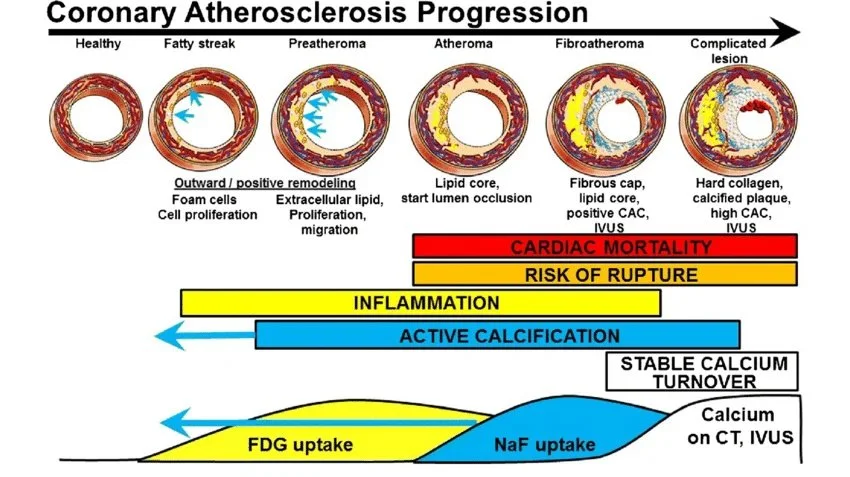
European Journal of Nuclear Medicine and Molecular Imaging November 2018: 45(Suppl 3):1-11
I think of it like the stages of cancer but applied to plaque. But plaque doesn’t fight back like cancer and if I fight it with everything that has been shown to reverse plaque, I will attack it at all levels. I will find every weak link in the plaque and the pathways for plaque buildup and plaque reversal.
And this is what plaque looks like as it remodels. My carotid plaque remodeled so quickly and disappeared.
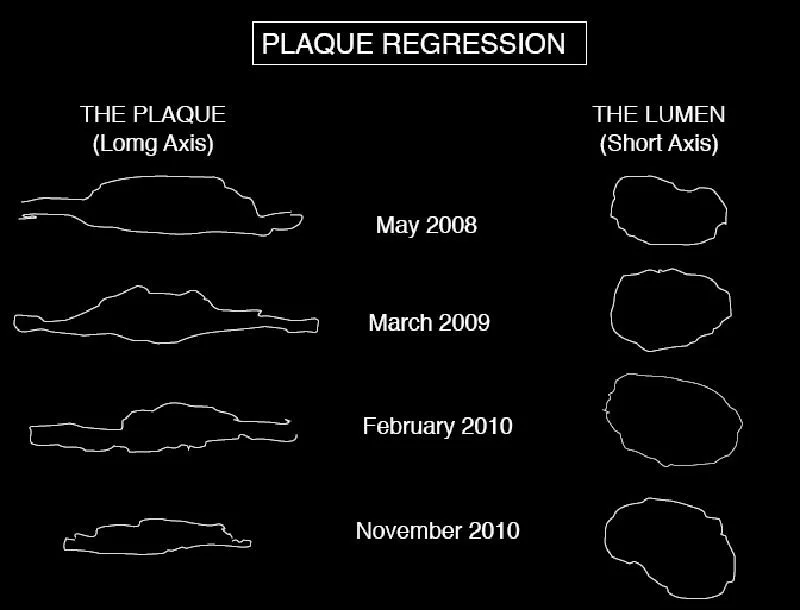
Plaque remodeling and reversal. B-mode ultrasound imaging of the carotid artery.
I started a YouTube channel. Not only for me, but also for Rob, and for almost everyone who is willing to fight.
Maybe you’ve seen it. My latest video, The Three Blood Tests that is better than cholesterol, went viral. This then led to an older video going viral. So I went from 0 subscribers to now over 8000. I will likely be ~20,000 by the end of this March. My goal is to educate people. I have found that this gospel of the heart I preach falls short.
So I do what I always do when I don’t know. I study. I study the data, the studies. I think I have figured out the biochemical pathways, the constraints and the 80/20 levers. As I learn the details, I realize how amazingly complex the body is, but also how remarkable. We just need to stop preventing it from healing itself and then find natural remedies to speed it up.
The good news, the gospel, is that this progression to the cliff of death, the top killers, heart attacks and strokes, can be arrested and, more importantly, reversed.
Just like the body can heal a fracture, it can recover from a stroke; your body has the means to reverse plaque.
It’s called Reverse Cholesterol Transport.
I've already proved it in my carotid arteries. In just three months. I haven’t found anything as fast and complete as mine in case studies or randomized controlled trials… yet. Did I set a world record in plaque reversal?
My hypothesis was that, just as a fractured bone heals in 3 months, why can’t plaque reverse in three months? Then I created a three-phase attack leveraging everything I learned from Esselstyn. Diet x Exercise x Fasting. My big weak point: sleep. I will solve that too.
You’ve all seen this by now. My plaque reversal. I believe it will make its rounds around the world as I continue to preach the gospel of your heart. I feel it is part of my calling. Doctor. Patient. Friend. I understand better now. I pray to God that I will understand more.
Your Questions
“Before I formed you in the womb I knew you, before you were born I set you apart.”
Jeremiah 1:5
Questions worth sitting with
For yourself. For someone you love. Answer them in the quietness of your day.
1. When did you last have imaging of your arteries, not just blood tests?
A lipid panel tells you what is circulating in your blood. A CAC score or CT angiogram tells you what has already built up inside the vessel wall. These are not the same question. One answer: What are your risk factors? The other answers: what has already happened. Most people have been asked only the first one.
2. Do you know your ApoB?
LDL-cholesterol is a proxy. ApoB is the actual count of atherogenic particles in your blood. It correlates more directly with plaque burden and cardiovascular events than any standard lipid panel number. Most annual physicals never measure it. Ask for it by name at your next appointment.
3. What did you eat yesterday, and what was that food saying to your endothelium?
Not a moral question. A molecular one. Every meal either upregulates eNOS or suppresses it. Either raises postprandial triglycerides or keeps them controlled. Either accelerates the disease or begins to reverse it. You made that decision yesterday. You will make it again in a few hours. The endothelium is listening to every meal.
Someone You Love
“The greatest single threat to the cardiac health of each individual is his own coronary arteries. And the greatest threat is not that we lack the knowledge to prevent the disease. It is that we lack the will to act on what we already know.”
Paul Dudley White, MD Presidential physician, founder of the American Heart Association. 1956, the year coronary disease became the leading cause of death in America
There is someone in your life with this right now.
You thought of them somewhere in this story.
Maybe it is the friend who is 53 and has not had a cardiac scan since his annual physical 5 years ago, which came back fine. That tells him nothing about what is in his vessel wall.
Maybe it is your parent, who has a family history of heart disease that came up briefly at one appointment and was never followed up with imaging.
Maybe it is your son, who lifts weights and believes the body he has built exempts him. The PDAY data do not agree. The wall does not negotiate.
Maybe it is you.
Rob Thompson did not have this wisdom. He had a cup of tea on a February morning, an investment in a company we were going to build together, and an arterial wall that had been accumulating evidence against him for forty years without producing a single symptom he could have acted on. He had been thinking about the future. The disease had been thinking about nothing. It does not think. It does not hesitate. It simply completes the process it began in the vessel wall.
You have what Rob did not have. Send this to the person you thought of while reading it. Ten seconds. It may matter more than either of you knows.
MORE READINGS YOU’LL ENJOY
Health
Reversing My 77% Heart Plaques
Stats Say You Likely Have Heart Plaque
The Healing Power of Food: Nitric Oxide
Wealth
The Power of the Compound Effect
Relentless Iteration to Mastery
Meaning
I pray you unlock your heart to reach the height of your full potential by discovering your calling.
Kevin Ham, MD
Subscribe to my Compounding Wisdom newsletter and start transforming your life. ham.com
Subscribe to my YouTube channel @DrKevinHam for videos on how I reversed my clogged arteries in 3 months, the top foods that clear your arteries, and the first principles of health that can save your life. Like, share and subscribe — it could save the life of someone you love.
