
Compounding Wisdom
Descent of the Soul
The valleys everyone must pass through.
The valleys everyone must pass through.
Kevin Ham, MD
The Last One Picked
I was usually one of the last ones picked.
I always felt so relieved when I was not the very last one picked. It meant I was more highly valued than at least one other person.
Last. That distinction belonged to someone else. And I was always grateful for it, as one is grateful for anything that distracts from obvious humiliation. But I was still late. The last of a handful of picks. The teams would form with the obvious stars first, down to those who seemingly didn’t matter.
I would apprehensively stand at the edge of that contracting pickup line, waiting. Tiny for my age. Just peeking over five feet in Grade 6. Quiet in a way that registered as invisible rather than deep. Easy to overlook.
I once fought the toughest kid at school. The biggest guy in Grade 5. Not because I was brave. Because something inside me wanted to show the others I was present. And the only language available for what I needed to say was physical. Words could not express the depths of my loneliness. I got him on the ground. A kid yelled, “Punch him!” I did. Right in the nose. He started to bleed. I got up and walked away. Afterward, the other kids looked at me differently, and that shift mattered more than the outcome. I could go up against the biggest and prevail.
Inside was not what the outside suggested. I had a creative spark inside of me that was insatiable. I was devouring Tolkien, reliving the Shire and the Mines of Moria with a completeness that left little room for the world requiring me to be smaller than I was. I was on that journey to Mount Mordor. I could visualize every scene. Peter Jackson did it almost as well as the visuals that played in my head. Then C.S. Lewis. The Narnia series. I did not know at the time that he was also a great philosopher. Then the Thomas Covenant series, which nobody else I knew had read, except my older brother Don, who introduced that and Terry Brooks’ elven series to me, which was precisely why I loved it: a leper, unclean, rejected, transported into a world where his very disease became a form of power. Then the Black Stallion. Then everything I could find. I was not reading to escape. I was reading to locate something I could not yet name. A self that the exterior world could not translate, but that I could feel the shape of, pressing outward from the inside.
The word I would have used, if I had known it then, was anointed. This word is special to me. Not in the religious sense. There was something in me that had been set apart before the setting apart had been made visible. The overlooking was not the verdict. The field was not the destination.
I did not know that word. But I found the men who did.
I David
“Create in me a clean heart, O God, and renew a right spirit within me. Cast me not away from your presence, and take not your Holy Spirit from me.”
Psalm 51, written after Nathan said: you are the man
My mother sent me to church with another Korean family with the same last name, Ham. I don’t recall much except that I had memorized some verses from the book of Proverbs and won a Bible as the prize. I read one of my favourite Bible stories, David and Goliath. The shepherd teenager who went against the giant and beat him. I found David the way you find something you had been looking for without knowing you were looking.
Here was a young boy who had been left in the field while his father presented the other sons before the prophet Samuel. The youngest, the smallest, the one not considered worth summoning until the prophet asked: Are these all of your children? And even then, David arrived covered in the smell of the field, ruddy and wild-eyed, not the picture of an anointed king.
This is the one, said the Lord.
The oil was poured. And David simply went back to the sheep.
What reached me was not the crown. It was the dozen or more years between the anointing and the crown. David returned to the same life he had lived before Samuel came. Anointed and unknown. Carrying an authority that had no external expression yet. Hunted through the wilderness by the king he served and would replace. Building an army out of men who had been cast out by the world and found him worth following. He was thirty years old before anyone outside his circle saw the fruits of the oil that had been poured.
I understood it then, not as theology, but that this pattern could also be in my life and everyone else’s, too. The field is not the failure. The obscurity is not the verdict. The anointing precedes the confirmation, sometimes by decades, sometimes a lifetime, and the work of the valley years is not to convince the world that the anointing is real. It is to become, through the pressing, the person capable of carrying what the anointing requires.
“You have shed much blood and have fought many wars. You are not to build a house for my Name, because you have shed much blood on the earth in my sight.”
1 Chronicles 22:8
But there is something anguishing in David’s story more than the valley years. The dream he longed for most, the longing that sat at the centre of his life like a fire that never doused, was to build a house of peace. The Temple. Jerusalem: the city of peace. He conquered the Jebusites, the last bastion and city, after centuries and rebuilt the city of David. He had the plans for the Temple. Glorious. Magnificent. Worthy of God. He had gathered the materials. He had devoted his life to making the kingdom secure enough that the Temple could stand.
Then God told him: You cannot build it. You have shed much blood. A man of war shall not build a house for my name.
There is no more heartbreaking sentence in the Hebrew Bible. Not because David was denied the Temple through failure. But because the very quality that made him great was precisely what disqualified him from the work his soul had been desiring his entire life. He was too good at the wrong thing. His greatest strength was the door the Lord closed. For peace, he had to go to war and shed blood.
When Nathan came with a different reckoning, the Bathsheba reckoning, David did not argue. Using power for deceit, adultery, dishonour, murder and evil. He said just five words, in remorse.
I have sinned against the Lord.
That instant recognition and humility is the priest-work still alive beneath everything, no matter how vile or grievous. His Psalm 51 became the language of confession for every generation that followed. The king-work was diminished by what he had done. The prophet-voice was deepened by what the valley stripped away.
I read the Psalms, all 150 of them, when I feel what I felt in that circle. Passed over. Misjudged. Or when I have sinned greatly. When I am late to be picked, or not picked, or pick myself and discover the self I have picked is smaller than the one I feel pressing from the inside. They do not resolve the feeling. They name it. Which is something more useful than resolution.
II Solomon
“Vanity of vanities, says the Preacher. All is vanity. I have seen all the works that are done under the sun, and behold, all is vanity and chasing after wind.”
Ecclesiastes 1, written at the end of everything
Solomon, the ‘illegitimate’ son of David, unlikely to be heir and king, did become king. He had the kingdom set up for him by his father. Anointed in David’s last days. He was so young that when God asked him at Gibeon what he wanted, he asked for wisdom to rule the people. And he got plenty of wisdom. More wisdom than anyone in history, a direct gift, in exchange for nothing. You can feel and read that wisdom in his Song of Songs, the most ecstatic love poem in any language, and in his three thousand Proverbs, aphorisms crystallized from a man who observed human nature and nature with an eternal eye. He built the Temple that David had been forbidden to build, and his writings on the vanity of life and its conclusion in Ecclesiastes. I ponder these books daily. I have a dream to inscribe them in my heart so I may have a heart of wisdom. But I wondered, how could someone so wise have become so foolish, especially when he had everything given to him?
I was foolish, so it was understandable, and so I seek wisdom, but once you have wisdom, can you become so foolish as to completely unclothe wisdom?
“He must not take many wives, or his heart will be led astray. He must not accumulate large amounts of silver and gold.”
Deuteronomy 17:17. The law written for kings, before Solomon was born
Before any of it, God had given the kings four laws specifically for kings. Four prohibitions, each one a warning written in advance against the temptations specific to the man who sits on the throne. Do not multiply wives. Do not multiply horses. Do not multiply gold. Do not place your trust in foreign alliances above the Lord.
Solomon opened all four doors.
Seven hundred wives. Three hundred concubines. The Temple of the Lord and the altars of Moloch, the same man, the same city, the same life. The wisest man who ever lived warned specifically against his specific temptations, violating every warning systematically.
Vanity of vanities. All is vanity.
I have built companies. I have assembled a kingdom, three hundred thousand premium domains bought during the dot-com bust while everyone else was fleeing. I have read Solomon’s reckoning, the way a man reads a story that could have been written about him. Not the wives. But the accumulation. The building of structures that kept the deepest question at a horizon’s distance. The way achievement, if you build enough of it, functions as insulation from the self that was anointed before the building began.
Solomon found his way back. At the end of Ecclesiastes, stripped of every layer, the thread he had buried under a thousand coverings became visible again. What he had known at Gibeon, before the wives and the horses and the gold: fear God and keep his commandments.
The descent made it recoverable. This is not consolation. It is architecture.
III Marcus Aurelius
“You have power over your mind, not outside events. Realize this, and you will find strength. What stands in the way becomes the way.”
Meditations, written in a military tent on the Danube frontier, never intended to be read
I was introduced to Marcus Aurelius through a film.
Gladiator. 2000. Nominated for 12 Oscars, winning five. It blew me away. It was the evening I had just written my medical exams for my Medical Residency Certification, FRCP. I had the practicums the next day, but because I was building my Internet businesses at the same time, I thought that I would roll the dice. If I passed, I would continue in medicine. If not, I would continue being an entrepreneur. Surely I could not do both well.
I passed.
The old emperor at the edge of the screen, tired in a way that power cannot cure, gives Maximus a commission he knows cannot be kept. What struck me was not the tragedy. It was the face. The face of an aging man who has been required to live a life other than the one he was made for, and who has been living it with such sustained integrity that the requirement and the man have become indistinguishable, and who is still, somehow, the man underneath.
I later read Aurelius’ Meditations. I was not prepared for what I found. I should go back and reread it with new eyes.
This was not mere philosophy. This is a man talking to himself in a military tent on the Danube frontier, in the second person, as if the person he is addressing cannot quite be trusted to remain himself under war and politics. He writes the same principles many times. He is not working out a new thought. He is holding the thread against a current that continually pulls it downstream. Repetition is the cost of maintenance.
Marcus had wanted to be a philosopher. He had built an interior practice of extraordinary depth by his late twenties. Then the emperor died, and Marcus was emperor, and the life he had been building was over. Fourteen of his nineteen years on the throne were spent on the Danube frontier, managing wars necessary but not meaningful, watching his son Commodus developing year by year into the catastrophe he could foresee and could not prevent.
In the margins of the king-life, the priest-work survived. The Meditations were never meant to be read. Originally named Ta eis heauton ("to himself"). They are the private 12-book journal of a man striving to stay true to himself from the demanding life the world required of him. They have been read continuously for eighteen hundred years by people in exactly his situation: formed for one life, living another, trying to hold the thread.
The king-work of the Roman Empire is archaeology. The priest-work of the margins is alive.
The Oil and the Gap
“Even though I walk through the valley of the shadow of death, I will fear no evil, for you are with me.”
Psalm 23:4
My mind always seeks to weave threads in the seemingly unrelated. The brain works this way. Neural networks. Logic on the left brain with creativity on the right. I found the oldest framework to connect these three men and many others, me and you as well: the ancient world had a name for the three offices every anointed life must pass through, and a name for the valley between them. The prophet. The priest. The king. In that order. Each requiring a ceremony before the work could begin. Each requiring the valley before the office could be inhabited.
Three different descents. Three different reasons for the crushing. The same discovery at the bottom: the thing you buried is still there. The oil does not evaporate during the years in the field. It waits.
There was an art teacher who handed back an assignment I had worked hard on and was proud of. I can’t even recall what it was anymore because, for me, it was a traumatic experience.
I was thirteen. I had drawn something I cared about. The grade? C+. Not failure: worse than failure. Failure, you can argue with. C+ is a verdict without appeal: you are here, slightly above mediocre, and that is all you will ever be.
I eliminated art and any subjective courses from my future selections when possible. I decided to focus on exact, objective courses: math and sciences. I became a doctor. Then, a man who built a kingdom where no one would ever be in a position to give me a C+ again.
What I did not know: you cannot remove an anointing. It remains dormant, much like shingles, the chicken pox virus that appears when you are weak. You can only forget it. You bury it deep in your soul. It’s buried in the field. But it arises in the dark. In the valley. Every patient attended to beyond the clinical. Every conversation that became more than business. Every time I reached past the kingdom toward the story underneath it. The drycleaning shop. The three hundred thousand domains. The cardiovascular scan on the wall. All of it pressing. All of its formation.
The olive must be crushed to yield oil. The pressing is essential to the oil’s production. It is the mechanism of production. The crushing is not the destruction of the olive. It is the fulfilment of the olive’s purpose. The oil was always there, latent in the fruit. The pressure does not create it. The pressure releases what was always present but had no way of expression.
I did not know this when I was the boy at the edge of the circle, waiting to be picked. I did not know it when I gave up on my dreams after the C+. I did not know it when I built the first company, or the second, or when I assembled a portfolio of three hundred thousand domains while the internet was collapsing around me and told myself that this was what I had been made for. You do not know it during the pressing. You only know it when the oil appears, and you recognize it, and you understand that it was there the whole time.
I am somewhere between Bethlehem and Hebron. Between the private ceremony and the public confirmation. Between the anointing and the crown. Forty years in the field is a long time pressing. I am beginning, now, to feel what it has done.
Which Descent Is Yours
“The Lord does not look at the things people look at. People look at the outward appearance, but the Lord looks at the heart.”
Leo Tolstoy
Every person reading this is in one of these three descents.
The disqualification: the thing you long for most is what your life has made you unworthy to build.
The disobedience: the laws written specifically for you, warning you against your specific temptations.
The assignment: no fault, no drift, only the wrong life handed to the right person, and the question of whether the right life survives inside it.
The pattern is not coincidental. It is architectural. The spirit speaks first. The soul translates. The body builds. In that sequence, properly esteemed, the result outlasts the builder.
The valley is not punishment. It is the expression.
I do not know how this ends. Just as the other side of the summit cannot be seen from the valleys. I do not know what the crown looks like or whether I will recognize it when it comes. I do not know whether the books in my heart get written, whether companies become what I dream about, whether the musical playing in my heart manifests, or whether the cardiac scan in 2028 shows what I believe it will show. I do not know if the anointing I felt pressing outward from the inside at thirteen, in East Vancouver, in the line waiting to be picked, was the real thing or only the wish for it.
What I know is that the oil is not gone. That the pressing has a purpose. That Samuel came to Bethlehem looking for something the world had not confirmed yet, and found it in a field, and that the field is not the end of the story.
The dream did not die with the C+. It went into the field.
It is still there.
Prophet. Priest. King. In that order.
The spirit first. Always the spirit first.
Your Question and Your Assignment
“Before I formed you in the womb I knew you, before you were born I set you apart.”
Jeremiah 1:5
The Life Question
Which of the three descents is yours right now?
Not which one you prefer. Not which one is most exciting. Which one is actually operating in your life at this moment? The disqualification: the thing you long for most is precisely what your formation has made you unable to build yet. The disobedience: the laws written specifically for you, warning you against your specific weakness, and whether you are inside them or outside them. The assignment: the life you are living is not the life you were made for, and the question is whether the life you were made for is surviving inside it.
Write the answer down. One sentence. The descent has a name. Name it.
Three Applications
Find the buried thread. Every person reading this has buried something. A vocation, a longing, a creative life, a calling heard before the world had a category for it. The oil is not gone. Name the thing that was buried. Write it on a piece of paper and put it somewhere you will see it every morning for one week. You do not have to act on it yet. You only have to stop pretending it is not there.
Audit the laws written for you. Solomon had four specific prohibitions. Each one was a door his particular weakness would be tempted to open. You have your own four. They are probably not the same as Solomon’s, but they are equally specific and equally predictive. What are the four things that, if you allow them, will bury the thread? Write them. Post them. Not as shame but as intelligence. You are not weaker than Solomon. You are the same kind of person, facing the same kind of doors.
Do the priest-work in the margins. Marcus Aurelius kept his interior life alive in whatever margin the king-life left. Fifteen minutes in the morning. A journal entry on the commute. A walk without a podcast. The priest-work does not require a monastery. It requires a margin you can write on and the decision to protect it. Identify your margin. Name the time. Defend it the way you defend a meeting with someone you cannot afford to disappoint. Because you cannot. This newsletter is my margin. It pulls on the thread buried deep in the field. I am threading and weaving it through me to you.
There is someone in your life who is in one of these three descents.
You already know who it is. You thought of them while reading this.
Send it to them. It will take you ten seconds. It may matter for years.
MORE READINGS YOU’LL LOVE
Meaning
The Courage to Your Magnum Opus
Wealth
The Power of the Compound Effect
Relentless Iteration to Mastery
Health
Reversing My 77% Heart Plaques
I pray you unlock your heart to reach the height of your full potential by discovering your calling.
Kevin Ham, MD
Subscribe to my Compounding Wisdom newsletter and start transforming your life. ham.com
Subscribe to my YouTube channel @DrKevinHam for videos on how I reversed my clogged arteries in 3 months, the top foods that clear your arteries, and the first principles of health that can save your life. Like, share and subscribe — it could save the life of someone you love.
The Cocoon of Wealth
Wealth is the Obesity of the Spirit
Wealth is the Obesity of the Spirit
I. The Borrowed Dollars
Hope is nature's veil for hiding truth's nakedness.
Alfred Nobel
My father came to Canada with $100 borrowed.
Not from the South Korea you know now—K-pop, K-dramas, K-beauty, and the 14th-largest economy on earth. He came from South Korea of the 1960s. War-torn after the civil Korean War. A country trying to rebuild itself from rubble. A country where the path to a better life was a plane ticket to a nation cold enough to need the work ethic Koreans carry wherever they settle. First, he went to the mines of Germany, then to Toronto, then to Vancouver. The east side.
“Charlie” (my father’s nickname because his Korean name was hard to remember) was an entrepreneur with no “higher education” and no safety net. He built a chain of laundromats and dry cleaning stores. One, then two, then several.
He handled strangers' clothing and made them look new again, 7 am to 11 pm, seven days a week, year after year, for most of my life. No days off. Never sick. The only time his kids (my brothers and I) saw him was when we helped out at the laundromat after school or on weekends.
My mother was a nurse. She worked graveyard shifts. Always sleep-deprived. Which, as we know now, is a recipe for disease, a shorter healthspan, and a shorter lifespan.
My father strove for financial freedom. For the family. He came from a country town of just 1300 people. He strove with everything he had. He never fully attained it. That fact sat inside my soul the way a stone sits at the bottom of a river. Our conversations today (he’s 90 now) still hinge around making money.
I am a physician. I left clinical practice twenty-five years ago to build companies. I acquired domain names during the dot-com collapse, built businesses to eight- and nine-figure revenues, assembled a 300,000 premium domain name portfolio that a magazine once profiled under the headline "The Man Who Owns the Internet." This was not ambition. It was a son finishing what his father started, on an internet his father could not have imagined. The body inherits more than genes. It inherits unfinished sentences.
I finished the sentence. With exclamation marks (!!!), fulfilling all the dreams in my heart. I attribute this success mostly to God’s providence. And afterwards, I stood inside the resounding silence that followed to discover a question nobody had prepared me for:
What do you do when you have accomplished your dreams of wealth? What is higher than wealth? To whom do you look up when you are wealthy beyond your imagination?
At 53, an ultrasound revealed plaque in my carotid arteries. I ride a bicycle 7000 km a year with 100,000 metres of climbing (like climbing Mt Everest 9 times). I now eat with the molecular-level paranoia of a man who is on the edge of the cliff of life.
The #1 killer disease does not care about your cycling mileage. It is interested only in the endothelium, the single-cell-thick lining of your blood vessels, and whether you have been paying attention to it.
I have spent nine months establishing a reversal protocol. Aggressive dietary intervention, paired with exercise and fasting, topics that make dinner parties very uncomfortable. Three months later, my carotid plaque was gone. The ultrasound was clean. My cardiologist and doctor friends called it remarkable. Actually, the right word would be Unbelievable! I can tell that most of my doctor friends do find it unbelievable.
I call it terrifying because what the reversal proved was that I had spent years finishing my father's sentence while my own arterial walls were quietly calcifying and obstructing. I was too busy accumulating to ask what the accumulation was for.
The plaque was the visible issue. But behind it was an invisible one—a question neither my father's borrowed $100 could have purchased, nor my wealth could have answered:
What is wealth for?
I found the answer in three rooms, in three different centuries, occupied by three men who had nothing in common except the thing that was destroying them.
II. The Merchant of Death
Contentment is the only real wealth.
Alfred Nobel
On a Tuesday morning in 1888, Alfred Nobel unfolded a newspaper in his suite at the Grand Hôtel in Paris and read his own obituary. A French journalist had confused Alfred with his recently deceased brother Ludvig. The obituary’s headline called Alfred “the Merchant of Death”. Alfred had found new ways to kill people faster than ever before. He had gotten rich doing it. That was the whole story.
Nobel was 54. He held 355 patents, factories in 20 countries. He owned Bofors, the Swedish arms manufacturer. He had stabilized nitroglycerin with diatomaceous earth, called the result dynamite, and within a decade had reshaped mining, construction, and warfare. His personal fortune was worth 31.5 million Swedish kronor in 1896, equivalent to $200 million USD today.
He also had no children, no lasting romantic relationship, and no home. He lived out of hotels, not as a cosmopolitan but as a man without a country. He suffered from depression so persistent it was like air. To his sister-in-law, he wrote that she lived a warm, glowing life with loved ones, while he drifted without a compass, a wreck on the sea of life.
This, from a man who could purchase anything on earth. He had no real meaning, calling or purpose.
Nobel set the newspaper down. He did not call his lawyers. He sat with it the way a patient sits with a diagnosis. And in that silence, something structural broke. Not his health. Not his mind. The wall between the life he had built and the life he wanted to mean something more than himself.
III. The Rope Behind the Bookshelves
Is there any meaning in my life that the inevitable death awaiting me does not destroy?
Leo Tolstoy, A Confession
In the winter of 1879, behind the bookshelves in his study at Yasnaya Polyana, Count Leo Tolstoy concealed a length of rope. He also removed his hunting rifle from his own reach. Not because he distrusted the weapon. Because he distrusted himself.
He was 51. War and Peace had remade the European novel. Anna Karenina was complete. He owned 4,000 acres, had 13 children, and possessed the kind of fame that makes further achievement feel meaningless. What he was experiencing was not depression in the clinical sense but something more dangerous: a crisis of meaning in the presence of utmost abundance.
He did not use the rope. The novelist became a philosopher. The aristocrat became an ascetic. He renounced his copyrights, tried to give away his estate, dressed as a peasant, made his own boots, and was excommunicated by the Orthodox Church. The Kingdom of God Is Within You, published when he was 65, became the foundational text of nonviolent resistance. Gandhi read it in South Africa and felt a political philosophy lock into place. Martin Luther King traced his lineage through Gandhi back to Tolstoy's study. That chain began with a man who put down a rope.
In his final years, Tolstoy decided that War and Peace and Anna Karenina were not his greatest works. He spent fifteen years compiling A Calendar of Wisdom, a day-by-day collection of the world's deepest thoughts on how to live, drawn from Epictetus, Marcus Aurelius, Lao-Tzu, the Gospels. He called it his most important contribution to humanity and reread it daily for the last seven years of his life.
At 82, he fled his estate in the middle of the night. Died ten days later at a railway junction called Astapovo, in a stationmaster's bed, owning nothing.
IV. Christmas Eve
I read in a book that a man called Christ went about doing good. It is very disconcerting to me that I am so easily satisfied with just going about.
Toyohiko Kagawa
Kobe, Japan. Christmas Eve, 1909.
A 21-year-old seminary student loads his belongings into a bamboo box on a hand cart. His name is Toyohiko Kagawa, and in forty-five minutes, he will walk through a doorway into a place that even the police have abandoned.
The Shinkawa district. The worst slum in Japan. Open sewers, endemic tuberculosis, and ambient violence so constant that the municipal authorities had classified the district as unrecoverable. A place you quarantined and waited to see die.
Kagawa was walking in.
He was the illegitimate son of a Cabinet minister and a concubine. Both parents died before five. Two American Presbyterian missionaries, Harry Myers and Charles Logan, had taken him in, taught him English, and shown him a faith that would cost him everything he had. He was disowned at fifteen for converting to Christianity in Meiji-era Japan, which was less a religious act than a social execution. His inheritance evaporated overnight. Those same missionaries would later send him to Princeton Theological Seminary, where he studied the mechanisms of poverty with the precision his contemporaries reserved for the mechanisms of profit.
On that Christmas Eve, before Princeton, before the degrees and the movements, Kagawa did something no seminary could teach. He walked into the slum and gave away everything he had. First, his clothing. Then his food. Then his money. He took in a beggar with trachoma, a bacterial infection that scars the cornea into opacity, and contracted it himself. His vision began to fail.
From that tiny room, blind in one eye and sleeping on bare floors, he built a movement. Organized the first major labour strike in Kobe's shipyards. Launched cooperatives that became the foundation of Japan's cooperative economy. Organized earthquake relief. Won universal suffrage. Founded the Japanese Federation of Labour. Wrote over 150 books. Was imprisoned. Went back to the slums. Was threatened. Kept preaching. Publicly apologized to China for Japan's occupation and was arrested again.
Arthur Miller, hearing him speak at the University of Michigan in 1935, called him a merchant of the sublime.
By 1920, Kagawa was functionally blind in one eye, lungs scarred by tuberculosis, and malnourished to the point of organ failure. He was 32 with the body of a man in his sixties. And he was more productive than he had ever been.
V. The Dissolution
I would not leave anything to a man of action as he would be tempted to give up work; on the other hand, I would like to help dreamers as they find it difficult to get on in life.
Alfred Nobel
In cellular biology, metabolic syndrome is a constellation of pathologies that emerge not from scarcity but from excess. The cell is flooded with more energy than it can process. The system starves in the presence of abundance. It does not lack fuel. It lacks the capacity to convert fuel into function.
Nobel had more fuel than any man in Europe. 355 patents. Factories on five continents. And no destination for any of it. A full tank and an empty map.
Tolstoy had fuel and he had the engine. 4,000 acres, 13 children, the most celebrated mind in Russian literature. What he did not have, what drove him to hide a rope behind the bookshelves, was any reason to keep driving.
Kagawa had a destination so clear it burned like a fixed star. He had no fuel at all. No inheritance, no health, no institutional power. And he moved faster than either of them.
In cellular biology, apoptosis is programmed cell death: a cell, having received a signal that it has become dangerous to the organism, dismantles itself. It does not explode. It folds its membranes inward, packages its contents, and delivers them to neighbouring cells. A cell that recognizes it must die so the organism can live.
Nobel read his obituary and began his apoptosis. Over eight years, he restructured everything. When he died in 1896, his will directed ninety-four percent of his fortune to five annual prizes for those who confer the greatest benefit on humankind. His family fought it viciously. It took five years before the first prizes were awarded. The five Nobel Prizes, each granting a million dollars to its winner.
And the prize he created would, 58 years later, be offered 5 times to a half-blind Japanese preacher who had given away everything he owned, and who didn't need it, because he had found a wealth the prize could not confer. Kagawa was nominated twice for Literature, three times for the Peace Prize. He never won. The institution could measure dynamite. It could measure literary technique. What it could not measure was what Kagawa was running on.
In entomology, when a caterpillar enters a cocoon, it does not improve. It dissolves. The cellular structure liquefies completely, every familiar form destroyed, and from that dissolution something emerges that bears no resemblance to what entered. The remarkable butterfly. From crawling to flying.
Nobel dissolved. 94% of everything he had, converted into a perpetual engine of human aspiration that has been running for over a century.
Tolstoy dissolved. His copyrights, his estate, his reputation. His ideas travelled from a Russian study to South Africa to Montgomery, Alabama, a chain reaction of moral force that has not yet spent itself.
Kagawa dissolved. His health, his sight, his inheritance, his safety. His cooperatives still operate. His theology still hums through churches on five continents, invisible as music, but positive as sound.
Each gave everything. Each created a wealth the visible world cannot measure, because what they gave was not to the present but to future generations, to people not yet born, to societies not yet built. A transfer of energy across the barrier of death itself.
VI. The Climb
For man to be able to live he must either not see the infinite, or have such an explanation of the meaning of life as will connect the finite with the infinite.
Leo Tolstoy
I think about Kagawa on long climbs. There is a point on the mountains north of Vancouver, about an hour in, where the grade tilts past 20% and the body begins to negotiate with the mind. The legs say stop. The lungs say stop. Everything measurable says stop. And occasionally something else says keep going, and the something else is not cardiovascular fitness or glycogen reserves. It is something the power meter cannot register, and I have never been able to name it precisely, except to say that it feels like the reason I am riding.
Kagawa lived there permanently. His entire existence was the last kilometer of a climb that never ends. The optimization industry would look at his biomarkers and call him a failure. He was also more alive than anyone in the room.
I think about my father pressing the clothing of strangers, 7 days a week, for decades. I think about the borrowed $100 that became 300,000 domains. My father was building a vehicle for his children. I was building a vehicle for my health dreams. Nobel was building a vehicle for his genius. Tolstoy was building a vehicle for Russian literature. Each of us building, building, building. And Kagawa, who had no vehicle at all, who had given away even the wheels, was the one who arrived.
The question I keep returning to is the one Nobel faced in a hotel suite, Tolstoy faced behind the bookshelves, and Kagawa faced on a hand cart on Christmas Eve.
It is not how much you have accumulated. It is not whether the vehicle is strong enough, though you should maintain it with the seriousness of a man who has read his own imaging and knows what the endothelium can do when you stop paying attention.
The question is what you are willing to give, all of it, every last molecule, to the generations who will come after you.
Nobel answered with his will. Tolstoy answered with his ideas. Kagawa answered with his life.
I have a company to build and a book to write and a documentary to make with my daughter and thousands more kilometers to ride this year. And I have, somewhere in the architecture of my days, a destination I am still trying to make worthy of everything I have been given, and everything my father gave so that I could be here to give it away.
VI. What Will Profit Me?
What would it profit a man if he gains the whole world but loses his soul?
Jesus
That question is over 2,000 years old. It has never been more urgent than now, in an era that has perfected the science of gaining the world and forgotten entirely what the soul requires.
The wealth that stays inside you is not wealth. It is a pathology. The wealth that pours out of you, that you release until the caterpillar has dissolved completely and something unrecognizable emerges from the cocoon: that is the only wealth that compounds across centuries.
And it does not matter how much or how little you have. Start giving it away.
If you have physical wealth, the vitality in your body, pour it into service. Show up. Carry what others cannot. Use your hands, your hours, the sheer stubborn fact of your presence to lighten the weight on someone who is breaking.
If you have financial wealth, redirect it. Not from surplus. From the center. Fund what outlasts you. Build for people you will never meet.
If you have intellectual wealth, the clarity of your mind, give it freely. Teach what you know. Write it down. Make the complex simple for those who come after you, the way Tolstoy spent fifteen years compiling wisdom for millions of people he would never see.
If you have emotional wealth, the resilience, the grit, the steadiness that holds when everything shakes, offer it to those who have none. Sit with the broken. Absorb the shock. Be the wall that does not move.
And if you have spiritual wealth, the faith that the invisible is more real than the visible, transmit it. Across generations. Across death itself. The way Kagawa transmitted it from a six-mat room in a slum the world had abandoned, blind, starving, and more alive than anyone in the room.
Nobel answered with his will. Tolstoy answered with his ideas. Kagawa answered with his life. My father answered with a borrowed $100 and 55 years of pressing the clothing of strangers so that his children could stand where he could not.
The question is not what you have. The question is what you are willing to give. And the giving will feel, against every instinct the visible world has trained into you, like the first moment you have ever been fully alive.
Save a Loved One
Forward my newsletter and YouTube channel to your friends and family.
122 million Americans have high blood pressure. 1.3 billion worldwide. Most don't know. Many are your loved ones.
You may be able to help save someone's life with knowledge alone. It could be your father, your spouse, your best friend. It could have been my friend Rob who wasn’t aware and suddenly died. It could have been me. That’s why I started my Youtube channel, for you and your loved ones.
You'll find these articles essential reading:
In Wealth
In Health
Reversing High Blood Pressure in 2 Weeks! — How I reversed a 71-year-old diabetic's high blood pressure so quickly
Reversing Diabetes in a Month! — How I reversed a 71-year-old's diabetes so quickly
The Diabetes Reversal Flywheel — Emptying the liver to live fully
Life-Changing Question
What do you do when you have accomplished your dreams of wealth?
Dr. Kevin Ham
First acquire all the five forms of wealth above with the goal of compounding it for your next generation and give it all away to them.
Next issue:
An Essay on Compounding Wealth
Subscribe to my Compounding Wisdom newsletter and start transforming your life. ham.com
Subscribe to my YouTube channel @DrKevinHam for videos on how I reversed my clogged arteries in 3 months, the top foods that clear your arteries, and the first principles of health that can save your life. Like, share and subscribe — it could save the life of someone you love.
The Architecture of Your Life
How your hands can guide you powerfully in life decisions.
How your hands can guide you powerfully in life decisions.
Three Life Threads Woven Together
Man is not destroyed by suffering; he is destroyed by suffering without meaning.
Viktor Frankl
As I wrote about Life, I have come to see life woven together from three threads:
Health
Wealth
Meaning
Health sustains us. It is our vehicle into the world.
Wealth drives us. It is the fuel to move throughout the world.
Meaning enlivens our spirit with purpose and inner drive.
Health can be measured by blood tests and exams.
Wealth can be counted in assets and valuations
Meaning resists measurement. It resides deep within you.
Meaning is immeasurable, unbounded and yet its absence is unmistakable.
Without meaning, health is life without a spirit.
Without meaning, wealth just becomes accumulation.
Without meaning, life is meaningless and being swayed by life’s storms.
Meaning is not a thought, it is the energy of your spirit, that must be honed as a discipline.
The Intelligence of the Body
The body is wiser than we are.
D.H. Lawrence
I am writing this at the end of another three-day fast.
When I discovered I had severe plaque in my heart arteries, it was shocking. I knew intuitively right away that I must adapt my diet to stop the progression of my disease. But I also felt that fasting and modifying my exercise would also be highly complementary to my diet. So I have fasted one day weekly and 2-3 days monthly. After doing this for six months, I’ve now decided to move my 3-day fast to quarterly and continue my OMAD (one meal a day) weekly.
The first day of the fast is habit breaking.
The second day is mentally hard to do but mental clarity starts.
The third day is physical weakness but strong mental clarity for me now.
When glucose is depleted, the body performs an ancient survival strategy. It turns inwards and starts converting fats into ketones, small fat molecules that can power all the healthy cells of the body. The cancerous cells which can only metabolize glucose suffer and the immune system starts to recycle the weakest cells and organelles like defective or old mitochondria. This is called autophagy, which means self-eating but really it is self-repair and optimization to survive a period of starvation. Growth hormone increases to preserve muscle so one can still be active. After five days, stem cells are activated.
The body preserves what is essential and eliminates what is weak and unnecessary. Diseased or weak cells.
The brain and heart uses ketones and the pathways are changed. The energy is efficient. Seizures cease after four days. This is the basis for the ketogenic diet for people with seizures. It is also the basis to weaken cancer cells.
If the body must eliminate to live, what must the soul eliminate to mean?
Forty Days of Elimination
Man shall not live by bread alone.
Matthew 4:4
As Moses went up Mount Sinai to receive the law, The Ten Commandments, he fasted for forty days and nights. He did this three times. The second time to receive the new set of Laws written on tablets of stone and also once more to pray on behalf of his nation that had broken one of the laws.
Elijah, one of the prophets also fasted for forty days when the King and Queen sought to kill him. This too at Mount Sinai, also called Horeb.
Jesus also fasted forty days in the wilderness before beginning His ministry.
Gandhi fasted 21 days in protest three times, each time having to stop his fast due to losing too much weight.
I struggle with just three days. And yet on the second and third day, hunger disappears, I no longer feel attached or dependent on food as my mind seeks to survive. Clarity fills me. Ideas, thoughts and emotions surface that were long dormant or buried.
I started to think deeply about my hands, my body, and numbers and I wrote a book in my heart and my mind. Iwould like to actually write it one day. I have a trilogy of books on meaning. I thought of a trilogy of books on health and also on wealth. I wrote out a high level plan of what they were and will start to put my thoughts … in my newsletter.
I hope it helps you in your life. Here goes.
The Anatomy of Power
Anatomy is Destiny.
Sigmund Freud
In 1543, a young anatomist named Andreas Vesalius stood in a candlelit theatre in Padua and began dismantling centuries of anatomical assumption. Until Vesalius, anatomy had been blindly inherited more than observed. Ancient authorities were copied by routine. Diagrams repeated. Hardly questioned as to veracity.
Vesalius questioned.
He dissected the human hand bone by bone. 27 bones. A choreography of tendons. Cables under tension that produced a symphony of coordinated moves of fingers and hands. A structure of astonishing precision. Our marvelous hands’ structure was breathtaking.
He traced two nerves in particular.
The median nerve governs the thumb, index and half of the middle fingers. It si the nerve of precision. It allows opposition, the thumb to touch the finger, a motion that separates us from most mammals. With it, we write, sculpt, draw and perform surgery. It is the architecture of execution. Power exemplified.
The ulnar nerve, running on the inside of your arm governs the ring, pinky and half of the third finger. Subtler. Less dominant. Yet when injured, grip weakens drastically. Power drains quietly. Coordination dissolves. It strengths and stabilizes. Precision and support.
The body is not random. It is paired and it is balanced.
In cardiology, plaque accumulates millimeter by millimeter. An LDL particle slips beneath the endothelial lining. Inflammation follows. Immune cells seek to contain it and start forming fatty streaks that turn into atheroma, which harden over time, atherosclerosis or calcified plaque. I have too much of this. From fried and heated oil foods.
There is no alarm until arteries are blocked 70% or more or when they are fragile and break off to clot the entire artery. Heart attack. Stroke.
Drift is anatomical.
And your conviction and dreams do not collapse overnight. It erodes by degrees like rock withering by the constant waves over a period of time. Discipline does not disappear dramatically. It loosens molecule by molecule.
Meaning dissolves the same way.
The body organizes strength in two hands. Most of us are right-hand dominant. The right hand signs contracts, lifts weights, builds, executes. It is the hand of power.
The left hand rests closer to the heart. Often less dominant. Harder to write and draw with. Yet necessary. When you tie your shoes, zip up. It stabilizes. It balances. It carries the covenant ring.
Power and proximity.
Execution and alignment.
It dawned on me, as I visualized my fingers in the quiet morning, woken up in the heat of a double layer of pajamas, as my hands and feet get cold when I fast, that the body is hidden wisdom and not merely functional but also instructional. A blueprint to use to design our life, our businesses, our products. Our varied organs organized to sustain and grow life.
Ten fingers. Mean Ten principles to live our lives by. By design, rather than by circumstance, blown by the wind.
The right hand demands training. Strength must be cultivated beore it is trusted. Without discipline, power corrodes and becomes toxic. With structure, conviction decays and disappears.
The left hand demands alignment. Integrity must stablize execution. Gratitude must temper ambition. Humility must steady strength.
Power without heart corrupts.
Heart without power is weak and stagnates.
The Right Hand: Power (Execution)
Power must be trained before it is trusted.
Dr. Kevin Ham
The right hand is: Execution. Discipline. Structure.
Thumb: Strength & Opposition
Symbol: Capability
The thumb makes grip possible. Without it, power collapses. It represents foundational strength and the ability to oppose resistance.
My principle here: Observe and seek truth deeply. Slow down enough to see early signals — in my body, business, relationships, and soul. Catch drift while it is still reversible.
Index Finger: Direction
Symbol: Truth and alignment of aim.
The pointing finger sets trajectory. It determines where force is aimed.
Mine: Choose Truth Over Comfort. Do not negotiate with facts — medical, financial, relational, or spiritual. Face reality quickly. Correction early prevents catastrophe later.
Middle Finger: Backbone
Symbol: Discipline — the structural spine of execution.
The tallest and most central. It stabilizes grip and anchors force.
Mine: Practice Discipline as Reverence. Repetition builds strength. Train when I don’t feel like it. Fast when it’s inconvenient. Guard inputs. Small, daily obedience compounds into strength.
Ring Finger: Covenant
Symbol: Stewardship and responsibility.
Traditionally associated with commitment. It reminds us that power must serve something larger than self.
Mine: Steward, Don’t Possess. What you hold is entrusted. My body, influence, money, time, and intellect are entrusted. I am accountable for how I use them, not how I accumulate them.
Pinky: Stabilization
Symbol: Systems and small daily habits that preserve strength.
Small but essential for grip strength. Often unnoticed until weakened.
Mine: Build Systems That Protect Your Future Self. Structure carries me when willpower fades. Install structure while I’m strong, routines, guardrails, calendar discipline, so that fatigue or emotion cannot undo me.
Master these first. The right hand of power. Without power, intention weakens.
The Left Hand: Heart (Alignment)
Alignment protects what power creates.
Dr. Kevin Ham
The left hand is: Alignment. Humility. Wisdom.
Thumb: Integrity
Symbol: Core moral alignment.
Foundation of character. What you oppose defines you.
Mine: Live as If Heaven Is Watching. Hardest one for me. Make decisions as if God sees the motive, not just the outcome. Optimize for integrity, not applause.
Index Finger: Examination
Symbol: Self-audit and humility.
Turns inward before pointing outward.
Mine: Revise Without Ego. Examine myself quarterly. Tighten what drifts. Admit error quickly. Growth requires correction.
Middle Finger: Perspective
Symbol: Gratitude and balance.
Central stabilizer in times of stress.
Mine: Give Thanks in Gain and Crisis. Crisis carries both Danger & Opportunity. The Chinese character for crisis is made of two characters: Danger & Opportunity. When something good happens, give thanks. When something hard happens, look for refinement.
Ring Finger: Commitment to the Vital Few
Symbol: Protecting what truly multiplies.
Long-term bonds and focus.
Mine: Guard the Vital Few. Small inputs compound. The fractal law. Nature repeats patterns at every scale — arteries, trees, oceans. Identify the 20% of habits, relationships, and decisions that shape 80% of my outcomes — and defend them ruthlessly.
Pinky: Dependence
Symbol: Wisdom through reliance beyond self.
Smallest digit. Essential support.
Mine: Ask, Seek, Knock for Wisdom, With Confidence. Wisdom is pursued. Do not trust intellect alone. Ask for wisdom before acting. Seek clarity before scaling. Dependence sharpens discernment.
Your turn, Your Hands
Providential Serendipity has five fingers to grab a hold of you and me. Just grab her hand and let her lead.
Dr. Kevin Ham
Look at your hands.
On the right, write five principles of power.
On the left, write five principles of heart.
Keep them short. Behavioral. Non-negotiable. Count them weekly.
See the Appendix below for your Ten Fingers Manifesto Worksheet
Master the right hand first. Then rotate to the left.
Power without heart corrodes. Heart without power stagnates.
Ten fingers. Ten decisions. Write yours. And live them. The hand was never merely mechanical.
It blesses. It builds. It heals. It is lifted in surrender.
Ten fingers. Ten daily decisions.
May my right hand build with courage.
May my left hand remain near the heart.
May both hands stay open before God.
I will not merely study the structure. I will live it.
P.S. If you write your ten principles, send them to me. I would genuinely love to see what governs your power and what guards your heart.
Expect and Attempt
Expect great things from God. Attempt great things for God.
William Carey
In 1792, William Carey stood before a modest gathering and spoke the sentence above that would echo across centuries and reverberate in my soul and spirit.
Expectation is faith. Attempt is stewardship.
Meaning is not contemplation alone, it is construction. The body removes damaged cells to survive. The soul must remove trivial pursuits to live.
Our ten fingers represent ten decisions based on ten principles to live, repeated daily in varying forms to various people and circumstances. Perhaps this is why it is Ten Commandments and not any other number.
You are already living by some set of principles. The question is whether you chose them.
One day these hands will tremble, weaken and rest. Before that day comes, let’s use them to live life with intention. Train the hand of power. Steady it with the hand of humility. Keep both open before God and man.
The anatomy was not accidental. It was for our instruction. The body teaches survival. The soul must learn to life.
Save the Life of a Loved One and Friends
Forward my newsletter and Youtube channel to your friends and family.
Based on statistics, you can help save many of your friends and family from today’s Grim Reapers, the top killer diseases.
You’ll find these articles insightful and helpful as well:
Life-Changing Question
What do your ten fingers tell you?
Fill out the worksheet below.
TEN FINGERS MANIFESTO WORKSHEET
Write five Power principles on your Right Hand and five Heart principles on your Left Hand. Each principle should be short, behavioral, and non-negotiable.
RIGHT HAND: POWER (Execution & Discipline)
1. Thumb (Strength & Awareness):
________________________________
2. Index (Direction & Truth):
________________________________
3. Middle (Backbone & Discipline):
________________________________
4. Ring (Covenant & Stewardship):
________________________________
5. Pinky (Stability & Systems):
________________________________
LEFT HAND: HEART (Alignment & Humility)
6. Thumb (Integrity & Character):
________________________________
7. Index (Self-Examination):
________________________________
8. Middle (Gratitude & Perspective):
________________________________
9. Ring (Vital Few & Commitment):
________________________________
10. Pinky (Dependence & Wisdom):
________________________________
Weekly Practice: Count them weekly. Master the Right Hand first. Then rotate into the Left Hand.
Annual Practice: Revise without ego
Next issue:
Reversing High Blood Pressure in a Week
What Most Doctors Don’t Know
Subscribe to my Compounding Wisdom newsletter and start transforming your life.
Implementing Your New Year’s Plan
Something to Live By
Something to Live By
I will govern my life, and my thought, as if the whole world were to see the one, and to read the other.
Seneca
I met up with a dear friend, Connie, in San Fran, and she gave me a gift, an old book she had found at the library, which was selling all of their books. She loved it so much that she thought I would love it as well, since she knew I loved old, undiscovered books that felt like lost treasures and filled the soul. They had a second copy for sale!
“Something to Live By” was published in 1945, and my edition is its 18th printing, from October 1963. As I opened up to read the intro and then the ending, it lit up my heart. Dorothy Kopplin had compiled the writings that touched her heart throughout her life, and it appears she had not much longer to live when she wrote this book for her son.
I told my friend it was like discovering Tolstoy’s last book, “A Calendar of Wisdom” also known as “The Path of Life”, which he deemed as his greatest contribution to humanity. He had summited the literary world with War and Peace, yet found no contentment even after he had accomplished his lifelong dreams. He spent the last ten years of his life compiling the wisdom of other wise people throughout history and adding his personal thoughts for each day of the year. Priceless.
As I read “Something to Live By”, it was a book I instantly recognized as Priceless. I read the first chapter, “What is Happiness,” and thought I must write about each chapter in my newsletter. It felt like Emily Dickinson’s sister discovering her collection of poetry after she died, or Mendelssohn reviving Bach 70 years after his death. I’ve used a few quotes from this chapter in this newsletter.
What does ‘something to live by‘ mean for you? And, what is happiness for you? What are the prevailing thoughts, principles, and frameworks in which you view life and your place in it?
I have asked myself these questions for decades and know some things for certain. The pivotal moments, experiences, and decisions that shaped who I am today.
Have you deeply pondered and asked yourself these essential questions, as the busyness of life buzzes all about you?
Your Health:
I’ve just started a Youtube channel to educate others about the first principles of health and our most common diseases.
How I Reversed My Plaque in 3 Months
Stop Eating These 3 Foods (Heart Attack Warning)
Subscribe, like and share with your friends and family. I believe that through this, we can save many lives and prevent a lot of suffering through health education.
Implementing Your New Year’s Plan
We live in deeds, not years; in thoughts, not breaths; in feelings, not in figures on the dial; we should count time by heart throbs. He most lives who THINKS most, FEELS the noblest, ACTS the best.
Phillip James Bailey, A Country Town
What 3 Values Do you Live by and Aspire to?
1.
2.
3.
Mine are:
1. Love 2. Honour 3. Glorify.
I truly try to practice and live these three values. I often fall short. If I had to add a 4th, it would be Humility. A 5th would be Gratitude. This would be akin to Benjamin Franklin’s 13 Virtues and how he practiced them.
But as I distilled the practicalities of life, I have focused on 3 Main Pillars:
Health
Wealth
Meaning
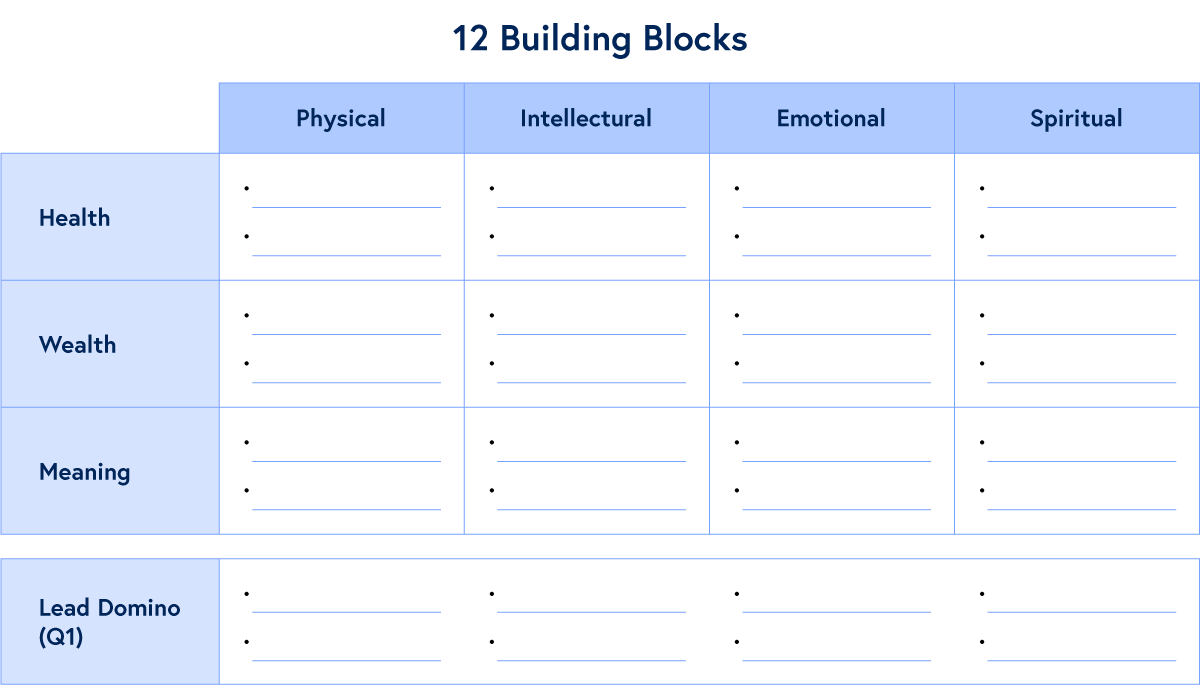
And its 4 dimensions of: Physical, Intellectual, Emotional and Spiritual
Some of you wanted to see my New Year’s plan. I hesitate not because I don’t have one, but because the moment I show you my plan, I take on more accountability. It reveals my deep inner heart, although still on the surface. They show what I aspire to, want, fear, what I am fighting for and what I’ve decided is “This is going to me!”
But let me first explain why your plan really matters and why most plans fail.
Why Most Plans Fail
Ideals are like stars; you will not succeed in touching them with your hands, but like the seafaring man on the ocean desert of waters, you choose them as your guides, and following them, you reach your destiny.
Carl Schurz
Your brain’s first priority is to keep you safe, to make you survive today and tomorrow and as long as possible. It isn’t engineered to make you noble. It’s designed to first make you efficient.
Survival instincts to feed hunger, thirst, sleep, arousal, mood, deep in the centre of our brains lies the command centre, the hypothalamus, relentlessly keeping you alive and seeking comfort.
This instinct for efficiency is what sabotages New Year’s resolutions.
A new year, a new start: your higher self, your prefrontal cortex, wants meaning, love, and growth in your soul and spirit, sacrificing any hardships and short-term gratification for long-term, meaningful outcomes. This higher self is not rational. It is profoundly emotional and spiritual.
But your basic self wants you not to suffer, to go through seemingly unnecessary risk and just be comfortable, make it easy, shortcut or hack your way to results and outcomes and to maintain your status quo. Why risk anything?
But to stay the same in an ever-changing world and an ever-changing you is riskier than venturing, growing, and fulfilling the deep-seated ideals of your heart.
So the goal of New Year’s plan is not motivation, but a rewiring from effortful intention to a sense of your true identity.
It is to strive for the process of becoming and not merely the result. This takes ‘work on yourself’ from the inside first. Mindset. Spiritset. And Physicalset.
The hardest is to go from 0 to 1. Whether it be in business, health, wealth, or meaning. Going from 1 to 2 is next. Then 2 to multiplying is much easier. Most of the world is used to this third stage, where systems are already built and determined. Very few as they get into their 30s, 40s and beyond, like going from 0 to 1. When you were younger, going from 0 to 1 was natural. But it got educated out of you as ‘risk’. You learned to walk. Run. Ride a bike, Learn languages. Study new topics. Read many books. Write. Create. How often do you learn a new thing? Set an impossible goal. We called that Daydreaming. How often do you daydream? How often do you try to make that daydream into reality? Compared to when you were much younger?
I am a perpetual daydreamer. But I am now 55 and realize I need to prioritize my dreams for the most meaning. My health and wealth are just ways to fulfill meaning.
Your Meaning: Your Destination
Your Health: Your Vehicle
Your Wealth/Gifts: Your Engine
How to Go from 0 to 1: The Lead Domino
The thought that leads to no action is not thought- it is dreaming.
Eliza Lamb Martyn
Have you ever seen hundreds of dominoes being knocked down, one after another, in spectacular fashion? Well, what if you lined up your New Year’s plan like a system of dominoes and figured out the first domino for you to knock down?
I plan the year in four quarters, just like a business does, but I plan Q1 (1st quarter) in the most detail, as it is where I establish my LEAD DOMINOS.
January is the first domino, the ignition, getting the engine started.
February is knocking that first domino down.
March is hopefully compounding or revising the plan/alignment of dominos, based on real-time feedback.
Once Q1 gains momentum, the rest of the quarters become more defined. It’s no longer a ‘start’ but a continuation of what your ‘new normal’ feels like.
This requires focus, self-discipline, courage, and faith.
You can endure the often painful process of growth and learning if you have a goal worth living for. Sometimes that is a person. Sometimes it’s a deep-seated want and desire from childhood or sometimes it isn’t even for you but for the world.
My Lead Domino
The thoughts which nestle within us, and issue from us in language and in act, determine our moral character. The most exquisite piece of sculpture which Michelangelo or Rodin ever carved, WAS ONCE only a THOUGHT.
Theodore Cuyler
I also think about what will prevent me or constrain me most—my biggest constraint. Right now, it’s my health. I have to take care of my body and my vehicle to get to my destination.
I used to think health was how I felt, even though I knew disease could grow silently, like rust inside a pipe. It can accumulate and present itself when it is almost too big to fail.
So I am not only focused on quality measures of health as to how I feel, but also a scorecard to keep track and process my body chemistry numbers.
My Jan 8, 2026 #s are:
LDL 79 mg/dl (2.0mM), HDL 58 mg/dl (1.5mM), TG 107
HbA1C: 5.3%
Weight 146 lbs
My goal in 3 months for further plaque reversal is
LDL 60, HDL 61, TG 60
HbA1c 5.0%
Weight 132 lbs (I was at this before with my rapid plaque reversal).
I’m currently at 138 lbs near end of Jan.
In 6 months,
LDL 50, HDL 65, TG, 50,
HbA1c 4.9%
Weight 132 lbs.
I had done this in my first three months after my high Calcium score from May to August. It’s when I knew I was rapidly reversing plaque.
Most experts say LDL<55, apoB<55 leads to plaque reversal.
I realized as I inputted all my meals, that I was no longer eating <20g of fat per day. I was more like 50-70 g fat per day! I wasn’t measuring things precisely and drifted to how I was feeling.
Oat milk matcha : 8g fat (I sometimes had two a day). Before I was just consuming matcha in tablet form.
Edamame: 8g fat
Chia seeds: 2 tbsp is 8g fat. I started taking 4 tbsp
Flax seeds: 2 tbsp is 8g fat. I started taking 4 tbsp
Just eating these daily was 48g-60g of fat per day.
2.5-3x more fat than when I had first started.
Not to mention fat in beans and other foods I started to increase.
I’m removing oat milk matcha and just matcha tablets I used to eat, very sparingly edamame and no more chia seeds and just 2 tbsp of flax.
I’m aiming for Esselstyn’s < 20g fat/day
Intermittent fasting with 6 hour meal time windows with one day of the week one meal a day (OMAD) with enough calories, protein and as needed complex carbs.
Lentils have a 22:1 ratio of protein:fat (15g Protein:0.8g fat)
Black beans 17:1 (15g Protein:1.1g fat)
Chickpeas 4:1. (15g Protein:4g fat)
I am choosing Lentils and Black Beans as my protein source.
Now I am being much more ‘prescriptive’ so I can reverse my heart plaque. I realized the body is like a system, a machine and its cause and effect—input/output. I knew, but I didn’t truly understand it or implement it as concisely. I was ‘eyeballing’ measures and foods. Now I am treating it much more quantitatively, like math.
But my ultimate result is coronary plaque reversal, which typically takes 2.5-5 years.
Dr. Esselstyn noted that only his patients who had LDL<50 reversed their plaque. He’s proven it. I just need to follow it and enhance it for my own anatomy and physiology.
The blood flow in my artery with the biggest blockage (77% blockage) has increased from 75% in late August, which was considered the danger zone, to 80% blood flow, which is low-normal now. I do feel great, but I will repeat these exams in June.
My goal is to reduce my D1 obstruction from 77% to 60-70% by the end of 2026, to 40-50% by the end of 2027, and to 20-30% by the end of 2028. By then, the coronary arteries' remodelling plaque obstruction should be readily noticeable.
Carotid plaque is much easier to reverse, and I did that in 3 months.
I’m focused primarily on my PHYSICAL HEALTH in the health category.
For the rest of my HEALTH SCORECARD:
Intellectual health: Read one great book. I chose Paradise Lost and am reading it with my daughter.
Emotional Health: Solo bike rides 3x/week for relaxation, meditation and to get outdoors. Ride and run in nature.
Spiritual Health: memorize the book of Ephesians in the Bible. It has 6 chapters, so memorize a chapter every two months.
This is just my health section. If my wealth and meaning plans are of interest, please let me know, and I will consider writing about them as well if you think it will help you see into my mind and life.
Wealth is not just money, which is like fuel, but optionality to drive your vehicle and life where you want. But more importantly, there is your intellectual wealth, emotional wealth and spiritual wealth you must invest in.
Your Challenge (if you are willing)
There are only a few things that really matter in life. The rest is dressings.
Dr. Kevin Ham
Set a timer for 30 minutes.
Sit down with a blank page. Write one thing for each of the 12 dimensions below—one practice that, if it grew this year, would genuinely fill your body with energy, your mind with clarity, and your soul with peace.
Copy this:
HEALTH
Physical: ______________________________
Intellectual: ___________________________
Emotional: _____________________________
Spiritual: ______________________________
WEALTH
Physical: ______________________________
Intellectual: ___________________________
Emotional: _____________________________
Spiritual: ______________________________
MEANING / PURPOSE
Physical: ______________________________
Intellectual: ___________________________
Emotional: _____________________________
Spiritual: ______________________________
Then choose your training mode for January:
Draw the 12 boxes.
Write one practice in each.
Then answer one question:
What is my lead domino for the next 90 days?
Write it in ink.
The goal isn’t a perfect year. It's the year you became intentional. A year where the person you become by December feels like a quiet miracle. Built, not wished for.
Ease the Heartache of Loved Ones
Please forward my newsletter to your friends and family and ask them to sign up.
I’d love to help a lot of people prevent, reverse, heal and ease the suffering of disease.
You’ll find these articles insightful and helpful as well:
The Power of Your New Year’s Plan
Life-Changing Question
What is your Lead Domino for Q1?
Next issue:
What is Happiness
Something to Live By
Subscribe to my Compounding Wisdom newsletter and start transforming your life.
The Three Core Inputs That Shape Your Self
What Shapes the Self?
Our soul is not reflected through our body without deep intention. Let your soul be master of your body and do not let your body be your master.
Dr. Kevin Ham
The road to self-confidence, self-actualization and self-transcendence, the Fruits of Self, come from three Self Inputs, the Roots of Self.
Every self is shaped by three foundational inputs. I lacked these three self inputs and only saw myself through the lenses of others’ and my environment. I was the second shortest in my grade, a minority, feeble-minded although bright, and didn’t have any dreams or purpose in my life. That started to change when I started asking myself important questions about life and my role in it. It changed even more when I made my misfortunes take on meaning and purpose. When I was bedridden in the hospital with an autoimmune disease, I decided that I was going to be a doctor of medicine to help other unfortunate people like myself.
These three Self Inputs started to reveal the deep core of my soul and spirit in my diseased and weak body.
Self-Perception
The privilege of a lifetime is to become who you truly are.
Joseph Campbell
Self-perception is how you view yourself. It is the story you believe about yourself and it dictates how high you dream, how deeply you love and how boldly you live.
Where Negative Self-Perception Comes From:
Most of your negative self-perception comes from:
Childhood labels, experiences, especially traumatizing ones and early conditioning. These play in repeating patterns both silently and actively with dependency, neediness, blaming, complaining, excusing, compromising with situations and peoples.
Unresolved failures mistaken as identity. Failures do not equal who you are. They are a byproduct or process on the way to learning and figuring you out. With every failure a seed of growth can be planted and redemption and wisdom gained. Edison said he failed 10,000 times before he could find the way to invent the light bulb.
You should ask yourself some important questions about your Self-Perception and understand the deep fundamental truths about yourself.
Do I align with my potential or with my past? In other words, do I constrain myself because of my past or can I have limitless possibilities because of my future?
What truth about myself do I believe? What lie about myself can I live with?
Practices:
Clarify who you are and who you wish to become. Write a “Who I Am Becoming” vision statement.
Reframe your past, good and bad, including the hardest failures, as preparation, learning rather than disqualification and unworthiness. Be honest with yourself.
Self-Talk
Between stimulus and response, man has the freedom to choose.
Viktor Frankl
Your self-talk is the words you speak about yourself and believe. What you say, you reinforce. These repeated words then become your self-identity, which dictates how you think, speak and behave. This is then reflected into your outer world.
Negative self-talk comes from unclosed loops and perceived gaps between your present critical self and your future aspired self as well as what others tell you about these seemingly large gaps.
The criticisms from your esteemed ones, authority figures or peers echoing in your head like a perpetual pinball machine.
Subconscious repetition of old emotional scripts and trauma that has not healed.
You should ask yourself:
What stories am I repeating and living that no longer serve me?
How would I speak to myself if I truly believed I was becoming who I was meant to be?
The purpose of questions is to explore, to provide clarity and hopefully define you, your true deeper self more fully.
Practices:
Begin each day with a truth-based affirmation about yourself. All things are relative and there are only levels in every direction.
Interrupt internal criticism with compassion, clarity and curiosity. Explore its deep roots and see if you transform or transplant them into healthy soil for purpose or meaning or learning.
Self-Environment
We must let go of the life we have planned so as to accept the one that is waiting for us.
Joseph Campbell
Your environment is not neutral. It either nurtures your self-actualization to become who you are or normalizes your excuses and binds you to your past, preventing your future.
Your negative self-environment comes from staying in environments out of habit, familiarity rather than alignment to your purpose. It is the city or country you grew up in, your friend groups, your families, your language, your customs. It is also bound by your cultural, familial, religious and social systems that resist non-conformity, that do not let your soul stand out as unique.
You should ask yourself:
Who consistently reinforces my highest identity?
What do I need to step away from in order to be freely me?
Practices:
Deeply curate your content, community and commitments. This is 80% elimination and 20% addition.
Design your mental, physical and relational space to support your future self.
Roots to Fruits
You alone determine and establish your roots. And your roots determine the fruits you share with the world.
Dr. Kevin Ham
When your three Self Inputs (Roots) align:
Clear Self-Perception
Consistent and authentic Self-Talk
Supportive Self-Environment
The three Self Outputs become your Fruits:
Self-Confidence
Self-Actualization
Self-Transcendence
One Life-Changing Question
In the final analysis, the question is not what we expect from life, but what life expects from us.
Viktor Frankl
What does the future You expect you to allow in today?
Final Thought
We are not human beings on a spiritual journey. We are spiritual beings on a human journey
Dr. Kevin Ham
You don’t just shape your habits. You shape your Self and your Self will shape the world you touch. Shine and Smile.
Choose your three Self Inputs with deep intention.
Next week: The 7-Self Framework: the Transformational Journey of Self
From Self-Perception to Self-Transcendence
See you next Thursday!
Subscribe to my Compounding Wisdom newsletter and start transforming your life.
The Mirror of Transcendence: How Serving Others Awakens You
From Self-Actualization to Self-Transcendence
He who has a why to live can bear almost any how.
Viktor Frankl
Last week, we explored the top of Maslow’s pyramid to Self-Actualization — becoming your highest self. But later in life, Maslow realized that there was a level even higher, broader and deeper to your soul and that is Self-Transcendence.
You don’t become your highest and best self on this earth until you give your self-actualized self away to others.
It’s not the next step or level after success, but it is the purpose for your success and self-actualization. It’s not the mountaintop. It’s the mirror.
That’s why so many people who climb the summit of success to self-actualization only have a brief glimpse of victory and celebration before they feel empty, down and alone on this summit as the celebration fades.
The mirror of transcendence reflects who you are — not when you look into it, but when others are changed by what they see in you.
Self-actualization is your calling. Self-transcendence is your contribution, your gift to the world.
Begin with the End in Mind
Only a life lived for others is a life worthwhile.
Albert Einstein
Everyone sets personal goals, but wisdom says to begin with legacy. Ask not “What do I want?” but “Who do I want to become for the sake of others?”
When you begin with who you want to serve, everything you do and build is sacred and purposeful.
Self-transcendence doesn’t diminish you or your dreams. It highly amplifies them. It gives your growth and success meaning beyond just you and your name.
The Three Lenses of Self-Transcendence
Maslow: The Final Step Most Miss
Transcenders are consciously motivated by values which transcend their own self.
Abraham Maslow
Maslow describes the highest level of self as Self-Transcendence: “the very highest and most inclusive or holistic levels of human consciousness, behaving and relating, as ends rather than means, to oneself, to significant others, to human beings in general, to other species, to nature and to the cosmos.”
This is when we:
Seek truth, beauty, and righteousness not for status or personal gain, but because they are fundamental values
Serve without recognition
Align with something larger than ourselves
It’s about giving and serving on your way down from the summit of success.
Frankl: Meaning Through Others
Being human always points, and is directed, to something or someone, other than oneself.
Viktor Frankl “Man’s Search for Meaning”
In the holocaust camps of WWII, Frankl found that survival often depended not on strength, but on purpose.
People transcended this personal suffering and hell by living for:
The person they loved
A mission they needed to complete
A vision that outlived pain and perhaps incorporated this pain into the marrow of their souls to give it meaning and purpose
You transcend by offering your pain, not but hiding or running away from it.
Campbell: The Hero Returns to Give Wisdom
The hero’s journey ends when the hero returns to serve.
The Hero’s 12 Step Journey ends when he returns to the Ordinary World from which he came, transformed by an insight in the New World and offers this wisdom to his Ordinary World. He returns not to claim victory or to take, but to share. Not to shine, but to reflect and uplift.
You become the medicine you needed and offer it freely to all those who need it.
My Moments of Transcendence
It only takes a moment of insight into yourself to transform you.
Dr. Kevin Ham
The Hill For Elliott
As my good friend Elliott lay dying from sarcoma at age 28, I decided to do a charity ride to conquer cancer, a two-day ride with each day 100 km. That was in 2008. I was very afraid of the hills on that ride and I had this insight that this fear paled in comparison to the hill that Elliott had to climb due to his cancer. So each pedal up that hill was symbolic of the fight each cancer victim had to take where the summit was likely death. Now I embrace each hill climb in honour and in memory of Elliott, my mother and everyone who has and is fighting this fight to conquer cancer. I am helping my good friend Dr. Azra Raza with her life mission of preventing, detecting and eradicating this vicious self-immortalized cell we call cancer.
Practices to Awaken Transcendence
Begin every day and meeting with Gratitude
My team meetings start this way. It opens the heart.
Give Without Credit
True giving leaves no mark
Ask Who, not What
Who can I serve today?
Let Pain Become Your Path
Embrace it and transform it with meaning
Build What Will Outlast You
Principles, wisdom, systems, people. Seed the future now.
Life Questions:
Answer these questions and write them down.
Am I living to be seen- or to serve?
What pain in my story could become someone else’s hope?
What would it look like to live as a mirror and not as a monument?
Final Thought
“Self-Actualization says to become your best self. Self-Transcendence say to give your best self to others.”
Dr. Kevin Ham
Your light was not meant to be buried deep in you. It was meant to shine through you to others.
The mirror of transcendence is clearest when someone else sees themselves more clearly because of how you lived.
Next week: The Three Core Inputs That Shape Your Self — Self-perception, self-talk and self-environment.
See you next Thursday!
Subscribe to my Compounding Wisdom newsletter and start transforming your life.
The Secret to Realizing Your Full Potential: Self-Actualization
The Paradox of the Pyramid
Begin with the end in mind.
Stephen Covey (The 7 Habits of Highly Effective People)
To Begin with the End in Mind means to start with a clear understanding of your destination. It means to know where you're going so that you better understand where you are now and so that the steps you take are always in the right direction.
Begin with the End in Mind" is based on the principle that all things are created twice. There's a mental or first creation, and a physical or second creation to all things.
At the top of Abraham Maslow’s Pyramid of the Hierarchy of Needs sits Self-Actualization, the end point we all strive for.
We often think that self-actualization is the world’s image of success, whether that world be your family, your friends, your peers, your workplace, your community or the media. Those are self-imposed expectations based on other’s conformed ideas of success.
Do we really strive to self-actualize and burst out of the seeds planted in our hearts, nurtured by plowing of the heart through the valleys of hardship, sorrow, and despair polarized by the heights of joy, recognition and pleasure?
But if you begin with self-actualization as the end in mind, you start on your journey to self-reflection, self-discovery and self-awareness.
This is what I started to realize in my 20s and became ever so aware in my 30s. All my years of darkness, hardships, sufferings, trials and tribulations were the cocoon that fostered the seeds deep in my heart to sprout and bear fruit in this world.
The End starts when you have a dream, a vision of what you want to do with your life, no matter how unseemly grand or small your vision may be. You can become that self-actualized person now as you need to first create the mental image of yourself and then the physical creation of yourself will come in due time.
I saw a grand vision, mission, values for myself that were somewhat clear but also somewhat vague. It was hazy but I started to take a step in that general direction. I have a much clearer vision and mission of my life now as I reflect on my many foolish missteps and mistakes.
The 3 Models of Self-Actualization
I realized I only have a relatively short time on this earth. How could I live and fulfill my dreams? So I asked, I searched, I knocked diligently upon this question for decades. I have read and been inspired by these three powerful models and contemplated how I could apply them in my heart and in my actions.
Maslow: Self-Actualization Through Growth
What a man can be, he must be.
Abraham Maslow

At the bottom of the pyramid, Maslow postulated that you need to fulfill your basic needs in succession, like food, safety, love and belonging, esteem before self-actualization. But later, Maslow revised his model when he realized that self-actualizing people often grow before their lower needs are fully met. Why is this?
How many stories have you heard of those without such basic needs rise up and grow up despite those deficiencies to do things that seemed unlikely or even impossible?
They saw a vision or a mission of who they could become in that moment they stepped forward into that void between lack and fullness. A purpose beyond just themselves. A vision of how they could transform themselves, like the caterpillar embracing its own cocoon to later emerge as the butterfly.
Your Hero’s Journey: Self-Actualization Through Trials
The cave you fear to enter holds the treasure you seek.
Joseph Campbell
In his book, “The Hero with a Thousand Faces” written in 1949, Joseph Campbell inspired George Lucas to write the trilogy Star Wars. Campbell saw that the principles of life in religion, myths and legends all had a common journey for the Hero.
He outlined 12 Stages of a Hero’s Journey, which can further be simplified to 3 broader Stages. He saw these as the transformation of the ordinary person into that extraordinary hero.
The Call - an invitation in your ordinary world calling you on a journey
The Trial - crossing the threshold into a new world of uncertainty, loss and fear
The Return - wisdom brought to others as you have a transformation from the inside out
Self-actualization does not happen in your ordinary life. It’s when you hear the calling in your heart to cross the threshold into the unknown, into the deep, into that dark cave you fear. Remember Luke Skywalker as he accepts his call to join the Rebels, as he faces Darth Vader in Yoda’s World first in a dream and then battles him losing his arm? He had to lose himself spiritually then physically in order to be reborn, resurrected, transformed.
This is the wilderness journey of Moses by himself for 40 years and later with his 600,000+ people from Egypt to Israel together.
This is Jesus’ 40 days of fasting in the wilderness and being tempted three times by the devil in private and then carrying his cross and being crucified to it in public.
Note: You are that hero. Go find your journey.
Viktor Frankl: Self-Actualization Through Meaning
Life is never made unbearable by circumstances, but only by lack of meaning and purpose.
Viktor Frankl
If you have not yet read Frankl’s book, “A Man’s Search For Meaning,” make it one of your top books to read this summer. Frankl details his life in the Holocaust camp and what he saw. He was a psychiatrist, but on his arrival to Auschwitz, he was stripped bare of all that he was, all that he and instead of Dr. Frankl, was given a number for his name.
“I can see beyond the misery of the situation to the potential for discovering a meaning behind it, and thus to turn an apparently meaningless suffering into a genuine human achievement. I am convinced that, in the final analysis, there is no situation that does not contain within it the seed of meaning. To a great extent, this conviction is the basis of Logotherapy.”
Frankl saw that those who had meaning despite the torture, depravity and horror of the concentration camps, increased the chances of one’s survival. So he saw who he would become because of his experience and gave and encouraged others with what little he had in the camp. One morsel of bread daily.
Meaning gave him strength and hope. He believed that each person is the only one who could decide about the meaning of their life and that he has to take responsibility for creating and deciding his own personal unique meaning. S/he can also decide the meaning of a situation individual is the only one to decide about the meaning of their life and that the individual has to take responsibility for creating and deciding its unique meaning. The ability to decide the meaning of a situation has the power to create a positive outcome from the worst of situations. The worse the situation, the more profound the meaning and personal transformation.
How to Start Self-Actualizing Now
To be yourself in a world that is constantly trying to make you something else is the greatest accomplishment.
Ralph Waldo Emerson
Aspire Your Full Potential now
Write out your Self-actualization Identity Statement:
I am a person who is _________ (write out at least 3 or more things you aspire to be and do).Tape it to your bathroom mirror or by your bedside to read each morning and evening. Memorize it.
Align With Your Full Identity
Think and Act from this identity today
Don’t wait until you are ready or confident.
Start with one thought and action that reflects who you are actualizing.
Actualize
Notice in the word actualize is the word act.
Thoughts become actions. Actions become words. These become your character.
Life Questions:
Answer these questions and write them down.
What identity do I want to start self-actualizing now?
What is preventing me or constraining me from starting now?
Solve that obstacle or constraint
Final Thought
Start today with who you wish to become. Embrace hardship, failures, obstacles, fear and make them the fallowed ground to plant the seeds of your heart.
Dr. Kevin Ham
Next week: Back to How to be Self-Transcendent: How Serving Others Transforms You to Your Highest Self
See you next Thursday!
Subscribe to my Compounding Wisdom newsletter and start transforming your life.
How to Build Unshakeable Self-Confidence
Do you have what it takes to live your dreams?
Self-Confidence is so fundamental to you flourishing, yet it is the most misunderstood aspect of personal growth.
Dr. Kevin Ham
When I was young, I lacked a great deal of self-confidence. When teams were being picked, I was often the last one selected. I was short. I was quiet. Deep inside, I hoped that I would get picked early and be recognized as someone worthy of being part of their team. As I grew older, I decided to strive harder than anyone to develop the skills necessary to be a valuable team member. My mother invoked her dreams of playing the piano on me, but for me, such a solitary endeavour was not my dream. Instead, my dream was to make one of the high school sports teams. I tried out for the volleyball team. Despite being one of the shortest, I was pretty good, but I got cut. I didn't even try out for the basketball team.
In my final year of high school, I decided I would try out for the soccer team. During the summer, I would practice doing 100 kick-ups every day, ensuring that the ball never hit the ground with each foot. Then, I would practice hitting each corner of the goalpost ten times. I got very good at kickups and shooting. I gave it my all. Guess what? I made the cut! Even though I was mainly a benchwarmer, that was the beginning of my understanding of what it took to be self-confident.
Over these five decades, as I have developed myself, I have grown from nothing to 'me'. Weak in mind to strong. Physically weak to very fit. I have observed the inputs that lead to the Seven Pillars of Self and the Three Self Outputsthat have shaped who I am today. I want to write about these in the hopes that they help you develop yourself into the person you dream and aspire to be.
Self-Confidence is not Pride or Arrogance
Pride goes before destruction and a fall before a haughty spirit.
King Solomon
A fall from a great height hits hard. The higher you go in life, the greater the fall. True self-confidence is founded on humility and wisdom.
Humility is knowing who you are and in a spirit of serving and honouring others while still honouring yourself. God loves a humble and contrite heart.
Wisdom is discerning good and evil and knowing what to think, say and act, to who, when and where and understanding the depths and breadths of the circumstances and people.
Pride and arrogance stem from a heightened sense of self at the expense of others, characterized by self-interest and a lack of empathy for others, leading one to believe they are superior to others. It is self-serving, built upon the desire for power, status, control and recognition. It seeks gain rather than to give and serve.
Your 3 Self Outputs
You only reap what you put in and process with time, thought and action.
Dr. Kevin Ham
As you develop the Seven Pillars of Self, you will experience Three Self Outputs.
Self-Confidence
Self-Esteem
Self-Actualization
As I contemplated what I wanted to do in life, I also considered who I wanted to be. At the age of 14, I knew I wanted to be a medical doctor. At age 21 I knew and believed I would be a part of the Internet revolution. I dreamed of making some epic movies in my 50s to 70s. But these are things I wanted to do. Who did I want to be? I wanted to be a man of God. I wanted to be a good father, a good son, a good husband, a good friend, a good entrepreneur, a good doctor, a good philanthropist. I wanted to be an inspirational visionary, giving much more than I received. I wanted to have a wise and understanding heart, one that praises and glorifies God. And if I dared and God granted me such blessings to be not only good but also great as a human being and also in each endeavour I dreamt of doing. This has been my prayer. I have failed often, but each time I reflected and have been humbled by my shortcomings and looked to God and wisdom to lift me upagain.
I realized that self-confidence came from just a few things. But first, I realized what came before self-confidence.
3 Impostors of Self
Being untrue to your heart makes living a shadow of darkness.
Dr. Kevin Ham
Your life is a constant ping-pong match of self-doubt, self-lack, and self-criticism between your present being and the ideal being in your heart.
Self-Doubt
Until you have a good sense of who you are, you will have self-doubt. Everyone around is telling you who you should be, how you should be and what you should be doing. This can be internalized as criticism that confuses your heart about who you truly are and who you should blossom into. Thus, the great oracle wisely asks you to "Know Thyself." Until you are comfortable knowing who you are, warts and all, in spirit, mind and body, you will have varying degrees of self-doubt. Who are you? And you are not just your body. You are in your body.
Self-Lack
You came into this world empty-handed. You will leave empty-handed. What you lack does not define you, but most of the time, we view ourselves from the point of lack, of scarcity rather than as possessing all that we need. It is hard to believe in yourself if you view yourself as lacking in what you require. I knew I was going to be a doctor. If I had viewedthis from a point of lack, I surely would have given up easily. I failed the MCAT (Medical College Admission Test) twice. I failed to get into medical school right after I finished university. Eventually, during my medical interviews, my dreams and confidence in being a great doctor shone through. Where did this come from? I believed I was going to be a great doctor. The energy that emanated was palpable, and I was finally admitted into medical school.
You are not lacking. You may lack the resources, the money, the skills, the network, but you can gain those things in due time. King David said, "The Lord is my Shepherd; I have no lack." (Psalm 23:1.) See yourself with all the gifts and abundance within you, just waiting to be actualized. One day, it will be… if you believe you do not lack.
Self-Criticism
Who are you to do that which you dream of? You don't have what it takes. You are not good enough. This self-talk, this self-criticism, where does it come from? Impostor syndrome. The inauthenticity of being leads to self-criticism. When you see a seed, do you see the tree? When you see a caterpillar, do you see the butterfly? Imagine doubting the two.
Imagine criticizing the seed and telling it that it will never become a tree. Imagine criticizing the caterpillar and telling it that it will never become a butterfly. When you compare your current being to that which you dream and aspire to become, what does the process look like? What does that transformation look like? What does that cocoon look like? And when you tell others your dreams of becoming your dream self, what do they say? Do they criticize, in the same vein, comparing your present state (that of a caterpillar) to your dream state (that of a butterfly.) It may be logical, but logic does not actualize dreams. Belief and being do.
Acknowledge who you are now. Accept yourself. But strive to be the being in your heart and your spirit. Develop the discipline and belief to become that person who you aspire to be. Every thought, word, and action tips the scale in favour of the present and future self. Each day is a new day to start again. We do go around life in circles.
While we might deeply care about what others think, both praise and criticism, it is often best to take it in, reflect upon and discard that which is not edifying or useful to you. I often discard 80% of the feedback from others after deeply reflecting upon them and examining my heart. If valid, I take it to heart.
3 Step Self-Confidence Builder
There are many systems proposed to build your self-confidence, like the great Dale Carnegie, Napoleon Hill, King Solomon, and Marcus Aurelius' Stoic principles.
Dale Carnegie
Do the thing which you fear.
Shift focus from self to being interested in others.
Over-practice and over-prepare
Smile, use people's names, and practice being present.
Turn criticism into fuel, not fire.
Live with gratitude and enthusiasm.
Napoleon Hill
"I know that I have the ability to achieve the object of my definite purpose in life. Therefore, I demand of myself persistent, continuous action toward its attainment..."
Definite chief aim (Desire)
Belief in yourself and your outcome (Faith)
Autosuggestion (Repetition of Belief). Speak your goal aloud daily.
Specialized knowledge (Skill building by practicing)
Persistence
Mastermind Alliance with like-minded people
Marcus Aurelius
Control what you can. Release what you can't.
Align your actions with your virtues.
Ignore praise and criticism. Follow your heart.
I focus on just three practices. This has been my self-confidence practice since Grade 10 when I had a deathly fear of speaking to girls. My first step was to look them in the eyes and say 'Hi,' then listen to them. I was so surprised when most looked away. This was a big realization that self-confidence is adding drops of water to a bucket and it will soon fill to the brim and overflow if I do the three practices below. The most important is #3, then #2, and then #1. Spirit, then mind, then body.
Self-Confidence Trinity
Make eye contact, smile and listen. (body)
See if you can maintain eye contact longer than the other person. In due time, you will be able to. Don't forget to smile. If someone is smiling, you cannot help but smile. Smiling is contagious. Since I have such a big mouth, my smile stretches wide. Then my heart starts to smile. I recall a time when I was having a bad day, and a stranger simply smiled at me; it had a profound impact on me. I felt like my burden just melted away.
Think and practice. (mind)
Think deeper, with your heart. Dream. Practice more. Rehearse and act until it is you. I practised my medical interview for years in my head and in front of a mirror. The more you practice, the shorter and more impactful your delivery becomes. Lincoln's Gettysburg address. It's just two minutes long. Wow.
Do your best to serve. (spirit)
Your best is all you can do. Give it your all. All your thoughts, all your energy, all your actions. What more can you ask of yourself? And each time, you will get better. It is the law of growth.
Life Question:
How self-confident are you on a scale of 1-10?
How self-confident do you aspire to be in 3 months, 6 months, one year, and two years?
Write a score down and evaluate yourself every 3 months.
Next week:
Self-esteem: Why do icons feel empty when they reach the pinnacle of success?
See you next Thursday!
Subscribe to my Compounding Wisdom newsletter and start transforming your life.
You have the will but lack the discipline (to accomplish your dreams).
Our brains are wired for short term gratification while dreaming of happily ever after without effort.
There is a dream in your heart, a goal you desire. You might pray for it, wish for it, and plan for it. But the effort to actually make it real seems intimidating. The bigger the dream or goal, the more daunting. So, you start shrinking your dreams and goals until they feel comfortable. You decrease the gap between expectation and reality until they are no longer inspiring dreams or goals. They are just another task to check off.
The Will vs the Spirit
Where there is a will, there is a way.
George Herbert
Deep down, you feel your will is enough to make things real despite any lack, limitations or obstacles. When you believe in it strongly enough, you think you will do anything and everything to find a way to bring your dreams into being.
The spirit is willing but the flesh is weak.
George Herbert
As Jesus prayed the night before he was to be crucified, he spoke to his disciples who were falling asleep. Even though his disciples all believed that they would also do whatever it took to protect and fight for their leader, they fell asleep, as their bodies were too tired to follow the will of their spirit.
This is tantamount when it comes to effort. One common form of effort that translates will into reality is exercise. How do you define exercise?
Exercise is a planned, structured, and repetitive subset of physical activity. The objective is to improve or maintain physical fitness.
To exercise your will is to plan, structure, and repetitively act to produce a result of that will. Now, apply this not only to physical exercise but also other areas of your life, such as mental exercise, spiritual exercise, relationship exercise, or financial exercise.
Once you apply it in one area of your life, you can then apply it in other areas of your life.
How can I climb higher?
You just have to do the climb.
Michael Woods, pro cyclist
I asked many of my pro cyclist friends how to ride my bike up mountains faster. They answered, "I hate to tell you this, but the best way is to climb bigger mountains and do it as much as possible." I was able to ride alongside four-time Tour de France winner Chris Froome and Hugo Houle, the winner of stage 16 at the 2024 Tour de France, during their training mountain climbs. They were to go up the mountain, increasing power each minute and decreasing rest periods. Eg. 50 seconds regular, then 10 seconds at 500 watts for ten minutes and then increase this to 20 seconds at 500 Watts, then 30 seconds at 500 Watts. I tried this and, after 15 minutes, didn't have the mental strength to continue doing it. I realized that the practice rides were intense, and they had to often do blocks of training that were harder than the stage races of the Tour de France, where they rode in a peloton, drafting behind others to conserve energy.
Only by actually doing the 'work' will you see your limits, constraints, current level, and potential. I started to schedule mountain climbs on my bike, even doing the same mountain two or three times in one ride. I became very fit and much better at climbing mountains, although it was a power hour of mental endurance as much as it was physical.
Can you imagine your heart beating 170 beats per minute for an hour? My heart became so efficient, that my resting heart rate is now 43. In medicine, we were told that the normal heart rate is between 60 to 100 beats per minute (bpm). I asked Froome what his resting heart rate was-- 32 bpm. Wow. Lance Armstrong's? 28. This is why their hearts are able toendure the tremendous rigours of climbing the European Alps and mountains for 3,400 km and 50,000m of elevation over 21 days. That's an average of 160 km and 2300m climbing every day.
The Hill Principle
The climb is your friend who is always right before you.
Dr. Kevin Ham
When I used to peer up the face of a mountain from the base on my bicycle, I would experience a lot of anxiety about how hard and painful it would feel to ride up. Then, one day, I realized that although the mountain would always remain the same and I would suffer, I would also become stronger, fitter, and healthier.
My mindset changed from one of anxiety and suffering to one of taking on a challenge to gain great physical and mental benefits. From that moment, I started riding up the hills and mountains with resolve and discipline to become the fittest person I could be. It was my version of 80/20 cardio, where I would climb each climb with intensity and then rest on the downhills and flats—like HIIT, High-Intensity Interval Training.
Best Longevity Predictor: VO2Max
Why do I want to live forever when I know my body will not?
Dr. Kevin Ham
My friend Paulo, who is the Performance Director for the pro cycling team Israel Premier Tech and a coach to Olympic Athletes, taught me this longevity hack: If you exercise HIIT for 30 minutes three times a week, your VO2Max will only decline 6% from age 60 to 80. I realized that my VO2Max could be the same at 80 as it was at 50 (my VO2Max was 51 at age 49 and ~60 at age 52).

So, mountain climbing became my will for physical and mental fitness with the purpose of longevity.
Schedule it in your calendar
Time is just moments scheduled, serendipitous, or passed away.
Dr. Kevin Ham
Your will is like the clouds. When you repetitively schedule your will into your plans and your calendar, it becomes like the weather forecast for your life--but you determine the weather forecast by your schedule. You determine the actual weather by doing what you put in your calendar.
It's that simple yet hard to do. First, you need to schedule your 'will' and then follow it with consistency and intention.
That's when your dreams manifest over time into reality. It's simple yet hard to do. If you start doing this, you will naturally rise to the top 10% or top 1% of whatever you set your will, mind, and body to.
Life Question:
What do you will to do this year, this month, this week, today?
Just do it.
Nike
Many things are out of your control. Find the things you can control, focus on them and then act on them. You will find your way to your dream by walking that path that appears before you.
Next week:
Resilience is the last step to the gates to success
Failures and breakdowns are inevitable before success appears.
See you next Thursday!
Subscribe to my Compounding Wisdom newsletter and start transforming your life.
Why Multitasking Makes You Ordinary. Instead Be Extraordinary with the F word.
Even an hour of deep, focused work a day can produce extraordinary results.
Kevin Ham
The world encourages you to multitask and get lots of things done. This results in 'shallow' work over sustained, focused, 'deep' work that can give rise to something extraordinary.
Einstein focused for over a decade on trying to solve the problem of time and energy. Isaac Newton invested years obsessively focused on a few key problems, writing Principia Mathematica in the 1680s, which delivered the three laws of motion. Most people never dedicate themselves fully to one pursuit.
The most powerful F word most people think of is a four letter word. But there is a more powerful F word with five letters. It also has the letters U and C, but no K. A lack of it makes the day blurry, caused by constant distractions, newsfeeds, notifications, and busy work. It prevents us from dedicated, focused, deep work towards a single vision. Even an hour of deep work each day over a period of time can produce remarkable results over years, decades and your lifetime.
During the COVID pandemic, I decided to ride my bike every day for 30 days--either 30 km or 300m of elevation (a small mountain climb). It was about an hour a day. After a month, I was tired but was super fit, having ridden almost 1000 km in a month. I kept that up but with rest days and rode an average distance of 7,700 km and elevation of 100,000m every year for three years. In 2022, I was in the best shape of my life. I could ride 110 km in four hours on one bottle of water and one energy bar. Now, I maintain my fitness by riding more focused at 3500 km a year. My 100-year-old goal is to ride 100 km like Robert Marchand. He lived to be 109 years old and is the world record holder for fastest 100 km ride and distance cycled in one hour, for the 100–104 and over 105 age categories. He likely had very little competition at that age :).
But Multitasking Allows You to Accomplish Multiple Things at Once.
Ordinary is average. Extraordinary is special. Just takes an ounce of thought and a pound of application.
Dr. Kevin Ham
I used to think multitasking allowed me to accomplish much, but Dr. Alan Barnard had us do an exercise. Write down the numbers 1-10 then the letters A-J in order and time yourself. Next, write 1A, 2B, 3C, 4D, 5E to 10J and time yourself.
Writing 1-10 took me less than 2 seconds, and A-J took me 2 seconds. The total time was 3.55 seconds, but counting 1A-10J took me 10 seconds, which is 2.5 times longer.
When I memorize one chapter of Proverbs, it feels good and flows. When I try to memorize two chapters at once, I feel stressed. I get confused between the chapters, and it takes me longer, and I forget easier.
What's your experience?
Try the number/letter test. Next, expand that 1-26, A-Z. Then, add a circle, triangle, square as a third task. Then, add a fourth task—the time it takes compounds as more tasks are woven in.
Yes, you can talk and drive. But texting and driving? Forget it. Don't do it because you need to focus on your driving.
If you just set aside a dedicated time to filter out all the distractions, notifications, and thoughts and focus on doing deep work for one thing, it is incredible what you can accomplish.
Think … Just Think.
Of all the beautiful gifts we have, the ability to think is the greatest, next to love and to forgive.
Dr. Kevin Ham
Think and Grow Rich is one of the perennial best-sellers written by Napoleon Hill. The key word here is "Think". I almost think the title should be "Think, then you will grow ____ (fill in your word of choice here … rich, smart, fit, wise).
One of my mentors, Bob Proctor, told a pro golf player that if he wanted to improve, he needed to focus his attention on being able to focus. He asked the golfer to put a dot on the wall and stare at it for five minutes without losing focus on the dot. He said most people cannot stare even five minutes without their mind wandering. Then, increase the time each day. He would be successful when he could focus an hour on the dot. Then, he was told to apply that skill to each aspect of his golf game.
90% of my time, I like to think, then write my thoughts down, and then plan a path for my thoughts to come alive. Most are stillborn. Some are born. Few make it to adulthood. Very few reproduce offspring. Earl Nightingale, the father of personal growth, said that 95% of people do not think, 5% think they think but only 2% of people really think. I did not understand this because I thought I thought, but the question is, what are you really thinking about? The more I thought about my thoughts, the deeper my thinking became.
The problems that arise in life, like the waves and the stormy weather, not only give rise to emotions but also allow you to think. "Necessity is the mother of invention."
So think about your thinking, for you become what you think about.
Life Question:
What is your most important focus in life?
Focus is like a magnifying glass that makes sunlight start a fire.
Dr. Kevin Ham
Most people don't really know the answer to this question. Find one thing you'd like to focus on for the next month.
Put 10 minutes to one hour a day devoted without distractions on your most important focus for the next 30 days and see. Then persist and continue for the rest of the year and see. Then let me know the results in 30 days and each month.
Schedule this like an appointment in your calendar. Then tell your family and network that you have focused time for this period you blocked out, and then keep that appointment.
Guaranteed to be life-changing.
Next week:
You have the will but lack the discipline to accomplish your dreams. Why?
Our brains are wired for short-term gratification while dreaming of happily ever after without effort.
See you next Thursday!
Subscribe to my Compounding Wisdom newsletter and start transforming your life.
Why your external drive is not enough. What’s inside of you?
Most people get depressed when they reach their goal because there is nothing more to obtain and hope dies.
Kevin Ham
Michael Phelps set the record for most gold medals in an Olympic game with eight golds. His dreams were more than realized. Then depression hit hard. He had worked all his life for this moment: 23 golds, 28 total medals. After the 2004 Olympic golds, he felt the post-Olympic blues and often felt suicidal, and this became more pronounced the more medals he won. Why?
Dopamine momentarily surges to new heights after we achieve a goal and then after the joy and excitement fades, it drops… It drops below the baseline. Mood plummets. This is the science behind postpartum depression and after other goals and dreams are realized.
While there is a goal and a drive to obtain that goal, what happens after the goal is accomplished?
Is More Better and Does More Make You Happy?
The day you discover less is more is the day you start living.
Dr. Kevin Ham
What is the goal? More... Success? Money? Fame? Power? Status? Happiness? Health? Joy? Peace?
Simon Sinek's famous three circles point out the obvious. Most people focus on the What, then the How, and perhaps the Why. Instead, we should focus deep within and focus on the Why, then the How, and then the What.

Simon Sinek’s Three Circles
Our focus on the Whats drive us to seek after more and more--even after getting one big What. What is your purpose? What is your Why? The reason to be? Whether personal or professional.
I've often pondered my drive for more, even after much success. What is driving me. Why do I feel so alive when I am starting something new, something big and all the while, I know just how much time and energy it will take in the remaining time I have left?
Harper Lee published one novel, which became a hit, winning the Pulitzer Prize: To Kill a Mockingbird. She never published another book, opting to stay out of the spotlight. She told the story of moral courage amid racial injustice. She told her story and the stories of so many throughout history, as she saw growing up in Alabama.
The same goes for Margaret Mitchell and Gone with the Wind. Neither of these authors felt the need to win another Pulitzer Prize or write best-sellers to define themselves. Their why had been accomplished, and it was enough.
These days, in my mid-50s, I am driven much more by purpose and meaning than the Whats. In 2007, I was on the cover of a business magazine I adored and on the front pages of many international newspapers. I had tasted great success, but I let it melt, not speaking with any reporters or venture capitalists, even as they clamoured all around me.
Everyone is Remembered By a Sentence
The man who freed the slaves and held America together during its darkest hour.
The man who wore simple clothes, walked in silence, and brought down an empire by starving, without lifting a sword.
Do you recognize each person above by what they did? Can you tell who they are by what they did? Can you tell why they did what they did?
Abraham Lincoln saw an enslaved person in chains when he was young and thought that if he ever had the power to free such enslaved people, he would. Born into poverty and raised with little formal education, he rose through perseverance, self-study, and deep moral conviction. As a lawyer, debater, and eventually the 16th President of the United States, he fought for liberty, for a nation "conceived in liberty, and dedicated to the proposition that all men are created equal."
Gandhi was a lawyer educated in the UK, but when he travelled to South Africa, he was thrown off the train for being Indian, even though he had a first-class ticket. That injustice shaped his life. His life mission was to "Awaken the soul of a nation and lead by example--with humility, truth and love," He didn't wish for power. He wanted people to realize their own power--the power of truth, moral courage and peace. "An eye for an eye makes the whole world blind."
What is your one sentence?
Life Question:
Who am I?
I am a spiritual being living in a human body, not a human body with a spirit.
Bob Proctor
Be the change you wish to see in the world.
Gandhi
You are not your body. You are in your body.
Dr. Kevin Ham
Next week:
Why Multitasking Makes You Ordinary
Even an hour of deep, focused work a day can produce extraordinary results.
See you next Thursday!
Subscribe to my Compounding Wisdom newsletter and start transforming your life.
Do you value your own thoughts and opinions enough?
Don’t let fear of criticism prevent you from doing what is in your heart
Don’t let fear of criticism prevent you from doing what is in your heart
What do you think?
Honour your own thoughts and heart first.
Dr. Kevin Ham
This may be one of the oft-asked questions you ask your friends, family and coworkers. A more critical question is to ask yourself, "What do I think?"
"Cogito, ergo sum." "I think therefore I am." declared Rene Descartes in the early 1600s as he pondered how he existed. Such doubt gave rise to thought, and this thinking declared his existence.
When we have a thought, an idea, an opinion, or a philosophy, why do we tend to doubt its veracity? As we develop our intuition, insight, and inspiration--all that comes from our heart or spirit--we need a logical way of expressing these in words and stories to bypass the logical guards in others' minds before making their way into their creative hearts.
We grow up with wonder and creativity, but over time, we are hammered into thinking mostly logically and scientifically. Without signs or proof of an intangible, an invisible insight or idea does not have merit until it is proven or if we can show it another's vision. This is why so many contrarian ideas seem foolish in foresight but obvious and genius in hindsight.
We become afraid to express those thoughts and ideas that spring up from our hearts--the ones that inspire us--because they are so quickly and easily discarded as being foolish by others. The filter on most people's minds is that of logic, proof, fitting in and conformity. So much so that unless one conforms or fits into the norm or the regulations, they are also quickly discarded as crazy and their idea as pie in the sky.
If I liked to wear bright turquoise or pink pants, many would consider me eccentric. I have been called crazy for so much of my life because many of my thoughts and ideas are contrary to what is the norm. I question why things are the way they are and how they can be reinvented or improved upon. For instance, why does the traditional school system focus on teaching children information rather than empowering them to question things and learn from first principles? Why don't we praise failures when experiments are conducted to find truths and gather insights instead of solely praising good grades? Almost all great discoveries, innovations, businesses and growth have resulted from a series of failed experiments that guided us to a version of the truth.
I think therefore I am. Your thoughts may be foolish, but with continued thinking about your thoughts, words, and actions, your thoughts can one day become wise. We are learning, growing, and loving beings. The moment we cease to do these three things, we diminish as human beings.
As You Think So You Are
Each of us is literally what we think, our character being the complete sum of all our thoughts.
James Allen
Deep in our hearts, we may feel and believe one thing, but outwardly express something that is superficial or contrary to our hearts. We call such a person 'calculating'. This proverb was written by one of the wisest kings in history, King Solomon, who demonstrated his wisdom when two harlots claimed a baby as their own. He ordered the baby to be cut in half and one half given to each mother. The real mother asked out that the baby be given to the other. The false mother asked that it be done, as she had accidentally smothered her baby to death while sleeping and did not want the other mother to have a child. The Hebrew word in this proverb, translated as 'thinketh' can also be translated as 'inwardly calculating'.
James Allen pondered this Proverbs 23:7 and wrote 7 chapters on it in a book entitled by the proverb, "As a Man Thinketh" in 1902. In it he expresses, "Each of us is literally what we think, our character being the complete sum of all our thoughts. Action is the blossom of thought, and joy and suffering are its fruit. We are the masters of thought, the moulders of character and the makers and shapers of condition, environment and destiny."
If our thoughts shape our character, condition, environment, and destiny, we should really think about our thinking. The thoughts and opinions of others about our thoughts and ideas should be like mirrors to us, but what is truly important is our deep understanding of our own thoughts. This is presaged by the age-old wise oracle to "Know thyself."
Criticism is but a Different Perspective
Since everyone is unique, each will have their own perspective. This difference is what we perceive to be criticism.
Dr. Kevin Ham
Even the most popular book has its lovers and its haters. If you don't have any thoughts or opinions, there is nothing to love or hate. If you express no thoughts, what is your existence? The moment you have an idea you want to express, consider to whom you are expressing it. If you express it to experts, you may gain a valuable perspective and insight. If it's to people without any expertise or experience in the matter, what they have to offer is likely a mere matter of opinion.So then the question is how deeply have you thought about what you have just expressed?
I've started many businesses. I've failed many times, but I've succeeded many times too. The great home run hitters were also the ones who struck out the most. I go for home runs in my ventures. I value customers' perspectives, but as Henry Ford said, "If I had asked people what they wanted, they would have said faster horses." As in the scientific method, I should have a hypothesis that I believe to be true, craft out my assumption that I must disprove, gather the relevant data and conclude if my hypothesis has merit. We call this agile experimentation. I believe this works in almost every field, not just science and business. What we assume to believe, we need to experiment first through thought experiments as Einstein did, then through real experiments as quickly as we can. This is a skill and secret of life.
I've come to a personal conclusion for myself regarding criticism. Take it all in, and consider it deeply. Discard what is not useful, adopt what is helpful, and give yourself space between the criticism and the response with a statement like, "That's interesting. Let me ponder that a bit. Thanks." When people tell me how I should name or run my business, I consider if they've built a startup and how seriously I should take their criticism of the name or idea of my business. If they are a customer who would pay money, I will listen more carefully.
1000 True Fans and 1 True Friend
I only really cherish a small number of people. My heart can only hold so many.
Dr. Kevin Ham

Credit: Emmanuel Lafont
I heard that if you sell 10,000 books, you would be in the top 1% of all authors for all time. 90% of books sell less than 1000 copies. I've contemplated why this is. Robin Dunbar, a British anthropologist proposed that a person has 150 meaningful relationships. This consists of just five loved ones, followed by 15 good friends, 50 friends, 150 meaningful contacts, 500 acquaintances and 1500 people you can recognize. So if all your friends and acquaintances bought your book, it's still hard to sell 1000 copies. When I started my Linkedin following, it was hard for me to get 1000 followers from my existing real-life relationships. I now have 45,000 followers, but most of them I do not have a bidirectional meaningful relationship with.
I hope to publish books in my sixties and sell over 10,000 copies :). When it comes to business, your goal should be to get 1000 true fans. This implies the quality of the relationship is more important than the quantity. It allows you to find your target niche and those whom you service and how. When it comes to life, your goal should be to have five true friends. Lifelong friends. There are friends for a reason, friends for a season. But lifelong through all the ups and downs is special.
Why is this important? With true fans and true friends, you can express yourself and your ideas and have believers give you true feedback that you would not be defensive about because you have built such a strong foundation of trust. Criticism by those who aren't within your inner circles of trust then needs the circle of expertise.

Upon this foundation, you can figure out product-market fit for business and character-life fit for personal.
I gave the opportunity for 100 friends and family to invest in my new AI startup. 80% invested, saying they believed in me and that I would figure it out. They knew it was high risk and could lose their investment but were betting on me to hit it out of the park. This is more valuable to me than all the money they have invested, close to $10 million USD. It fuels me and inspires me while giving me deep accountability.
Life Question:
Do you really think about your thinking?
What are your five most important thoughts?
Write them down now.
Think about them deeply, three to five layers deep
Next week:
Are you willing to pay the price to get what you want?
Every great accomplishment in life requires a sacrifice.
See you next Thursday!
Subscribe to my Compounding Wisdom newsletter and start transforming your life.
Why Fear of Failure is Preventing Your Success
Your failures are the stepping stones to your success.
Your failures are the stepping stones to your success.
Failures are only truly failures when you give up on your way.
F. Failure. I failed. Another great F word, next best after Focus.
No matter how many times you fail, you are not a failure. Please reread this sentence and engrave it into your memory. Why? Because the world, your parents, teachers, coaches, and peers all seem to engrain and espouse the opposite: that failure is bad and that when we fail, we are failures.
In my first year of university, I failed all of my midterms. I had never failed so badly in school before. Why did I fail? Because I didn't study. I thought I could cram as I had in high school, but these university exams were much harder. Being unprepared and not doing my best were my failures. I was a student. It was my duty to study. This I did not do. But even though I had failed miserably, I knew I was not a failure. I decided to study a minimum of two hours every day. By Christmas exam time, my lowest mark was 92, and my highest was 98. But even if I had failed again, I would not have felt like a failure.
As we age, we stop trying new things because we become afraid of failure. If we don't try to learn new things, we can't fail, but our circle of knowledge, experience, and influence remains stagnant and limited. The law of life is growth and experience.
Failure Lays the Foundation for Success
The repeated pains of failure harden the cornerstones of success.
Dr. Kevin Ham
Sara Blakely was told during her family dinners that failure should be celebrated and embraced. This, along with seeing her best friend dying, gave her the courage to do what she believed in. By embracing failure, she created the billion-dollar clothing business called Spanx.
If you think about how you became good at anything you do, it is through practice. Practice makes perfect. Hidden inside this statement lies dozens, hundreds, if not thousands of failures to gain perfection. Playing a song? Playing a sport? It's the amount of repetitions multiplied by the intensity that leads to your result. So, when someone says they practice medicine or law, it means they are making mistakes along the way. It's human.
# of Repetitions x Intensity x Intention = Level of your Result
Larry Bird, one of the greatest shooters in NBA history took 500 free throws every morning before school. My youngest son started practicing three-pointers daily during the Covid pandemic. You raise the level of how many times, then change a few variables. 500 free throws at 90% success in 1 hour, jumpshots, eyes closed …
What Matters is Not Whether You Win or Lose
Whether you win or lose, you can be proud when you’ve given it your all and your best.
Dr. Kevin Ham
Life is not a scoreboard of wins and losses. Every day you are alive, you are in the game of life. The game is not about how much money you can make or how many titles or awards you can get.
What is the scoreboard, then? What is the purpose?
Look around you. Look at how the ants, the bees, the birds, and the butterflies live. They propagate life.
We are alive this day and each day to enter our cocoon. It's a unique cocoon, just for you to transform anew and be reborn in your mind and heart. Have you ever marvelled that what constitutes you came from just 46 chromosomes? But these body parts are not the real you. Your philosophies, values, beliefs, dreams, and purpose are your core.
Are you being you?
Thrive on Failure
Just a reminder:
You are allowed to fail. Really.
See your Magnum Opus, believe in your Magnum Opus, live your Magnum Opus and be your Magnum Opus.
Today’s Life Question:
Are you truly being you?
Dr. Kevin Ham
Just be you.
Next week:
Why Fear of Criticism is Stifling You
Your confidence is made either of sand or bricks. You determine which.
There is a time to listen to others and a time to listen to your heart.
See you next Thursday!
Subscribe to my Compounding Wisdom newsletter and start transforming your life.
Leave Your Mark in This World
Timeless relevance in a world where it’s hard to stand out
Timeless relevance in a world where it’s hard to stand out
Paradise Lost was missing its mate, Paradise Regained, as blind John Milton saw Paradise in his darkness.
From the age of 12, John Milton dreamed of writing an epic story like Homer's Iliad. He believed he would and could. He trained himself in the works of the great writers throughout history, learned all the classical languages and dreamed of the epic he would one day write. Then, in his early 40s, he lost his eyesight. He lost all hope, believing that his dream had died with his blindness. He even wrote a sonnet, "On his blindness." Then, a flash of light arose in his heart; perhaps he could memorize his book and dictate it to his daughters to pen for him. In his blindness, he could imagine worlds beyond their mere physical appearance. He regained his belief that he could write something epic, something so transcendent that the world had never seen before.
Paradise Lost was his labour of love for the next 13 years. In his 10,000-word epic, he coined the term pandemonium. He combined his love of God, and the fall of man into a mesmerizing poem of epic proportions. He is one of my big role models, alongside Bach, Handel, Beethoven — who composed his last symphonies while deaf (listen to Symphony No. 5 and No. 9 full blast) and Helen Keller — though blind, deaf and mute from a young age who could see better than all of us (read a selection of her writings.)
In Your Weakness lies Your Strength
Most people believe their weakness is their weakness, but within your weakness lies your greatest strength. Thus it has been throughout all the ages.
Dr. Kevin Ham
Because I was bedridden with an autoimmune disease at age 14, I have always appreciated each day of health. This drove me to become a medical doctor. This past week, I was bedridden again from a itty bitty virus. It reminded me once again of just how weak and fragile I am. A little virus could wreak such havoc upon me in a short time.
The martial arts of Judo show us that another person's strength can be powerfully leveraged against them, and their weakness can be even more so. When I separated my left shoulder in Judo, I had to protect my left side a lot, so I attacked my opponent's left side, which was typically a person's weaker side. I won a lot of matches this way--as I was a right-handed fighter fighting like a left-handed person.
But when it comes to life, your deep desires and dreams arise from some essential deep need. Out of sickness, I sought health. Out of poverty (my parents were immigrants with very little), I sought to be wealthy. Out of weakness, I sought to be physically strong and fit. I've discovered that I can be in the top 1% through simple discipline, starting with just one sit-up per day.
What do you really desire deep down inside? Ask yourself why. It may be rooted in one of the six great fears of humankind:
Fear of poverty
Fear of loss of love
Fear of criticism
Fear of loss of health
Fear of old age
Fear of death.
(...Or maybe it is rooted in one of 7 great faiths--a topic for another time).
We tend to overcompensate for what we are weak in as we seek to complete ourselves. We want to be whole, holistic beings. But we all know that we each have an expiration date upon which we must return back to where we came from. And that which we fear the most is death, for upon that day, which we do not know, we cease to be. And so, deep down, we wish to leave our mark in the world so that we may live on.
We Exist Beyond This Present Time
That which is, will always be, forever and ever beyond the passage of time
Dr. Kevin Ham
We are blessed with life each day. And each day has enough of its own troubles and worries. We often wish that all the troublesome and hard things could forever go away and we just be left with the good. But we know that life teaches us that before joy there must be suffering. It is shown with the labour that birthed you, and so it is with every labour of love.
We must remind ourselves that what the world teaches us about success is not truly success. It is good to define what words truly mean to you. I used to think success meant fame, riches, high positions, titles, and awards. I have received many of these, but they have never fulfilled me for very long. But I am very fulfilled when I think of my loved ones and deep relationships. However, I also have a strong internal drive to accomplish my Magnum Opus. Like Milton wrote his Paradise Lost, his true Magnum Opus was Paradise Regained. Beethoven's Symphony No. 5 is epic but not as much as his No. 9. And what of all the works that led up to these?
Success is doing what you were meant to do or believe you were meant to do.
Only you can define what this is. To know thyself is great work only you can do. Just as Milton displayed that even blindness could not prevent his Magnum Opus when he believed it was possible to accomplish his great works, even so, it is with faith and perseverance you do your Magnum Opus to transcend time. Do not let time, space, criticism or any other constraint prevent you. With faith comes miracles.
I want to say a huge thank you to those who reply to this newsletter and let me know your thoughts and heart. Thank you dearly.
Bet on You
Just a reminder:
You are such a unique individual. No one will truly understand you 100%. Seek to understand yourself as deeply as you can. That is your insight. That is your true power.
I had a realization last week. I told my daughter why I love hugging her so much, and it is because I do not recall being hugged by my parents. Lately, I have been hugging my father, but he still doesn't hug me back :). He is 89.
My daughter has freely hugged me since.
See your Magnum Opus, believe in your Magnum Opus, live your Magnum Opus and be your Magnum Opus.
Today’s Life Question:
What truly lights you up?
Dr. Kevin Ham
Lean into this 100%, over and over again.
Next week:
Why Fear of Failure is Preventing Your Success
Your failures are the stepping stones to your success.
Failures are only truly failures when you give up on your way.
See you next Thursday!
Subscribe to my Compounding Wisdom newsletter and start transforming your life.
Becoming a Renaissance (Wo)Man
You are made to unify wisdom from all walks of life liberally.
You are made to unify wisdom from all walks of life liberally.
You are neither just reason nor just rhyme. You are an epic poem in time.
To my dear friend, Rob T.,
When you didn't show up for lunch on Monday, I knew something was wrong. Something was so gravely wrong that I felt profoundly sad all day Monday and Tuesday. Today, I heard what happened.
When your business partner called me this morning, I knew my intuition was right. He told me you passed away in your home in San Francisco before your flight up to Vancouver. Just the day before, on Sunday morning, you texted, "Great…. Looking forward to it. See you then." You were such a wonderful person. I will miss you so much. You were only 58 and so full of life.
What is life when such moments come upon you? Each breath is so precious, and each life is ever more precious.
You are whole. You are human. You are soul. You are spirit. The psyche is the mind. You have two sides to you: logic (with sense and reason) and creativity (with imagination and innovation). Most people are right-handed, so the left of their brain, the logic side, develops more. We say, "It makes so much sense." "That's reasonable."
But we are creatures, creative beings who dream, imagine, make these dreams reality, and innovate. We aspire to what might not make sense, be reasonable, or be logical. This is the heart of the entrepreneur, the entrepreneurial spirit.
Which side do you lean on? I believe that we should develop both sides to realize our full potential. Those who do this are called "Renaissance men and women."
What is Renaissance?
Renaissance means rebirth. You must be reborn, like a caterpillar from its cocoon to a flying monarch adorn.
Dr. Kevin Ham
Leonardo da Vinci was trying to find a job when he was young. For ten paragraphs, he touted his engineering abilities to design bridges, waterways, cannons, buildings, and military engines. In the eleventh paragraph, he wrote, "Likewise in painting, I can do everything possible." Da Vinci is the perfect example of a Renaissance Man who mirrored the "infinite works of nature" that knit together the world in a tapestry of wonderful mathematical patterns with beauty and creativity.
You, too, have this within you. Both a scientific and engineering mind and a creative, artistic mind. The left and the right. Imagine if you were taught to use both the left and right hand to write? The left hand taps and develops the right creative side of your brain, and the right hand develops your brain's logical, scientific side. It is not that we are incapable; we haven't developed these two sides of ourselves evenly or with intention and practice. Even now, you can develop these parts within yourself to a much higher level.
I grew up with a creative mind and a musical spirit. Still, when I received a C+ in art, I decided to no longer take any courses in the arts that might affect my grades, as I believed at that young age it was essential to focus on mastering the sciences so I could get into medical school. Looking back, I wish I had a liberal arts education as an undergrad, as medical school was all science, logic, and process, with very little invention, art and creativity. I have this strong internal desire to excel in music and develop some musical and artistic masterpieces, even though I am a novice in these fields, having only played the piano for ten years.
The Generalist is the Specialist
Go deep like a microscope and see far like a telescope.
Dr. Kevin Ham
I had to decide whether to be a specialist or a generalist. I loved all the specialties as they delved deeper into each part of human health. Pediatrician if I wanted to work with children. Maybe a Geneticist, as I loved genetics. Surgery is known for its fast pace and immediate outcomes for patients. Oncology was interesting because cancer was/is such a devastating disease. Ophthalmology because the eye made an impression on me. However, I chose family medicine because I could learn about everything and meet so many people with so many different types of health issues. It allowed me to think about the whole person. Not just the body but also their soul and their spirit. About nutrition, exercise, the environment, family history, and genetics.
Steve Jobs took a calligraphy class he wasn't even enrolled in. This led to his love of typography and fonts, which became core to the beauty of the Apple computer. What if he hadn't taken this class? What would Apple products look like?
Which Voice Should You Listen to?
Which Voice Should You Listen to?
Prayer is the voice of the heart asking to be heard.
Dr. Kevin Ham
A Renaissance person is a holistic person, with a big worldview, with multiple points of philosophy that may seem to be opposing but fit in the construct of the imagination. Sometimes, the path that does not seem reasonable or make sense is the path that should be taken. That is the voice of the human heart. The voice of the logical mind cannot make rhyme or reason of such voice. So, which voice do you listen to?
In such times, I ask to "sleep and pray on it before making a decision." My logical mind and past experience already lead me to a decision, but I wish to give time and space to my heart to hear her voice, which quietly whispers and feels. People are often surprised because I follow my heart, which does not seem rational at that moment, but after the heart's decisions are all laid out in plain sight, it usually makes sense.
The senses operate from logic and avoid risk and danger.
The heart operates from love, compassion, generosity and grace and is willing to sacrifice itself.
Never Give Up on You
Just a big reminder:
You are one of life's greatest creations. You are here for many reasons. Cherish life.
See your Magnum Opus, believe in your Magnum Opus, live your Magnum Opus and be your Magnum Opus.
Today’s Life Question:
Of all life’s beauties, there is none more beautiful than your human heart.
Dr. Kevin Ham
What can you do to develop your heart and mind more fully?
• Choose one thing:Heart: love, generosity, compassion, meekness, humility, kindness, or nobility.
Mind: Reason, memory, perception, imagination, intuition or will.
Next week:
Don’t Miss Your Window of Opportunity
Timing is everything and the best decisions discern time, place and person.
Most times things don’t make sense, but it is the right moment in time to embrace the irrational and follow your heart.
See you next Thursday!
Subscribe to my Compounding Wisdom newsletter and start transforming your life.
Resilience in Adversity
Every journey to Your Magnum Opus involves brutal setbacks and adversity.
Resilience is the mind to get back up even when everyone believes you can’t.
There comes a moment when you feel like giving up when it's just too hard, and you feel so trapped. You are about to throw in the towel and let life take you into the ground, but then a spark of resolve arises, whispering, "It's not the end yet. There is hope. You can live."
Have you ever had that moment?
This is the resilience in your heart, imploring your mind beyond reason that there is a purpose for you in this world. You just haven't discovered it fully yet. The setbacks, obstacles, adversities, and humbling blows push you down and drown you, but…
Adversities Are Your Mentors
We often seek mentors we admire, but the great mentors of our lives are the great adversities in which wisdom lies hidden.
Dr. Kevin Ham
Without resistance, there is no need for force to push forward. Without gravity, there is no dream to push upwards into space. If there is no adversity, what will shape your character, integrity, or resolve?
Just as weights, lifting reps heavier and heavier, tear and build new muscle and blood vessels, the weights of life come like waves, bigger and stronger as you confront them. If you are not pushed back, it will be difficult to develop your core values, mindset, and skillsets. These hardships are your mentors, just like coaches make you practice above and beyond your current abilities and capabilities.
I call this the "Hill Principle". I used to be very scared of riding up big hills. I once saw a cyclist fall because her chain snapped on the very hill I was about to ride up. After that day of riding, my knees hurt so much I could barely walk. This was a charity ride for cancer I was doing for my good friend Elliot Koo, who got a devastating cancer, sarcoma, at age 28 and died a good life at 30. I started riding up hills without fear when I thought of Elliot battling cancer. I could not imagine such a fight.
Now, I ride up large mountains, steep 25% hills, not merely to train my body but more so to train my mind and conquer my fears of the impossible. I started to ride standing up to generate more power up these 25% hills. Then, I developed the courage to ride up these steep hills sitting on my bike seat. Then I decided to ride up in the bigger, harder gear standing. Then, sitting, thinking that I would fall over. I got stronger and faster, climbing up the hills this way. They are still super hard, but now my body and mind are stronger.
The Hill Principle. Embrace it in everything that signals fear and conquer it by confronting it in bite-sizes until you can climb up that mountain of fear, pedal stroke by pedal stroke.
Resilience is the Hard Path to Your Magnum Opus
Life is just a series of setbacks to a dream placed deep in your heart that upon accomplishing it, you are ready to go onto the eternal stage of life.
Dr. Kevin Ham
The more you dream of doing your Magnum Opus, the more setbacks you will encounter, and they will become harder as you dream bigger. Each setback will either make you fall or make you stronger.
When I read the story of how God allowed the tribes in the land of Canaan to remain in order to train the younger generation in battle, as they had not yet experienced battle, it made me reflect on all the adversities I have had in my life. There were times when I was depressed, in despair, and sometimes suicidal. Still, looking back, I see how they made me resilient and full of grit — a tenacity to relentlessly overcome obstacles in different ways to advance to my dream.
Never Give Up on You
Just one big reminder:
When you think it's over, remember that it's not — you are just in the cocoon stage, and when you eventually emerge from your cocoon, you will be bestowed with a life-changing transformation. And unlike a butterfly, you will have many cocoon experiences that will transform you.
See your Magnum Opus, believe in your Magnum Opus, live your Magnum Opus and be your Magnum Opus.
Today’s Life Question:
What great mentor did you not see because she was dressed as Adversity?
Dr. Kevin Ham
What big hills do you still need to face?
• A hill that is not confronted will repeat in various forms (patterns) until you face it and eventually climb that mountain.Reflect upon the cocoons of your life.
Next week:
Becoming a Renaissance (Wo)Man
You are made to unify wisdom from all walks of life liberally.
You are neither just reason nor just rhyme. You are an epic poem in time.
See you next Thursday!
Subscribe to my Compounding Wisdom newsletter and start transforming your life.
The Courage to Your Magnum Opus
Greatness requires bold action and willingness to stand alone.
Greatness requires bold action and willingness to stand alone.
Your Faith
Faith is taking the first step even when you don't see the whole staircase.
Martin Luther
Deep in your heart, you feel you have something of note, something important to do in this life you are granted. Perhaps that is buried so deep in your soul that you have forgotten what that might be. When you were younger, did you dream of doing something, of being somebody?
I used to stare at the sun, seemingly so close yet far away — an apt analogy to the dreams in my heart — so near, yet so distant. I pondered my life. I felt extremely depressed at the ripe age of 11. I felt some hope, but I felt more despair. I thought about the struggles of life and felt it was too hard. Perhaps I could make it all disappear if I stepped out into busy traffic. But I didn't want to make my mom sad or disappoint her. So, I thought about what I could do in life to make it meaningful.
The answer came to me at 14; I became so ill that I could not walk or move, and at that point, I resolved to become a medical doctor. I knew. I believed I was going to be a doctor right then and there. Nothing was going to stop me.
My faith drove me from age 14 until I became a doctor at age 30. Even though I failed to get into medical school immediately after my undergraduate degree, I still believed I would eventually get in—even if it took another four years. The failure fueled me to think, act, and pray even harder. I was accepted a year later.
Find your faith in life, and you will conquer any fears or doubts.
Your Vision
It is only with the heart that one can see rightly; what is essential is invisible to the eye.
Antoine de Saint-Exupéry
What visions have you had?
What visions have become deeply embedded in your heart?
In 1984, at age 14, I saw that I would become a medical doctor.
In 1993, at age 23, I saw thatI would become an Internet entrepreneur.
In 2000, at age 30, I saw that I would build a great media company in 20-30 years.
In 2017, I saw that crypto would be a big trust layer of the Internet.
In 2018, I saw that NVIDIA would be an essential part of singularity and traded my Google stock for NVIDIA.
In 2018, I also saw that I would make a Broadway musical and movie in 10 years.
In 2019, I saw that I would be co-owner of a pro cycling team, helping Canadian riders.
In 2024, I saw that I would create a great AI company.
What do I see in 2025? That is the question I ask, think and pray about in January.
What do you see for your life?
What visions do you have?
How strongly do you believe in your visions?
Alfred Hitchcock visualized all of his movies. Then, he wrote the scripts and described the visual scenes on paper. Then he shot the film.
Jordan Peele said the same thing for his movie ‘Get Out’. He visualized it every night.
What do you visualize and see for your life?
What Edison Visualized
I have not failed. I've just found 10,000 ways that won't work.
Thomas Edison
Many people know Thomas Edison, who was sent home from school because he had learning difficulties. His mother told him, "Your teacher says you are a genius, and this school is too small for you. They don't have the resources to teach someone as brilliant as you, so I will teach you at home."
But his teacher's note said that he was 'addled,' meaning he was mentally deficient and not fit for the school. His mother homeschooled him and fostered his sense of curiosity and love of learning.
Learning implies that failure or not knowing is essential, and curiosity eventually reveals the truth.
In 1877, at 30, Edison had a vision for a recorder that could play back telephone messages.
"I want to record the human voice and have it speak back."
How determined was he?
"I am going to invent a machine that will record and reproduce sound, and I will do it if it takes the rest of my life."
Amazingly, it took him less than a year, but he resolved to do it, even if it took him the rest of his life.
After that, he went to work on the light bulb.
Edison said he found 10,000 ways that won't light up the light bulb. He didn’t say he failed. He was determined to find a way. How many more times was he willing to ‘not succeed’? How did he have the courage to continue?
He had a great vision and great faith that he would find a way. He had great courage to continue to learn and experiment.
And what was his vision? He saw a city of lights. In an era where candles were the only source of light at night, he saw an electrical system. It became his quest to deliver on his vision of a city of lights that inspired him to invent the light bulb.
"We will make electricity so cheap that only the rich will burn candles."
Do you have the vision, the faith and the courage to dedicate your life to your dream?
Courage is sacrifice and acting despite your doubts and fears.
The courage to act comes from the roots of your faith and your vision.You must stand and believe in yourself and what you dream in your heart.
Faith requires steady, consistent actions to make your dream a reality. A miracle is just speeding up the time to be miraculous, and time is sped up with faith, vision, and action.
Visualize Your Vision
Just two big reminders:
Your heart is your soul's eyes. Look and see from your heart.
Have faith in you. Have faith in your vision. This faith is in your heart and not in your head.
See your Magnum Opus, believe in your Magnum Opus, live your Magnum Opus and be your Magnum Opus.
Today’s Life Question:
See your life from your heart, not your eyes and your current reality. This is how greatness is born. It's born in your heart and then seen in the world.
Dr. Kevin Ham
What are the visions of your life?
Every night, dream and visualize it.
Upon waking, daydream, visualize and pray about it.
Write them down in your notebook.
Write them down in your Notes on your mobile phone.
Just one or two sentences like Edison did.
Next week:
Relentless Iteration to Mastery
Greatness is a process of constant refinement from failure to discovery.
Step by step walk the thousand-mile road.
Miyamoto Musashi
See you next Thursday!
Subscribe to my Compounding Wisdom newsletter and start transforming your life.
The 10 Obstacles Holding You Back From Your Magnum Opus
These 10 Obstacles to Greatness hold you back from your Magnum Opus.
These 10 Obstacles to Greatness hold you back from your Magnum Opus.
Hardships often prepare ordinary people for an extraordinary destiny.
C.S. Lewis
(The trials of life shape the character needed to complete great work.)
Your Magnum Opus
Good is the enemy of Great.
Jim Collins, author of Good to Great.
Have you ever felt like you were meant to do something GREAT..? And you've been searching for what that might be? You thought it would be this, that, but you felt ill-equipped, untrained, not good enough, not worthy, or someone told you it was a bad idea? Self-doubt, lack of confidence, lack of courage, lack of self-belief … And the list goes on why you cannot do something GREAT.
It's just a handful of things that truly hold you back from your GREATNESS.
I went to a Hans Zimmer concert. He's the guy who puts great music to movies, like Batman and all of Christopher Nolan's movies, like Interstellar, as well as the soundtrack to Gladiator and Dune. I love his music. He said that he's been trying to do his great work (his Magnum Opus) and almost obtained it with this song. He started to play his Interstellar and played on the church organ. It was mesmerizing and beautiful. But he's still seeking to play his Magnum Opus song.
Hans is 67. He's received 12 Academy Award nominations and won two for Lion King and the recent Dune movie. He's still on his quest for ultimate greatness.
What's preventing him still?
Welcome to week 2 in our 12-week series on "The Journey to Your Greatness: Overcoming the Obstacles to Your Magnum Opus."
Many fail to realize their Magnum Opus, their life's great work, because of Ten Common Obstacles that derail their journey.
Let's uncover these 10 obstacles to greatness.
10 Obstacles to Greatness
Visualize your Magnum Opus as if it was the only purpose of your life. And ask God for the eyes to see from your heart.
Dr. Kevin Ham
Solve these 10 Obstacles:
Creating a magnum opus — a defining work of greatness — requires a rare combination of overcoming three big fears and seven significant lacks. This requires vision, persistence, courage, and opportunity. Most people never achieve theirs for these key reasons:
The 3 Great Fears:
We had great faith when we were young, but we placed an emphasis on avoiding our fears as we grew older. Embrace faith once again. Believe in yourself and your mission.
1. Fear of Failure
Barrier: Fear of failing, being criticized, or not meeting expectations prevents people from even starting. We never had this fear of failure when we were young. You learned to walk, talk, and do so many things without fear of failure. Why now?
Root Cause: You are taught not to take risks. Society often discourages risk-taking, promoting "safe" choices instead.
Example: Michelangelo faced enormous pressure while painting the Sistine Chapel but embraced the challenge. Many avoid similar risks, fearing they might fall short. Aim for greatness.
2. Fear of Judgment
Barrier: The desire to fit in and avoid criticism leads people to conform rather than push boundaries. This can come from the people who care most about you.
Root Cause: Pursuing a magnum opus often requires going against the grain, which can attract skepticism or hostility.
Example: Vincent van Gogh was ridiculed in his lifetime but persisted. Many fear rejection and abandon their ambitions.
3. Fear of Sacrifice
Barrier: Achieving a magnum opus often requires significant sacrifices—time, relationships, resources—that many are unwilling to make.
Root Cause: People prioritize short-term pleasures or stability over long-term legacy.
Example: Newton spent years in isolation during the plague, developing his revolutionary ideas in Principia Mathematica. Many aren't willing to endure similar solitude or effort.
The 7 Great Lacks
We think we lack, but we lack nothing.
1. Lack of Vision
Barrier: It's hard to have vision until you see it. Ask, and you shall receive. Ask what the vision of your Magnum Opus may be. There will be a revelation.
Root Cause: Don't get caught up in the day-to-day grind or settle for mediocrity, never asking, What is the one great thing I want to leave behind?
Example: Einstein envisioned a unified theory of the universe over ten years, doing thought experiments.
2. Lack of "Why"
Barrier: Without a deep sense of purpose, most struggle to sustain the energy and passion needed for a magnum opus.
Root Cause: People often pursue external validation (money, fame) instead of an internal drive to create something meaningful and personal.
Example: Beethoven's Ninth Symphony was driven by a profound desire to express the human spirit, even though he was deaf. A shallow "why" cannot sustain such efforts.
3. Lack of Focus
Barrier: Most people live in a constant state of distraction and cannot dedicate focused, deep work toward a single vision. Even an hour of deep work per day can produce remarkable results.
Root Cause: The modern world encourages multitasking and shallow work over sustained, focused effort.
Example: Isaac Newton spent years obsessively focused on a few key problems, producing Principia Mathematica. Most people never dedicate themselves fully to one pursuit.
4. Lack of Discipline
Barrier: A magnum opus requires relentless focus, hard work, and time—qualities many struggle to maintain.
Root Cause: Modern distractions (e.g., social media, entertainment) and an inability to delay gratification derail long-term projects.
Example: Kobe Bryant spent countless hours refining his craft, getting an extra practice in at 4 a.m. just to practice three times instead of the pro's two practices a day. Most people aren't willing to sacrifice comfort or leisure for such dedication.
5. Lack of Resilience
Barrier: Setbacks, criticism, and failure often deter people from pursuing their goals. This, perhaps, is the most common obstacle.
Root Cause: Most people lack the mental toughness to persevere through challenges and rejection.
Example: Walt Disney faced bankruptcy and countless rejections before creating Snow White and Disneyland. Many give up after their first few failures. Edison said he failed 10,000 times in the creation of the light bulb. Wow.
6. Lack of Mastery
Barrier: People often attempt greatness without first mastering the fundamentals of their craft. You cannot break the rules if you don't know the rules.
Root Cause: Focusing on shortcuts and impatience prevents the years of effort needed to build expertise.
Example: Bach composed over 1,000 pieces before his Mass in B Minor. Many lack the patience to invest in such rigorous preparation. This mindset does not bow down to time but lets time ferment mastery.
7. Lack of Drive to the Finish
Barrier: Settling for "good enough" prevents people from striving for greatness.
Root Cause: Once people achieve modest success, they often stop pushing themselves, mistaking comfort for fulfillment.
Example: Steve Jobs was never satisfied with "good enough," which drove his constant innovation. Most lack this drive. Why? Observe the ants the wisest King Solomon pleas to you.
How to Overcome These Obstacles
Define Your Vision: Ask yourself, What do I want my legacy to be?
Embrace Failure: Recognize that failure is part of the process and a sign of growth.
Cultivate Discipline: Build habits that prioritize long-term goals over short-term gratification.
Seek Mastery: Invest time learning and refining your craft before attempting greatness.
Find Your Why: Connect your work to a purpose larger than yourself.
Build Resilience: Treat setbacks as stepping stones, not dead ends.
Eliminate Distractions: Create environments and routines that foster deep, focused work. Start with just 10 minutes daily. Then, increase as you build momentum. Think about doing it for a month, a quarter, a year, two years, three years and keep going. You cannot but progress with such a tortoise and ant mindset. Don't be the hare.
Make Your Legacy
Just two big reminders:
You do not lack. In time, you will gain all that you need. This is an incredible journey, adventure and purpose of your life.
Pursue faith over fears.
Most people never create their magnum opus because they let fear, complacency, or distractions hold them back. Greatness requires a clear vision, relentless effort, and a willingness to sacrifice comfort for impact. Those who overcome these barriers—like Newton, Einstein, Michelangelo, and Kobe Bryant—leave legacies that inspire generations.
Today’s Life Question:
There is often a big bottleneck in your life. Figure out what that is and flow through life.
Dr. Kevin Ham
What is your main constraint or obstacle for your Magnum Opus to be?
Start with the one that holds you back and work through them one by one until there are no more obstacles.
Write them down and figure out how to overcome each obstacle one by one.
Next week:
The Courage to Your Magnum Opus
Greatness requires bold action and willingness to stand alone.
Faith is taking the first step even when you don't see the whole staircase.
Martin Luther
A timeless expression of trust and courage in the face of uncertainty.
See you next Thursday!
Subscribe to my Compounding Wisdom newsletter and start transforming your life.
Unlocking Your Greatness: Your Journey to Your Magnum Opus (Your Great Work)
Patterns of Greatness do have reason and rhyme. Follow them and you rise to your Great Magnum Opus.
Patterns of Greatness do have reason and rhyme. Follow them and you rise to your Great Magnum Opus.
Great things are not done by impulse, but by a series of small things brought together.
Vincent Van Gogh (1853-1890)
Your Magnum Opus
Do great things, for you are destined for greatness.
Dr. Kevin Ham
Welcome to the first edition of 2025 in our 12-week series on "The Journey to Your Greatness: Achieving Your Magnum Opus."
Each week, we will delve into the lives of extraordinary individuals who achieved their magnum opus — and their contemporaries who fell short — to uncover the patterns of greatness we can apply to our own lives.
Achieving your Magnum Opus revolves around seven patterns of greatness — universal traits that drive success. Many fail to realize their Magnum Opus, their life's great work, because of seven common obstacles that derail their journey.
Let's first uncover the seven patterns of greatness.
Seven Patterns of Greatness
The meaning of life is to find your gift. The purpose of life is to give it away.
Pablo Picasso
(Sharing your magnum opus with the world is one of your life’s great purpose.)
Achieving your Magnum Opus requires mastering these seven patterns:
1. Vision Beyond the Immediate: Visualize a bigger picture and work toward a purpose greater than themselves.
Steve Jobs envisioned computers as tools for creative empowerment, not just machines.
2. Relentless Iteration To Mastery: Greatness is a process of constant refinement from failure to discovery.
Marie Curie spent years isolating radium; even when progress was slow, setbacks pushed her back, and obstacles seemed insurmountable.
3. Resilience in Adversity: Every journey to greatness involves brutal setbacks and adversity.
Walt Disney faced bankruptcy and repeated failures but persevered to create an empire of happiness, imagination and magic.
4. Courage to Act: Bold decisions define legacies.
Steve Jobs risked everything to return to Apple in 1997, which was on the verge of bankruptcy, and radically transformed it when others thought it fruitless.
5. Synthesis of Diverse Disciplines: Innovators integrate knowledge and wisdom from many fields.
Da Vinci combined science, engineering and art to revolutionize art and human thinking.
6. Mastery of Timing: Understanding when to act, balancing patience with seizing opportunities at the right moment.
Walt Disney delayed the opening of Disneyland until his vision aligned with the necessary resources and technology, ensuring its monumental success.
7. Timeless Relevance: A Magnum Opus endures across generations.
Beethoven's Symphony No. 9 Ode to Joy remains a masterpiece.
Today’s Life Question:
If you can dream it, you can do it.
Walt Disney
(A magnum opus begins with a vision that dares to dream beyond the ordinary.)
What do you wish for your Magnum Opus to be?
Walt Disney envisioned a magical kingdom of happiness for families.
Steve Jobs envisioned making a dent in the world by creating innovative products that push humanity beyond the status quo.
Martin Luther envisioned freedom from religion and state.
What dream of greatness has been set in your heart?
Being a great father, mother, son or daughter?
A great teacher? A great doctor? A great author? A great entrepreneur? A great athlete? A great reader? A great thinker? A great driver? A great friend? A great lover? A great poet?
A great _____ by doing ______?
Next week:
The 7 Obstacles Holding You Back From Your Magnum Opus
Just as the 7 Patterns of Greatness lead to success, the 7 Obstacles to Greatness hold you back from your Magnum Opus.
Hardships often prepare ordinary people for an extraordinary destiny.
C.S. Lewis
(The trials of life shape the character needed to complete great work.)
See you next Thursday!
Subscribe to my Compounding Wisdom newsletter and start transforming your life.
The 3 Things That Make You Unique
What are you a triathlete of? Explore your blend of abilities that make you truly unique.
What are you a triathlete of? Explore your blend of abilities that make you truly unique.
Why fit in when you were born to stand out?
- Dr. Seuss (1904-1991)
Have you ever wondered what made you unique? Special?
I pondered this as a child. I loved reading, numbers, dreaming, and riding my bike. I wanted to prevent and cure disease. I wanted to share God's love.
But I wasn't exceptional at any one thing.
The best triathletes aren't the best at cycling, swimming, or running, but they are really good at each of them, and when woven together, they excel. If they only competed in cycling, swimming, or running, where fractions of seconds decide whether you matter or not, they would be quickly forgotten.
So, what are your unique abilities and dreams, and how can you weave them together to be especially unique? See this, and your whole world will change!
1. Your Experiences are Your Key to Unlock Your Greatness
The only source of knowledge is experience.
- Albert Einstein (1879-1955)
I've always been a generalist, not a specialist. I've been a Family Doctor, CEO, and generalist. I thought that was a weakness. When I read David Epstein's book Range: Why Generalists Triumph in a Specialized World, I realized I was uniquely positioned to combine my love for health, wealth, and wisdom.
When you lose something, you can despair or fight to rise again.
I lost my health when I was 14 and vowed to learn about health so that I could help others. I became a doctor at 30. I don't teach health in hospitals or clinics but at community events, Bible and business conferences, and food festivals (and in the future via newsletters, social media, and books). I teach health as philanthropy. I learn so much more in these diverse settings and communities.
But to do that, I asked above for the wisdom to be an entrepreneur, a purveyor of wealth principles. My specialty is online startups intersecting with tech and the real world while bootstrapping.
I learned from my wise mentors that I should always seek wisdom, walk with wise people, and immerse myself in books that unlock wisdom.
The ability to connect seemingly unrelated fields allows for more insight and connections — making one exceptional in a special class. Don't limit yourself to a single narrow path; instead, cultivate a wide array of experiences that can give you unique perspectives.
2. Trial and Error is the Way
Mistakes are the portals of discovery.
- James Joyce (1882-1941)
Since I had not taken any business courses when I started my entrepreneurial ventures, I applied what I knew — the Scientific method:
Form a hypothesis, a list of assumptions.
Design an experiment.
Gather the data and get results.
Then iterate upon your hypothesis and assumptions until you discover ‘truth’.
Trial and error were the norm. But in school and business, you are taught you should not fail. Failure and learning are part of the process to discover truth. Don’t shy away from this, but lean deeper into trial and experimentation, designing and conducting the experiments to disprove your hypothesis (way of thinking) and assumptions (false beliefs) as quickly as possible in order to unearth truths.
Rather than sticking rigidly to one way of doing things, people who excel are often those who experiment and learn from their failures. The most successful people often take a winding path, testing different interests before finding their sweet spot. For personal growth, being open to making mistakes and iterating on lessons learned is key to standing out.
3. Thinking in Decades
Most people overestimate what they can do in one year and underestimate what they can do in ten years.
- Bill Gates (1955-present)
Reading the stories in the Bible taught me to think long term. When God promised something, it often took decades, centuries, or millennia to be accomplished. But our natural inclination is to expect to realize our dreams quickly. We then give up too easily on our dreams.
What are your goals for each decade of your life? Your 20s, 30s, 40s, 50s…80s, 90s, 100s? Work backwards from 120 to your present age.
I've done this exercise often. At 100, I would like to:
ride my bike 100 km and do 10 pull-ups
recite the book of Proverbs and
have donated 100 million dollars to health and church
These are subsets of the impact and measures of health, wealth and spiritual health for me.
While specializing early might give you a short-term advantage, you position yourself for better long-term success when you take time to explore and learn more broadly. Developing a range of competencies helps you be more adaptable and prepared to innovate or pivot when necessary, making you more resilient and exceptional in the long run. Play the long game.
Your Life Question:
You are most special but somewhere along the way, you forgot just how special. Remind yourself daily why you are special.
What are your 3 unique abilities?
List them now.
Then, a metric that will measure your progress for each of them, both a quantitative and qualitative metric.
For my health, I focus on VO2Max (a measure of oxygen utilization) and my 122 km bike ride to Whistler once a year. Ten years ago, it took me 5:07. This year, I did it in 4:01. Next year, my goal is 3:45.
My Life Lesson Then (from my younger self):
Dreams are meant to come true but we often forget to even dream, let along believe that our dreams can come true.
Dream and ponder.
I loved reading fantasy and science fiction books when I was young. The stories allowed me to travel across the universe and time, to imagine what life could be, and why not?
Life Advice Now (from my present self):
People dream of heaven, but we often don’t realize that heaven starts within us.
Let heaven come to earth. All dreams to become true must manifest while we walk the earth.
How do you pull the spiritual realm of the heavens into you and onto this earth? You pray and seek wisdom, networking with those who have similar dreams and align with you. Even the Son of God had 12 disciples.
Next week:
The One Thing that Skyrockets You to Success
The secret of all the most successful people in history.
The 80/20 principle states that 80% of outcomes come from 20% of efforts. Focus on the few things that truly matter, and success will follow.
Richard Koch (1950-present)
See you next Thursday!
Subscribe to my Compounding Wisdom newsletter and start transforming your life.