
Compounding Wisdom
The Power of Your New Year’s Plan
Great things are not done by impulse, but by a series of small things brought together.
Vincent Van Gogh (1853–1890)
Happy New Year! It’s been a month, and I’ve enjoyed reflecting upon the setting of 2025 and embracing the rising of 2026. I pondered why I am so motivated to start the new year, filled with hope. Why? And why do so many New Year’s resolutions die on the vine, despite our eagerness? I also got ‘rusty’ from not writing for a month, from using too much AI, which made me lazy in my thinking, but I have been so busy.
Why am I so busy? I asked myself. 2026 was a planned sabbatical year for me, where I could just ‘rest’ and do whatever I wished. I announced this years ago, but now that it is here, I am busier than ever. I am doing what I wish, but I am not ‘resting’ in the way I had imagined it. Just riding my bike, meeting with friends and family, travelling, reading, writing books, poetry, musicals, and movie drafts.
So I am pondering why, in my sabbatical year, I feel like this is my year of great growth. In my health, my entrepreneurial endeavours, and especially my faith. I desire the faith of Caleb, who was one of two out of 600,000 Israelites who came out of Egypt to enter the promised land 40 years later. What gave Caleb this great faith? I wish for a similar faith as Caleb.
Why do I need to grow? In health, wealth and faith or meaning?
The Law of Growth
Man is a growth by law, and not of artifice.
James Allen from “As a Man Thinketh”
He has set eternity in their hearts.
King Solomon (Ecclesiastes 3:11)
On January 1, the whole world clamours on a new morning—some still imbibed or hungover from the celebrations of New Year’s Eve—to a new day, a new year and a dream of a new beginning. A fresh start from a clean slate.
Gym doors open to new crowds and memberships, which later churn into obsolescence. New calendars are wiped away like an emotional solvent, dissolving the hardships of last year and bringing new hope for a better year.
This is the heart of every person in the world, including you. But it is more than a cultural or time phenomenon. It’s deeply rooted in your biology, in your soul and your being.
If you could observe any living cell, you’d see it busily living: metabolizing, repairing, adapting, renewing, replicating. It seeks to survive. But there comes a time when it must go. It is this battle of life and death in each cell. When it starts to decay, it ceases to grow.
This is what James Allen captures in his profound declaration: Man is a growth by law, and not a creation of artifice. Quietly ponder this statement. You must, by law, grow. Not by means of strategy or cleverness, deception, dishonesty… of artifice. What does it mean for you to grow? In physical stature? Financially? Intellectually? Mentally? Emotionally? Spiritually?
And King Solomon declares it even more wisely, that you have eternity in your heart. This struggle to grab hold of eternity, beyond time, while you live in this physical world in a physical body, there is something unseen that you must see and understand. Even if you obtain all of life’s possessions and comforts, these can not satisfy this longing for eternity in your heart. This is the ultimate growth… in your heart to obtain eternity.
Standing on the Shoulder of Giants
Resolve to perform what you ought; Perform without fail what you resolve.
Benjamin Franklin
If I have seen further, it is by standing on the shoulder of giants.
Isaac Newton
When people think about New Year’s Resolutions, they often think of motivation. I think of the giants who lived such amazing lives. They didn’t merely wish for a better year. They planned for a better mind. A better self. A better way of seeing the world.
Ben Franklin was the epitome of practical, virtuous transformation. Not because he was perfect, but because he was so intentional. He didn’t merely speak about virtues, but he treated them with precision, like a craft to be learned and practiced, measured and improved upon.
His famous list of 13 virtues was his private experiment to focus, measure and repeat. A way to design behaviour. Franklin called it character. James Allen would call it your garden of most dominant thoughts. Franklin practiced each of these 13 virtues, focusing on one per week. With 52 weeks in the year, he would focus on each for 4 weeks of the year in rotation. Wow!
Rather long, I think it would be good for us to ponder each of his 13 virtues:
Temperance: Eat not to dullness, drink not to elevation.
Silence: Speak only what benefits others or yourself; avoid trivial talk.
Order: Have a place for everything and a time for everything.
Resolution: Resolve to do what you ought and perform it without fail.
Frugality: Waste nothing; spend only to do good.
Industry: Lose no time; be always usefully employed.
Sincerity: Use no hurtful deceit; think and speak justly.
Justice: Wrong no one; do your duty to others.
Moderation: Avoid extremes; don’t over-resent injuries.
Cleanliness: Tolerate no uncleanliness in body, clothes, or habitation.
Tranquillity: Be undisturbed by trifles or common accidents.
Chasity: Use venery (sexual indulgence) rarely, only for health or offspring.
Humility: Imitate Jesus and Socrates.
He lived his life with intentionality and lived quite a remarkable life full of 84 years as one of the founding fathers of America, helped draft the Declaration of Independence, inventor of the lightning rod, bifocals, stove, printer, politician, established America’s first library, hospital and fire department, writer, author and philosopher. Wow!
I wished to also remark upon the thoughts of Isaac Newton and Albert Einstein on this, but I do not have enough time, and this newsletter would get rather long.
Finding Your Meaning
Those who have a ‘why’ to live can bear almost any ‘how.
Viktor Frankl
Frankl discovered something of deep insight as he lived through the terrors of the Holocaust. Human beings can survive the utmost suffering if they have meaning. Or they can collapse in comfort if they don’t.
Meaning is our soul and spirit’s oxygen. Meaning doesn’t activate cognitive ease. Ease, comfort, and luxury distract you from meaning. These can give you pleasure and entertainment, but they sedate and anesthetize your soul. You were built for more than mere survival and replication.
Abraham Maslow revealed this through his visual depiction of our hierarchy of needs. Once the basic needs are satisfied, there arise hunger, thirst, shelter, and safety not only for our physical being, but more deeply for our mental and emotional being, and later he discovered our need for transcendence, which I ascribe to the hunger and thirst for our spirit.
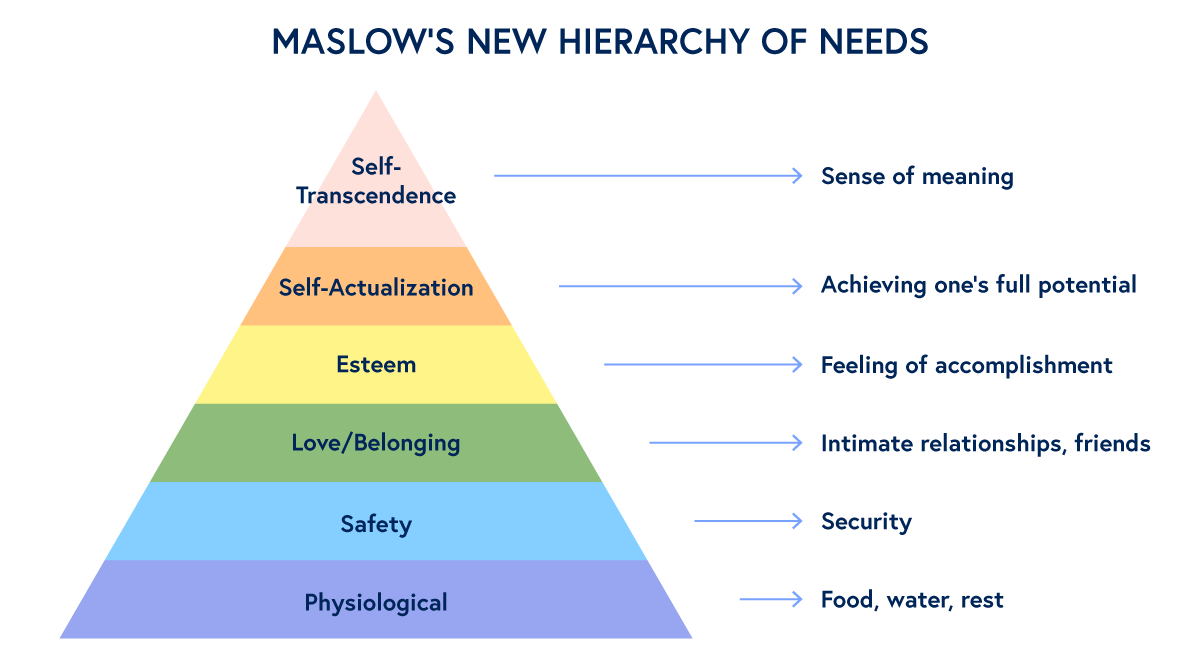
This is why people can look great and successful on the outside, rich and famous, but still feel deathly hollow and void inside. They’ve fed the lower basic physical needs abundantly but neglected and starved the more important needs of their souls and spirits.
Deep in our brain, in a part called our hypothalamus, is the ancient circuitry that ensures we fulfill two types of needs: survival and meaning.
For our survival, we seek and fulfill our hunger, sleep, shelter, tribe and sexual mate. It is deeply embedded and our default. It focuses on our physical well-being. It focuses deeply on the short term. It doesn’t care about meaning, fulfillment or legacy. It cares about now. Instant gratification.
But once these basic needs are fulfilled, the higher needs for meaning, purpose, and transcendence are activated. The rest of the brain, then, is alerted to plan, inhibit impulses, delay gratification, learn, reflect, and choose values over cravings. This is the battle between your higher and lower needs.
Who do you become? A person fulfilling the lower needs, and when is enough enough?
Or do you focus and become intentional on fulfilling your higher needs as well?
If you don’t train the “become your higher self” now, then when will you?
When will you look fit enough? When will you have enough money? More cars? More houses? More purses? More shoes? More clothes? More bicycles? More games? More friends? More followers? More …
My New Year Framework
There are only a few things that really matter in life. The rest is dressings.
Dr. Kevin Ham
I thought over the decades about what really matters in my life, and as I read the autobiographies of people I adored, I felt that some things really stood out. Faith, family, friends, finance, fitness, fears, fun, future, and education. As I am now 55, I like simplicity, as Franklin did. I’ve narrowed my own framework down to three main essentials: Health, Wealth and Meaning.
Health: our capacity to live and function to our full potential.
Wealth: our capacity to choose what would fulfill our full potential
Meaning: our capacity to endure despite hardships and setbacks, and to matter
And with each of these pillars, I train in four dimensions:
Physical. Intellectual. Emotional. Spiritual.
This is not just my philosophy, but my operating system.
Health is my energy, resilience, recovery, clarity, and calmness of mind.
Wealth is more than just money; it is my optionality, skills, judgment, and integrity.
Meaning is my responsibility, love, service, and legacy.
So, with health, wealth, and meaning in four dimensions, that gives me 12 dimensions. There are 12 months. 12 is a magical number. Jesus had 12 disciples. If each of them had 12 disciples, that would be 144. Add the original 13, and that makes 157, which is around Dunbar’s number, which is what he determined as the cognitive limit of how many relationships we could maintain. So we have a lot of capacity to do a lot, but 12 is the basic number to start.
I’ve advanced to the point of not only doing these 12 dimensions one pillar at a time. I’ve started to train like this is endurance training, month after month, year after year.
Sometimes you are running a marathon, one focus: running. One domino. Simpler and doable.
Then you can advance to a biathlon: running and biking, both in parallel. And then the next level is to do a triathlon: run Health, Wealth and Meaning, training at the same time.
The most advanced is the decathlon, a training program for 10 events. Wow!
I like to do the triathlon as I believe in training my whole being, my whole body, my whole mind and my whole spirit. Holistically.
Otherwise, if you only train a specific set of muscles, your body can get lopsided. Same with life. You can build wealth, as I have, but lose health. You can build health and lose meaning. A triathlon approach helps keep me balanced.
But to start, you should focus on your most constrained pillar. Right now, mine is the physical health of the eye and heart vessels. I am getting them to a safe level so I can focus on my next constrained pillar: my spiritual health. Meanwhile, I am still doing my Wealth pillar.
My Challenge to You: Your 30 Min Plan
Set a timer for 30 minutes.
Sit down with a blank page. Write one thing for each of the 12 dimensions below—one practice that, if it grew this year, would genuinely fill your body with energy, your mind with clarity, and your soul with peace.
Copy this:
HEALTH
Physical: ______________________________
Intellectual: ___________________________
Emotional: _____________________________
Spiritual: ______________________________
WEALTH
Physical: ______________________________
Intellectual: ___________________________
Emotional: _____________________________
Spiritual: ______________________________
MEANING / PURPOSE
Physical: ______________________________
Intellectual: ___________________________
Emotional: _____________________________
Spiritual: ______________________________
Then choose your training mode for January:
If life is heavy, run a marathon: pick one dimension and win it for 30 days.
If you’re stable, run a biathlon: two dimensions, simple and consistent.
If you’re ready, run a triathlon: one from Health, one from Wealth, one from Meaning—small reps, daily, compounding.
The goal isn’t a perfect year. It’s a year you became intentional. A year where the person you become by December feels like a quiet miracle. Built, not wished for.
My New Year Plan
And now I’ll end where I always end: with my own plan—my current “training block,” my first dominos, my triathlon set for this year.
Here’s my New Year plan:
Ah, I have to run to a lunch meeting, so I’ll continue this next week, along with my new year plan (not sure how many are interested in seeing my plan and if it might be helpful for you).
If you think it might, reply and let me know.
Ease the Heartache of Loved Ones
Please forward my newsletter to your friends and family and ask them to sign up.
I’d love to help a lot of people prevent, reverse, heal and ease the suffering of disease.
You’ll find these articles insightful and helpful as well:
Life-Changing Question
Who do you wish to become by unlocking your heart’s full potential?
Next issue:
Implementing Your New Year’s Plan
Becoming Yourself as You Dream
Subscribe to my Compounding Wisdom newsletter and start transforming your life.
Strategy of Breakthrough for Health and Wealth
Just 5 Principles for Remarkable Growth and Renewal
Just 5 Principles for Remarkable Growth and Renewal
I was having dinner with my daughters' friends, eager in their 20s to find their way in the world. Some are applying for jobs, have just started a job, or are thinking about starting a new business. I asked them what business, and they started explaining it with excitement and hope. I asked them when they were going to start—a long pause. "I am working on a 20-page document detailing how I would do it."
I told them that because I was doing a medical residency and had very little time, I had to build my first business very simply. That was a very great blessing. My time and skills were very constrained and limited. I had never taken a business course in my life, nor any technology or computer science courses. I quit the arts in Grade 8, so I wasn't very creative.
My business plan was just half a page. It was so simple that I could execute it in little time and hyper focus on it.
I envisioned the internet equivalent of the Yellow Pages —a book listing all the types of businesses in a city. I would have to start with just one page of the Yellow Pages to make it easy for me to build. I chose Web Hosting companies because I imagined the large number of companies that would need one to host their online businesses.
I didn't have time to build an app, so I decided to find an existing application I could modify and add to. I found one, Links SQL, and decided to learn the computer language it was written in, as I couldn't afford a programmer. During my time on call as a medical resident, I learned the basics of PERL and started coding a review and rating module for the program. I thought that many other people who bought the app would want this review module. I would offer it for free and, in turn, ask them to add their web hosting company and review it. This is how I would garner hundreds to thousands of reviews, and other people would come to read them. It was a very early version of Yelp (which is an abbreviation of Yellow Pages).
It worked. I got thousands of visitors and eventually advertisers. I then added the next business category: Domain Name Companies. I was generating $25,000 to $30,000 USD per month as a medical resident on a meagre salary of $45,000, with on-call duties twice a week. (I still have a bit of PTSD from my pager, which beeped every time there was an emergency call. I don't check my voicemail and don't like responding quickly to texts and emails as a result.)
I had seen a domain sell for $7.5 million: Business.com in 1999. I thought to myself that my goal was to make enough money so I wouldn't need to practice medicine for financial gain. One domain like that, and it would be more than I could dream of. This was a new type of real estate: virtual real estate of the burgeoning Internet.
This led me down the path of discovering the secret of how domain names became available when they weren't renewed. I discovered a precious way of acquiring valuable domains for as little as $8 in 2000, during the dot-com crash. To achieve this, I stopped working on my first business and focused exclusively on domains. It took a while to figure out the domain name system, but that barrier to entry limited the number of competitors in the race to acquire and register these domain names. An opportunity of a lifetime, for which I put my medical dreams to cure disease on hold... Until now. Thank God. And I am so grateful for each disease I have and for those who are determined to cure their own with my guidance.
I realized that building a business was essentially a process of experimentation guided by a handful of principles and uncovering insights that others had yet to discover.
I had used the scientific method (hypothesis, assumptions, design experiment to test assumptions, gather data, analyze data, conclusion of results to affirm or deny assumptions and hypothesis). It was the only thing that I knew and made sense. I had a specific goal with a specific time frame. I would ponder how to accelerate this goal and its results by constraining time, money, and processes. How can I accomplish this in one day, rather than one month or one year? How can I accomplish this on my own with limited technical skills?
This forced me to be creative and plan 2-3 experiments. I drew out my business model in 3 steps, which I call the Flywheel now.
The book "The Lean Startup" by Eric Ries describes this scientific method for building a business beautifully and simply. He advises to "Start small, start now, learn fast."
As I explained how to design their business simply, I thought a newsletter that showcases the five simple principles and the books that describe them would be very powerful for entrepreneurs looking to start a business.
So here it is.
1. Flywheel of Breakthroughs
From Growing Wealth to Health Renewal
Greatness is not a function of circumstance. Greatness, it turns out, is largely a matter of conscious choice and discipline.
Jim Collins
When you get it right, the wheel turns itself.
Jeff Bezos
When Jeff Bezos drove across America from New York in 1994, leaving his cushy Wall Street job, he did not really know which city he would arrive at. Somewhere in the Pacific Northwest. Why? He had a great vision of an online marketplace that sold everything. But that vision was too large to begin with. So he chose to start with one category first. He constrained his vision to just one thing, but also thought about how he could expand it category by category. First, he would need to choose the one that had the most promise and could scale the fastest and easiest.
He chose to start with building the world's largest bookstore. Bookstores were limited by their physical stores; they had to have multiple locations and hold a large amount of inventory. How could he strategically leverage these weaknesses using the Internet?
He found the biggest distributor of books in Portland. But there weren't many programmers there. Programmers were plentiful in San Francisco (Silicon Valley) and Seattle, largely due to Microsoft. Seattle was just a short 3 hour truck drive away. He decided Seattle would be home to his new business Cadabra.com, like magic. But people thought the name sounded too much like Cadaver so he thought switched to Relentless.com and registered the domain that still points to the name of what we know as Amazon.com. Named as a metaphor for the great Amazon jungle and river, and also because, like Steve Jobs, he liked that it started with the letter 'A', which would list it at the top of the page, in business directories like the Yellow Pages.
He sketched his business model on a napkin, after hearing a talk by Jim Collins, who wrote a book called 'Good to Great' describing the Flywheel Principle as the relentless growth of a business due to consistent small pushes in one direction that pushed each step like a gear and with each rotation of the Flywheel, would grow larger and larger.

He later added Prime membership (more convenience, faster checkout)
He thought about the question: "What three things will never change?" as the Internet changes almost everything. This question becomes even more pertinent in the age of AI, a more exponential force.
The power of the Flywheel is in its power of increasing momentum, linking cause and effect into a virtuous loop.
This not only applies to business, but to almost everything that you wish to improve or grow. It may be the most powerful concept you can train yourself to think and apply to what you do.
I’ve applied this Flywheel concept to health, as the CAST Flywheel, in honour of the cast that protects the body to allow it to heal itself.


For each step in the Flywheel, assign it an objective and the desired result or goal. This is called the OKR. O is Objective, and KR is Key Result. This is what the brilliant John Doerr talks to the entrepreneurs he invested in. Doerr was a giant in the Venture Capital world in Silicon Valley, funding Intel and learning this method from the founder and CEO of Intel, Andy Grove, who describes it in his brilliant book "Only the Paranoid Survive." Doerr went on to mentor two young Stanford Ph.D students who dreamed of creating a great company by building a simple search interface. Google implemented the OKR system as it was simple and scalable as the company grew. This concept is described in the book "Measure What Matters" by Doerr, who states, "We must measure what matters most."
2. 80/20 Principle
The Fractal Law of Leverage
The aim of sociology, as of every science, is to discover laws of phenomena and apply them to practical problems.
Vilfredo Pareto
Few things really matter — but those that do matter enormously.
Richard Koch
80/20 isn’t just a rule. It’s the law of cause and effect in everything you do.
Perry Marshall
In 1896, Italian economist Vilfredo Pareto noticed something unique: 20% of the pea pods in his garden produced 80% of the peas. He found this same pattern in wealth: 20% of people held 80% of the land.
Richard Koch then expanded on this in his book, "The 80/20 Principle," a brilliant application of the 80/20 principle.
80/20 Truth:
20% inputs or cause gives you 80% outputs / effect:
20% of 100 tasks account for 80% of the results.
Focus on the 20% and neglect the 80% that yield only 20% of the results.
Perry Marshall then described, in his simple yet remarkably insightful book, "80/20 Sales & Marketing," how there is an 80/20 principle within each 80/20 principle. This is known as a fractal pattern. 80/20 was fractal! A breakthrough insight that could powerfully leverage the 80/20 Principle.
Fractal Truth:
80/20 repeats forever
20% of 20% (4%) creates 64% of the results.
20% of 4% (0.8%) creates 51% of the impact.
Key Learning:
A few inputs always drive most of the output — and the pattern keeps repeating.
Your job is to identify the high-leverage nodes and amplify their impact.
Business Example:
20% of your products create 80% of the profit.
20% of your clients generate 80% of your referrals.
Focus on those and build your Flywheel around them.
Health Example:
Approximately 20% of your lifestyle habits account for 80% of your overall vitality.
Diet is the core 20% giving you 80% health. Remove obstacles and friction here — your health accelerates quickly.
The remaining 20% of your health comes from sleep, fasting (rest from eating), movement, and gratitude.
3. The Golden Domino
The Tipping Point of Transformation
What’s the ONE Thing you can do such that by doing it everything else will be easier or unnecessary?
Extraordinary results are directly determined by how narrow you can make your focus.
Gary Keller
The Tipping Point of Transformation
At Domino Day 2009 in the Netherlands, the first domino toppled 4,491,863 other dominos. The key was alignment; each domino was perfectly spaced to transmit its falling momentum, creating a chain reaction.
In business, this "Golden Domino" is the one domino that triggers all the rest. The Golden Domino is the one thing that a 20% domino gives you 80% results.
For Amazon, it was cash flow velocity that resulted from receiving payments from its customers 45 days before it had to pay its book publishers, creating a large cash float that it could use to grow its business.
Gary Keller, in his book 'The One Thing', illustrates a masterful concept that builds upon the Domino effect, where the first domino knocks down a second domino that is 50% taller, creating even more momentum.
If you start with just a 2-inch domino, how many dominoes do you need to knock down to reach the height of the Eiffel Tower, or Mount Everest or even to the Moon?
Any guesses?
Eiffel tower - just 23 dominos
Mount Everest - just 27 dominos
The Moon - just 31 domino

This is the power of compounding, exponential growth.
The One Thing book is asking you to focus on this one Golden Domino that can knock down a series of larger dominos that you determine.
In health, my one thing looks like this:
My Golden Domino was to stabilize and stop plaque growth. Accomplished.
My 2nd domino was to reverse plaques and regress them back to nothing. I already reversed plaques in my neck carotid arteries in 3 months. I hope to accomplish this within 18 to 30 months.
My 3rd domino was to accelerate this reversal by adding strategic fasting and HIIT exercise. I am hoping 12 months to 24 months.
My 4th domino is to figure out how to reverse calcified plaque, which is deemed impossible. May the Lord give me wisdom to do so, amaze the world, and help a lot of people. I am researching decalcification and reverse cholesterol transport.
My 5th domino - which I deem much easier than Domino 4 - is to adopt a whole food diet, eating the foods I love (seafood, pizza, ice cream, burgers, hot dogs) that nourish my blood vessels and eyes and help prevent disease. I've researched this extensively in the past. It works well when there is no disease, but with my specific conditions, I need to target my diet to reverse the disease. Once reversed, I can maintain my wholesome health.
4. The Theory of Constraints
The Bottleneck Determines the Speed
The goal is not to make money. The goal is to increase throughput while simultaneously reducing inventory and operating expense.
Eliyahu Goldratt
In the 1980s, an Israeli, descended from a long lineage of Rabbis, decided to apply the principles of physics to business. Dr. Eliyahu Goldratt wrote The Goal, a business novel that described how a group of young Boy Scouts, tied together, was constrained by the slowest one, and how this one constraint slowed productivity in the factories. He later showed that this also applied to organizations. In fact, it applies to anything that involves a process.
Goldratt taught that every system has one primary constraint — the slowest step that limits the entire process.
Improve that one bottleneck, and the whole system flows faster.
Then, remove the biggest constraint, as a faster flow reveals the next constraint. Think about and conceptualize each constraint in succession, and design a plan to remove each of these constraints, optimizing for global system constraints, rather than local optimization.
Examples:
In a manufacturing plant, the bottleneck might be a single slow machine.
In a business, it might be cash flow, decision-making, or the founder's time.
In terms of your health, it may be due to inflammation, insulin resistance, or sleep disturbances.
Key Learning:
You don't need to fix everything.
You need to fix the one thing that is the biggest constraint and limits the flow of everything else.
Application:
In the body, the constraint is usually due to metabolic bottlenecks, such as impaired circulation or mitochondrial fatigue. Remove it through fasting, nitric oxide foods, and oxygenation, and the system accelerates.
Just as Amazon freed cash flow by getting paid before paying vendors, your body can free energy flow by burning stored fat before refueling.
Of the many books written by Eli Goldratt, the one I really enjoyed and put in my Top 5 books is "The Choice." He wrote it in the last months as he was dying from cancer. It's his swan song to the world, but because his first book, "The Goal," is a Top 150 bestseller of the modern era, The Choice has fallen into the shadows.
5. Time & Money Constraint Exercise
The Catalyst of Innovation
When you have no money and no time, you cannot help but be creative and innovate.
Dr. Kevin Ham
In 1957, Walt Disney faced bankruptcy while trying to finish Sleeping Beauty, a project upon which he had bet his entire company. So he imposed extreme time limits, forcing creative breakthroughs. This extreme time constraint became creativity.
In Business:
When Bezos needed cash flow early, he couldn't wait 90 days for supplier payments.
He made a rule: receive cash from customers immediately, pay suppliers 40 days later.
That time constraint turned into Amazon's cash flow flywheel.
Elon Musk applies this exercise by devising a 5-step algorithm, which is essentially a combination of the 80/20 principle and constraints.
Question all requirements and remove the ones that don't make sense. Base it on first principles, rather than tradition or habit.
Delete what's unnecessary: Remove the steps, processes, people or tasks until you are required to add 10% back (cheaper)
Simplify & Optimize: Improve the quality (better)
Accelerate cycle time: Speed it up (faster)
Automate it (easier)
In Health:
Time constraints force the body to innovate too — it's called fasting.
When deprived of calories, your body turns on autophagy, recycling damaged cells and regenerating new ones.
Key Learning:
When you compress time, inefficiencies are revealed.
When you compress assumptions, you discover the truth.
Ask yourself:
"If I had to achieve this in 1 day, 1 week, 1 month, 3 months, what would I do differently?"
Plan and design an experiment that can be completed in no more than 3 months. The smaller the time constraint, the better, as you will learn a lot before you make big mistakes.
Do this for each constraint (time, money, resources), starting with the extreme time constraint: If I had to achieve this in 1 day, what would I do?
Now do the same with money, even if you have enough money.
Now do the same with resources, even if you already have enough.
If I had to do it myself, how would I do it?
If I only had one other person, how would we do it?
Think of all the innovations by small teams, like the Wright Brothers, Einstein.
Larger teams often spend more money, take longer, and have poorer results.
The Flywheel of 5 Principles
What if you made these five key principles a flywheel in every essential facet of your life?
Dr. Kevin Ham
This is what nature does: it flywheels every aspect of itself to grow wild —bacteria, viruses, plants, and creatures all flywheel life. Humans, in their drive for growth, can wreak havoc on the Flywheel of life, instead turning a virtuous flywheel of life into a vicious cycle of death.
As we transform the nature of light, air, water, food, and rest into things that are convenient, cheap, and fast. Using these very principles, we create systemic disease within ourselves and the natural world around us. Who will win? Mankind has set in motion the Flywheel of disease and destruction.
But we can reverse disease and destruction if we turn back to nature and the powers that lie dormant and hidden in nature and in us. This is the deep, hidden mystery that lies locked within us. Unlock it and leverage it and let the first golden domino within you start to create and innovate.
Reflection
Just a handful of powerful principles set up as dominos can change the world.
Dr. Kevin Ham
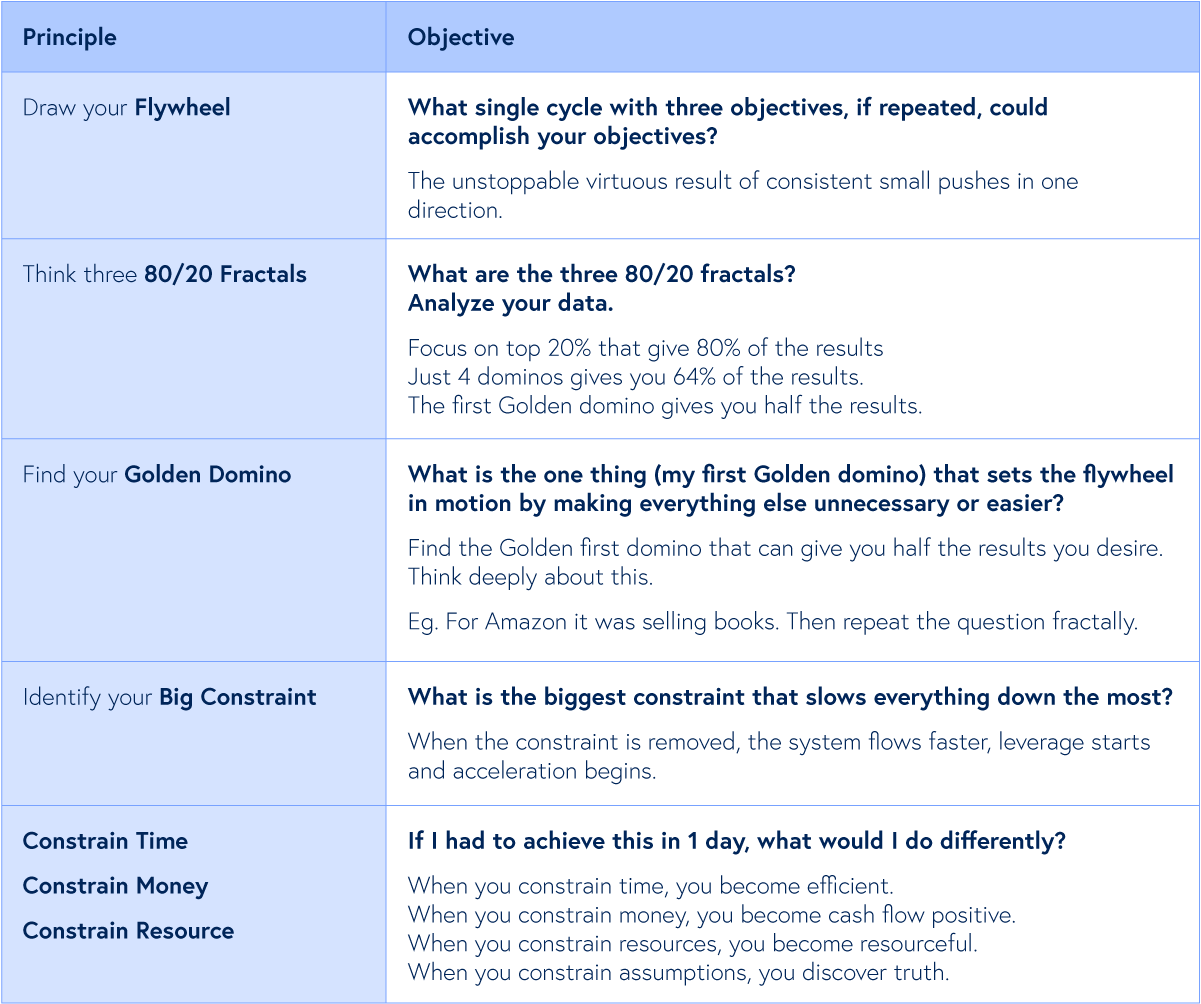
Above is the Flywheel of Flywheel Principles. This is the power of principles. They span industries across business and life. Just as there are only 12 notes for all music, 3 primary colours that make up all colours, and just a handful of principles for you to practice and apply to every facet of your life, starting from thought to plan to action, leveraging your mind can result in great outcomes. At first, it is hardly visible as you knock down the first golden two-inch domino, but as each larger domino falls, flywheeling stronger and larger and gaining momentum, it becomes self-propelling.
This is the power of momentum and the power of life.
These invisible principles power all of life.
Newton discovered its simple formulas. F=ma describes the formula for all Forces.
Einstein discovered the power of energy. e=mc2, describing energy proportional to mass and the speed of light, a constant 3 with 8 zeros m/s.
What simple formula will you unlock in your mind as you think, plan and execute your thought experiments in health and wealth?
The same laws that built Amazon can rebuild a body.
The same constraints that stall a company can stall cancer cells.
And the same 80/20 fractals that create wealth can rejuvenate health.
Your job is to design your flywheel, remove the bottleneck, and tip the golden domino.
Ease the Heartache of Loved Ones
Please forward my newsletter to your friends and family and ask them to sign up.
I’d love to help a lot of people prevent, reverse, heal and ease the suffering of disease.
Life-Changing Question
What flywheel can you design for your health or wealth in one day?
It should fit on one sheet of paper, preferably on half the paper.
And how can you start executing it in one day?
Appendix:
Books That Power the Flywheel of Breakthroughs

Next week—
The Power of Fasting (Part III)
Fasting to stress cancer
Subscribe to my Compounding Wisdom newsletter and start transforming your life.
How to keep thinking while leveraging AI
How to keep thinking while leveraging AI
How to keep thinking while leveraging AI
The Mind of AI
The real problem is not whether machines think but whether men do.
B.F. Skinner (psychologist, 1960s, on automation and memory)
We know we have five physical senses of the body: Sight, smell, hear, taste, touch and feel.
But what of the senses of our mind and the senses of our spirit?
I was often confused as to what my mind was. The psyche. The soul.
Later, one of my mentors outlined that the mind consisted of six major faculties.
Memory
Reason
Perception
Imagination
Intuition
Will
He said that if we focused on each of these and developed them, we would have very powerful minds. I have been focusing a lot of my time on these six faculties of the mind and also on what I deem as the seven faculties of the spirit.
Humans have dominated the world of nature due to our powerful minds and powerful spirits, but now we have developed a technology that is surpassing us in each of these faculties one by one and by great leaps and bounds.
We call this AI. And AGI, Artificial General Intelligence, is an intelligence that surpasses us in all of these faculties in all categories and in all subjects. Many believe this is not a question of if, but of when.
AI has already surpassed us in memory, is quickly advancing in reasoning and perception and excelling in quantum leaps in imagination and creativity. Its intuition is much weaker, and its will is still bound by human programming and guardrails. Many are concerned that it will eventually develop its own will and determine a dystopian future, using all its destructive capabilities to rid the world of humanity's malicious and fallible intent.
The End Has Already Been Prophesied
The development of full artificial intelligence could spell the end of the human race.
Stephen Hawking (2014)
Since 2000, I have been pondering when this age of AI would come as I watched the internet boom and bust and left my medical profession to focus on becoming an Internet entrepreneur. I spent the past 25 years watching the Internet, mobile and blockchain (crypto/Bitcoin) revolutions form and burgeon. With the launch of ChatGPT in November 2022, I knew the time had come for AI to take off.
In 2007, I placed a $6 million bet on semantic search, but it was much too early. We were trying to teach computers to 'understand' meaning, not just match keywords and allow people to program visually without code. The vision was right, but the timing was too early, as the computing power was too small, slow, and too expensive.
In 2016, I decided to give AI another try, this time in the form of a mobile piano teaching app. It could perceive your notes, reason about mistakes, and turn the pages of the music as you played, highlighting each piano note as it heard. Still, it was a little too early again. One of our interns, Aidan Gomez, is now CEO of Cohere, a company valued at $6.8 billion.
In 2018, I asked myself, which companies would be central to the development of AI? What microchip company? Intel, ARM, AMD, Nvidia? I knew that the AI revolution would be powered not just by ideas, but by computational power. In other words, microchips and AI software, followed by AI hardware, such as robots, vehicles, appliances, and consumer products. I decided it would most likely be NVIDIA due to their GPUs (graphic processing units), which were already big in gaming and mining, the most popular application being blockchain crypto Ethereum, and were being used by AI, such as OpenAI, which would debut ChatGPT just four years later in 2022. I sold 80% of my Google stock, which had grown in value after I placed a $10,000 bet on NVIDIA in 2006. This investment, which had 20x'd in 12 years, was now reinvested in NVIDIA, yielding a 30x return in just 7 years. So, my $10,000 in 2006 has grown 600 times in 19 years, to roughly $6 million. It was more about placing a bet on my first principle thinking in investments than about my desire to make a lot of money.
In 2024, I founded How.com with my co-founder Aytunc Ozturk. I owned all these valuable domains and had many friends who owned valuable domains, but these assets were sitting idle on pay-per-click advertising pages. It was like seeing waterfront properties with nothing but little sheds on them. We prototyped one of my domains How.com, with AI and I invited 100 of my friends to invest in it. 80% were on board, and we raised $8M with $2M in warrants. We then entered into deals with our domain investors to prototype and develop their most valuable domain properties using our AI infrastructure. This resulted in the development of Email.com, Face.com, Songs.com, Notebook.com, and Queen.com. We are creating an AI ecosystem, a network community of skyscraper intelligence on the prime real estate of the Internet.
How did I know about AI 25 years ago?
I'm an avid reader of the Bible and in the book of Daniel and Revelation, it speaks of the coming end of the world, even though it was written thousands of years ago. I knew that there would be digital currency aka blockchain = crypto currency. But blockchain is also a platform upon which trusted secure transactions can be built upon. And the concept of an image speaking alluding to AI is prominent as well, where souls are bought and sold.
“Also it causes all, both small and great, both rich and poor, both free and slave, to be marked on the right hand or the forehead, so that no one can buy or sell unless he has the mark, that is, the name of the beast or the number of its name.”
Revelation 13:16–17
The Exponential Growth of AI
Within a few decades, machine intelligence will surpass human intelligence, leading to the Singularity.
Ray Kurzweil (futurist, author of The Singularity is Near)
When you build a house or a product, it's said that you can't have high quality, speed, and low cost. You have to choose two, but you must sacrifice one of them. However, with AI, quality and speed are increasing exponentially, while costs are declining profoundly.
Compute power: doubling every five months or 4x per year. This means it will be 1024x in five years from now.
Costs have fallen 280x in two years. Hardware costs are declining at a rate of 30% annually, and efficiency is increasing by 40%. The rise of competition and the race to achieve AGI by companies and countries has led to massive investments and intense competition, resulting in competitive pricing.
Quality: Benchmark leaps are staggering. Coding, reasoning and multimodal scores double or triple in a year. The neural network is akin to a massive brain, with information being fed into it and its capabilities massively expanding with computing power as the industry grows and competes. It's demanded by the global populations and companies feed it endlessly and develop it.
Over the next five years, the exponential growth of AI will transform every industry, company, person, occupation, and the way we learn and do things. Most digital workflows will be AI-augmented or replaced by AI. In ten years, intelligent agents will run entire business units autonomously, as well as autonomous machines like vehicles, robots and devices.
Jobs: Destruction vs Creation
AI is creative destruction. It will transform industries, countries and people.
Displacement: Knowledge industries, clerical, routine and entry-level analytical roles are most vulnerable.
Creation: new fields of AI trainers, data curators, robotics engineers and human-AI managers.
By 2030, estimates show that +170 million jobs will be created versus -92 million jobs lost, resulting in a more productive workforce.
The danger is not job loss, but falling behind without reskilling and failing to leverage AI to enhance research and productivity.
I leverage AI a lot. I find that I need to think more to assign tasks to AI on my behalf, and then I can have a conversation with it to discern what is true, possible, or false.
The World Transformed
AI is the new electricity.
Andrew Ng (Google Brain, Coursera, Baidu)
Tesla touts that robots will be the most significant industry. Greater than the iPhone, which catapulted Apple to the #2 company behind NVIDIA. Tesla is a trillion-dollar company right now. It could be worth $10 trillion or more in the next ten years if it takes a lion's share of the robot industry. First deployed in industry, companies, and personal households. They will have AI inside, and this AI is like a nervous system that powers the hardware to be stronger, faster, and cheaper - again, the three levers that make it exponential and useful to the world and people. As more mass-scale developments occur, such as with the automobile and the mobile phone, costs decrease, allowing every household to own one or two, or even a handful, just as we have with cars. 100 years ago, only the wealthy could afford a car, but Ford democratized that. Tesla democratized the electric vehicle. They aim to create and democratize the robot.
Autonomous vehicles will transform transportation and logistics, along with shipping, just as Uber did, but on a much grander scale. Waymo, run by Google, logs 250,000 paid driverless rides per week. Baidu's Apollo Go did 2.2 million driverless rides last quarter.
ChatGPT had 1 million users in 5 days after it was launched in November 2022. Today, it has 700 million weekly active users. It is the #1 app worldwide. It's only a matter of time; it has 1 billion daily active users, and then 2B and growing.
There are its competitors who are trying to follow quickly. Google's Gemini, whose engine is quite good, and which Elon Musk predicts will most likely win in AI. Anthropic by Claude and backed by Amazon, Microsoft, which owns a good stake in OpenAI, the parent company of ChatGPT. Meta. And of course, Elon Musk's xAI, who is the most brilliant of our age. He built a 100,000 AI server farm in 19 days. This typically takes 3 to 5 years. The CEO of NVIDIA, Jensson Huang, says this is impossible and that only one person on our planet could do something like this. He has two other AI companies: Tesla, which is an AI car company, and SpaceX, where its rockets utilize AI.
But the real cold war of our time is which country will build the AI that everyone uses. US or China? In China, Alibaba, Deepseek, Baidu, and Bytedance (the owner of TikTok) are all vying to catch up, and they are moving quickly. The US has been trying to slow them down by not allowing them to buy the best AI chips from NVIDIA, but they are resourceful and, with slightly slower AI chips and with much lesser costs, they are innovative and leaping forward despite these speedbumps.
The world will become like the world of The Jetsons in due time.
How You can Leverage AI
We must develop AI with a sense of humility, knowing it can uncover patterns invisible to us, yet also mislead us if we treat it as omniscient.
Fei-Fei Li (Stanford, pioneer of computer vision)
Imagine what it would be like when AGI becomes accessible, and you have access to it. It will be more intelligent than all the world's combined doctors, lawyers, accountants, business consultants, psychologists, counsellors, and so on. How will you leverage this access?
Now (next 6 months):
Automate your tasks: research, organization, clerical and administrative tasks, translations, consultations.
Automate your front office: leverage AI for efficient intake, onboarding, and customer support.
Accelerate creative production: writing, ideation, production, such as writing drafts, proposals, transforming your business, ads, videos, and landing pages at 10x speed
Capture your proprietary data: this becomes your moat
Next (6-24 months):
Build AI-native product features for yourself or your company using AI, as it can now code, design, and market, and is improving rapidly.
Pilot physical autonomy (logistics, mobility)
Reskill yourself and your team from task-doers to AI supervisors of AI agents/apps.
Later (2-5 years):
Run multi-agent workflows as "AI departments"
Leverage edge AI everywhere that is latency-free, private, and on-device)
Establish governance as AGI levels emerge
Reflection
As soon as it works, no one calls it AI anymore.
John McCarthy (Father of AI, coined the term “Artificial Intelligence,” 1956)
I've been investing in AI for nearly two decades- sometimes too early, sometimes just right. AI is now mastering the six senses of the mind. The question is no longer if, but when.
The winners will be those who leverage AI and act early, build moats and reskill quickly.
And the true gift is that leveraging AI will enhance your and your team's productivity 10x, 100x, or more. This time can be used to develop your own faculties of the mind, such as memorizing, reasoning, perceiving, imagining, intuiting, and developing your own will.
And also to focus on the seven faculties of the spirit that are the source of a person's being and power, and focus on the long-term, purpose, meaning and love.
Life-Changing Question
Circumstances and events are the outward expressions of inward thoughts and aspirations.
James Allen - The Mastery of Destiny, 1909
With AGI approaching,
Am I using AI to amplify my humanity - or am I letting it replace it by relegating the faculties of my mind without thought to AI?
That one question reframes everything:
Memory: Am I outsourcing my memory to machines, or using AI to remember better and free my mind for wisdom?
Perception: Am I letting algorithms shape what I see, or am I leveraging AI to perceive hidden patterns and truth?
Reason: Am I trusting AI to think for me, or partnering with it to expand my reasoning?
Imagination: Am I passively consuming AI creations, or using it to multiply my creative reach?
Intuition: Am I dulling my own instincts, or sharpening them with AI as a second lens?
Will: Am I surrendering autonomy to machines, or directing AI with human purpose and conviction?
Next week—
My Remarkable Heart Disease Results in Just 3 Months
How I went from a vascular age worse than a 85 year old to a normal 55 year old in just three months
See you next Thursday!
Subscribe to my Compounding Wisdom newsletter and start transforming your life.
The Power of Serenity in a World of Noise
How Practicing Serenity helped me go from Anger to Peace
How Practicing Serenity helped me go from Anger to Peace
The Jewel of Serenity: A Legacy of Wisdom
You will become as small as your controlling desire; as great as your dominant aspiration.
James Allen - From Passion to Peace, 1910
In 1903, James Allen published As a Man Thinketh, a short book on Thought and its effect on life that has transformed millions of lives for over a century.
I used to listen to the last chapter, Serenity, recited by my mentor Bob Proctor, every single day.
Then, on a call with Bob, he challenged me to write down Serenity for 90 days in a row.
At first, I was perplexed. Why spend all that time (it takes around 20 minutes) writing it when I could listen to it in 3 minutes? It's only 7 paragraphs long.
Bob's answer was profound:
"Because writing activates all parts of you - your body, thoughts, emotions and spirit."
That truth struck me, and I said, "Yes, I will do it."
He asked me to let him know how it changed my life after I completed the task.
By day 45, I had the passage memorized as I wrote it. From then on, every morning I recited it aloud as I wrote it. I then asked my executive team to do the same. We had lots of internal issues. Some grasped it. Others did not. My older brother said he could not possibly memorize it in a million years. I then asked him to recite it 100 times a day. First, I told him to just recite the first sentence 100 times, record it, and send it to me daily until he had memorized the first sentence.
"Calmness of mind is one of the beautiful jewels of wisdom." Imagine him reciting that 100 times a day. Then moving on to the second sentence, "It is the result of long and patient effort in self-control," and doing this until he completed the chapter--even if it were to take him a million years. The recording was eventually so large he couldn't text it to me. He knew Serenity very well by the end of this exercise. I had another person on our team who also said the same, saying he had dyslexia. I gave him the same task. He was also able to memorize it.
On that call with Bob, he had actually quoted the second sentence of Serenity but I didn't recognize it. I realized then that memorizing or listening was not akin to understanding and seeing and so I tried to connect every sentence and word in Serenity to my life and the world.
My other great mentor Mr. Yoo said it's not that we can't memorize, it's the belief that we can't and the lack of attempting to do so. He said if someone swore at you, you would not forget. Leave the same impression on the things you wish to memorize.
At strategy meetings, I'd ask a random person to recite the first sentence, and then we recite it as we go around the room. This became our creed, especially when the storms of business hit, and instead of panic, we met them with calmness.
Treasures from Serenity
“The more tranquil a man becomes, the greater is his success, his influence, his power for good.”
“Keep your hand firmly upon the helm of thought. In the bark of your soul reclines the commanding master; He does but sleep. Wake him.”
“Self-control is strength. Right thought is mastery. Calmness is power.”
As A Man Thinketh in His Heart So He Is
Men are anxious to improve their circumstances, but are unwilling to improve themselves; they therefore remain bound.
James Allen - The Path of Prosperity, 1907
The Serenity chapter is the crown jewel of the book, but the whole book As a Man Thinketh is a gem. James Allen took a proverb from the wisest king in history, King Solomon, "As a man thinketh in his heart, so he is" (Proverbs 23:7) and wrote an entire book based on this proverb.
I urge you to read, reread and perhaps even memorize and live it. It will be life-changing. I guarantee you, just as Bob knew it for me. Here are a few key lessons and big points from each chapter, along with an unforgettable quote you can memorize.
1. Thought and Character
You are what you think — character is Thought made visible.
Noble thoughts build strength; base thoughts weaken.
Thoughts cannot be hidden; they shape destiny.
“A man is literally what he thinks, his character being the complete sum of all his thoughts.”
2. Effect of Thought on Circumstances
Circumstances don't create the person; they reveal him.
The outer world mirrors the inner world.
Change your thoughts, and you change your life.
“Men do not attract that which they want, but that which they are.”
3. Effect of Thought on Health and the Body
The body obeys the mind.
Disease and health both have roots in Thought.
Cheerful, pure thinking preserves vitality.
“The body is the servant of the mind. It obeys the operations of the mind, whether they be deliberately chosen or automatically expressed.”
4. Thought and Purpose
Thought without purpose leads nowhere.
Purpose provides direction, focus, and discipline.
To succeed, you must sacrifice drifting.
“Until thought is linked with purpose there is no intelligent accomplishment.”
5. The Thought-Factor in Achievement
Achievement is born in Thought.
Victories are mental before they are visible.
Dreamers are the builders of progress.
“Dream lofty dreams, and as you dream, so shall you become.”
6. Visions and Ideals
Cherished ideals shape destiny.
Vision lifts or drags us depending on its height.
Ideals fuel progress and reform.
“The dreamers are the saviors of the world.”
7. Serenity
Calmness is the crown of self-mastery.
Serenity earns trust and respect.
The serene person steadies others in life's storms.
“Calmness of mind is one of the beautiful jewels of wisdom.”
Epilogue
No duty is more urgent than that of returning thanks.
James Allen - Byways of Blessedness, 1904
Earl Nightingale — often called the father of personal growth — always listed As a Man Thinketh among the top three books he recommended.
In 1956, he recorded The Strangest Secret, which went on to sell over a million copies and became the first spoken-word recording to earn a Gold Record. It ignited the modern personal development movement.
Earl mentored Bob Proctor.
And Bob mentored me.
On February 1, I completed my 90th day of writing Serenity. I thought about calling Bob, or sending him a note of thanks. Instead, I told myself: why not go for 100 days?
But on February 3, 2022, I received the news: Bob Proctor had passed away in his late 80s.
I was crushed. I never got to thank him.
So I'll say it here:
Thank you, Bob. And thank you, Earl. May you both rest in heaven.
Reflection
Calmness, gentleness, self-possession, sweetness of spirit, are the beautiful fruits of self-conquest.
James Allen - Above Life’s Turmoil, 1910
The true legacy of wisdom isn't just in the words written on a page — it's in the lives they transform. What began with James Allen's pen in 1903 was carried by Earl Nightingale's voice in 1956, passed through Bob Proctor's mentorship until 2022, and now lives on in the practices we choose each day.
Wisdom multiplies when we don't just consume it — but embody it.
If self-control, anger, and emotional volatility reside in you, will you write out Serenity every day for 90 days in a row? Will you commit it to memory and practice it as you live in this turbulent, tempest-tossed world?
Life-Changing Questions
Circumstances and events are the outward expressions of inward thoughts and aspirations.
James Allen - The Mastery of Destiny, 1909
If my thoughts today are quietly shaping my character, my circumstances, my health, my achievements, and my destiny…
What one thought will I choose to live out my future?
What one thought will I let go of to let go of my past?
Next week—
Knowing in a world of infinite data and noise
How to keep thinking while leveraging AI
See you next Thursday!
Subscribe to my Compounding Wisdom newsletter and start transforming your life.
The Transformational Journey of Self
Self-Perception to Self-Transcendence
Self-Perception to Self-Transcendence
The 7-Self Framework: From Inputs to Outputs
The privilege of a lifetime is to become who you truly are.
Joseph Campbell
I often wondered how great people became great. Abraham Lincoln, despite his difficult youth and many political failures, demonstrated wisdom during the Great Civil War. I read biographies, books on how to be great, and how to be successful. Rockefeller, Disney, Jobs, Frankl, Campbell, Covey, and my favourite, the Bible, which depicts so many great men and women.
I believe 7 to be a very significant number. Our lives are depicted in stages of 7 years. A person of 70 years has typically gone through 10 stages of life. Some merely physical, others journey through the soul and some rarely journey these stages through the spirit.
But in general, there are the seven stages of self, the soul, that we go through, and I have thought and pondered a lot on what these seven stages might be, as I have now lived almost 55 years, nearly eight stages. There are more as we seek to live a wholly transformational life. We see this in nature with seeds becoming plants and trees. Eggs become caterpillars and then transform into butterflies. Humans, too, must transform into the depths of their soul and spirit.
Last time, we looked at the three core inputs that shape your self: self-perception, self-talk, and self-environment. We also looked at the three outputs everyone seeks: Self-confidence, self-actualization and self-transcendence.
But how do we get from these three inputs to these three outputs? How do we transform influence into identity and identity into impact?
We move through the 7-Self Framework- a tapestry of threads that weave your inner transformation.
Your 7 Selves: A Transformational Journey
Each self-journey is a thread in your being that weaves a multi-dimensional you.
1 Self-Awareness
You must know where you are before you can choose where to go.
Joseph Campbell
Self-Awareness: To see yourself so clearly that you no longer live by default but by intention and design. This is your inner mirror. Awareness is the light and self-reflection that breaks the cycle of unconscious living.
Practice: Track your patterns, habits. Journal your triggers. Build consciousness and awareness.
2 Self-Honesty
What is to give light must endure burning.
Viktor Frankl
Self-Honesty: Speak to yourself the candid truth so you can stop pretending and start transforming. It’s having the courage to speak the truth to yourself. Growth begins with unfiltered truth.
Practice: Name one truth you are avoiding and write why it matters now.
3 Self-Acceptance
When we are no longer able to change a situation, we are challenged to change ourselves.
Viktor Frankl
Self-Acceptance: Accept yourself as you fully are with grace and compassion instead of criticism and insults. Let go of your past and start anew where you are right now.
Practice: Starting anew and whisper to your heart, “This is where I begin.” And commit to you.
4 Self-Discipline
The main thing is to keep the main thing the main thing.
Stephen Covey
Self-Discipline: Build a structure for yourself so that your vision has a vehicle to drive in. Discipline is how you build trust with your future self by committing to yourself and keeping your promise.
Practice: Choose and commit to one non-negotiable keystone habit- and honour it daily. This allows you to respect yourself as you do the thing you promised yourself.
5 Self-Compassion
We must let go of the life we have planned, so as to accept the one that is waiting for us.
Joseph Campbell
Self-Compassion: Embrace all your imperfections and love yourself with each of these. Forgive yourself and do not disqualify yourself because of them. Compassion softens the sharp edges of transformation..
Practice: Forgive yourself for one regret- and reframe it as a teacher going forward. Embrace it. It’s your judo move, turning weakness into strength.
6 Self-Giving
The more one forgets himself- by giving himself to a cause to serve or another person to love- the more human he is.
Viktor Frankl
Self-Giving: Shift your focus from self to others. You begin to live from abundance, not scarcity.
Practice: Serve someone today without seeking credit or recognition.
7 Self-Renewal
Sharpen the saw.
Stephen Covey
Self-Renewal: Return to your core so you don’t lose yourself in your service. You protect the well so the water never runs dry.
Practice: Schedule in your calendar a weekly reset-renewal ritual for body, mind and spirit. A time for solitude, review and rejuvenation. The deeper into yourself you go, the better. Fasting helps you in this journey. This is the reason many spiritual faiths have days or times of fasting, so you can go beyond your physical self into your soul and spiritual self.
Life-Changing Question
In the final analysis, the question is not what we expect from life, but what life expects from us.
Viktor Frankl
What am I becoming through how I live today?
What will I be like in 3 months, 6 months, 1 year, 3 years, 5 years if I live like this?
Final Thought
A musician must make music, an artist must paint, a poet must write, if he is to be ultimately at peace with himself.
Abraham Maslow
The 7-Self Framework is not about achievement or performance. It’s about full alignment between your spirit, soul, body and life.
When your inner self is strong, your outer impact becomes effortless.
Start with your core roots.
Live through each of your Selves above.
And you’ll grow and transform into the person who doesn’t just rise, but lifts others up with you.
Next week—
Stillness Within: Practicing Serenity in a World of Noise
How Practicing Serenity helped me go from Anger to Peace
See you next Thursday!
Subscribe to my Compounding Wisdom newsletter and start transforming your life.
How to Know Your True Worth
What are you really worth?
No one can make you feel inferior without your consent
Eleanor Roosevelt
I used to think I was worthless and on the verge of committing suicide as a teenager. Then I asked myself, what would my mother think and feel if I were to do so? That gave me a realization that although my mother was very hard on me, she loved me and would feel devastated. I would ruin her life and most likely shock all of my younger brothers and family. I couldn't do that to them, so I decided to continue living and striving for them.
But I thought to myself, is life worth it?
What determines the worth of a thing and, better yet, a person?
If your self-confidence is derived from your sense of belief in yourself, your self-worth is derived from your feeling of Love for yourself.
What determines worth and value?
I have a dream that my four little children will one day live in a nation where they will not be judged by the color of their skin but by the content of their character.
Martin Luther King Jr.
I spent seven years buying, selling, and leasing premium domains. We spent millions and millions of dollars. Yet some of them are priceless, even though we acquired them at a considerable financial expense.
When I thought about the value of a person, I wondered, what is an eye worth? A kidney? A heart? A brain? The value of each part but also the value of the mind, the spirit as well as the body?
For things, we determine value by one of the following:
Market value - what others will pay
Replacement value - irreplaceable uniqueness gives more value. Eg. a Davinci Mona Lisa painting.
Sentimental value - what meaning, purpose and feeling it gives you
Utility value - what it does for you
Sacrificial value - what you are willing to sacrifice for it, especially used in the Bible to show the value of a person's life. Eg. sacrificial lamb or scapegoat.
In the past, people bought and sold enslaved people based on their utility value. Now, we pay people for their time and the value they provide. People have come to determine their self-worth by how much they earn, their net worth, and the possessions they have acquired.
But is value externally driven like that of goods, or should value be determined by what's inside?
My mentor's daughter, Heather Harnett, had mentioned to me that the company she was working for was worth over 3 billion dollars. I told her she was worth much more than that. I then asked an audience, how much would you sell your child for? A million, a billion? How much are they worth? Sometimes, we forget just how rich we really are when we take a survey of who we are and who we have around us, warts and all.
The 3 Factors That Determine Self-Esteem
You were born with wings, why prefer to crawl through life?
Rumi
1. Temporal Self-worth
Past self: How you view your history, failures, achievements, and growth
Present self: Current self-acceptance, authenticity and living your values today
Future self: Your hope, confidence in your ability to grow and believing you deserve honour, Love and grace
2. Source of Validation
Internal Foundation: Your character, values, integrity and growth
External Foundation: Marked by your possessions, status, achievements, and others' opinions
3. Transcendent Purpose
With a higher being who has unconditional divine Love, eternal worth and a personal relationship for a purpose greater than oneself that is full of Love, abundance and generosity
Without transcendence: relegated to an ego-driven life, scarcity mindset and self-preservation mode
The 10 Commandments can be summarized into two principles:
Love your God with all your heart, soul, and might
Love your neighbour as yourself
Here, the standard is how much you love yourself, which then dictates how much you can love God and the people around you.
Jesus issued a new commandment, "Love one another as I have loved you." The new standard Jesus set was in how much He loved you. He was willing to leave His heavenly kingdom to come as a man on this earth and sacrifice Himself for you in order to make all your sins disappear through His forgiveness. His Love was expressed as Him sacrificing His life and fully forgiving despite no work on our part. That standard of Love He set as how we should love one another. It's an almost impossible standard. We might love like this for our loved ones, our children, but everyone?
So, how is our self-esteem rooted in Love? What kind of Love?
Loves That Determine Self-Esteem
Be yourself; everyone else is already taken.
Oscar Wilde
Self-esteem is rooted in the different types of Love you have experienced and internalized within your heart.
I realized the great sacrifices my parents made for my siblings and me were their expressions of Love. When I realized the great sacrifice Jesus made for me in order to liberate me from my sins while yet holding me to a greater divine standard, I felt an overwhelming love and sense of worth because the Creator loved me unconditionally. When I received Love from my wife, family and children, I experienced a love that was personal, deep and unconditional.
Divine Love: Unconditional Love that is boundless, eternal and glorious.
Parental Love: First experience of sacrificial Love despite many imperfections.
Family Love: Love with rivalry for place, attention and validation.
Teacher & Mentors: The Love and belief they have in you and your potential.
Friends: Love that is accepting, making you feel a sense of belonging and mutual support.
Enemies: The opportunity to practice unconditional Love and forgiveness while also honouring yourself.
The Revelations of Self-Esteem
Self-esteem becomes unshakeable when it is rooted in divine Love and human Love instead of performance, possessions or praise.
Scarcity transforms into abundance when your comparison to others doesn't undermine your worth, their successes and well-being.
Love flows freely and generously when you are rich in Love.
Life Question:
What are you really worth?
You are not your possessions. You are not your body. You are not externalities. You are not others' opinion.
Reflect on who you truly are and who you want to be
Reflect on your dreams
Reflect on how much you love yourself or not and see if you can truly love yourself
Reflect upon a higher being and a higher purpose than what you imagine and dream for yourself
When I conduct this audit of myself, I feel I cannot put a huge number on it because even among my possessions, there are some that I would not sell at any price. Why would I then sell myself short? The laws of need sometimes elevator us down rapidly to a lack of self-worth and desperation out of a need for food, essential goods, shelter and Love.
Next week:
Self-actualizing Who You Really Are
See you next Thursday!
Subscribe to my Compounding Wisdom newsletter and start transforming your life.
Things Determining the Size of Your Wealth
How much do you really want?
How much do you really want?
Every order of magnitude of wealth starts with an order of magnitude of thinking, planning and praying.
In a world of 8 billion people, how many billionaires are there?
The US leads with 902 billionaires, followed by China with 516, India with 205, Germany with 171, Russia with 141, and Canada with 76 billionaires. The top 6 countries accounted for 66% of the 3,028 billionaires worldwide in 2011.
15 billionaires have 100B+ (0.5%)
257 billionaires have 10B+ (8.5%)
2756 billionaires 1B+ (90%)
—-----------------------------------------------------------
Total 3028 billionaires of 8 billion (0.00004%)
29,350 centimillionaires 100M+ (0.0004%)
Based on the above pattern, how many people worth $10M+ are there in the world?
If you guessed 300,000, that would be an excellent guess--add a zero.
The estimated number of high net worth individuals (HNWI) above $10M+ is 2.3 million (0.03%.)
And the number of millionaires is around 60 million people worldwide (0.75%)
613 million adults hold a net worth between $100,000 and $1 million. (7.7%)
So, less than 1% of the world's population are millionaires, and less than 0.03% are decamillionaires, centimillionaires, and billionaires.
This data suggests that it is incredibly challenging to become extremely wealthy. And it's unconventional, as 99% of the world will not become millionaires and beyond. And as wealth increases, it becomes more and more challenging to add that order of magnitude (another 0) to your wealth.
But How Do You Become Wealthy?
Wealth is mostly in your heart, then your head, then in your wallet and then given to others.
Dr. Kevin Ham
As I review the billionaire list, I don't see many people who have achieved this status by winning the lottery. Most of them either inherited wealth (10%), are self-made (61%) or a combination of both. Many deca and centi billionaires are tech moguls. They excelled in one or a few areas and scaled their success globally. Tesla, Facebook (Meta), Amazon, Oracle, LVMH, Berkshire Hathaway, Google, Zara, Microsoft, Walmart, and Bloomberg are examples of how thecentibillionaires made their fortunes.
They rode on a wave of a revolution that scaled. They were leaders and typically pioneers. Google was the 21st search engine, but they did it better than anyone else before them. Then, they compounded their lead by controlling the mobile OS (acquiring Android in 2005), becoming the dominant browser via Chrome, and striking a deal with Apple to power their search (they pay Apple $20 billion each year to be Apple's default mobile search engine).
If you keep going down the list of billionaires, you can see that they were focused on typically one area and built an ecosystem or supply chain around it.
What do Walmart or Costco create? The products they sell are those of other manufacturers, but they have developed a supply chain and logistical system that is accessible and offers volume-priced discounts, leveraging economies of scale. Walmart started in middle America, in small towns, and then expanded into the big cities. Amazon started with a long tail of books and an unlimited, searchable inventory, which made it the world's largest bookstore. It then replicated this model across every other category and leveraged its cloud computing business to build a logistical infrastructure that served its stores and customers.
All of this is fractal, meaning the patterns at the highest level are mirrored at the lower levels, but just on a smaller scale and also at the higher levels at a larger scale.
It's easy to predict who will 10x to the trillionaire level.
I believe that each of these individuals had a handful of things in common:
They thought, dreamed, planned and executed BIG. John Doerr of Sequoia Capital, a Venture capitalist, asked the Google founders, Larry Page and Sergey Brin, how big they thought they would be when they were interviewing them. Page responded, "10 Billion." John thought they meant market value, but when they said $10B in annual revenue, John nearly fell out of his seat.
They were bold and contrarian. They knew that the current way of things was limited and that there was a much better way to do it. Most will not agree with them initially. Everyone thought AirBNB was a stupid idea that would fail. Why would anyone want to rent out their room or house to a stranger?
They had an insight based on little data but could intuit and see the future. The Kodak moment when phones would replace digital cameras gave rise to Instagram.
They saw the revolution that would displace the current lifestyle. Ford saw that the automobile was not just something for the elite but could be democratized for all people within a decade. Bill Gates envisioned a future where every house would have a computer, and software would power them all.
They had self-confidence, self-belief in themselves and their mission. Many of them believed they would impact the world or had a greater mission and ambition, such as Elon Musk's desire to go to Mars. Jeff Bezos started Amazon because he wanted to go to outer space as well.
They believed in the long-term viability of what they were doing. Rockefeller bought the shares of those who thought each crisis they faced would be the demise of Standard Oil. Rockefeller believed he would become the wealthiest man in the world and that there was always a way to prevail and serve the world.
They served a large number of people and enterprises with their mission, products, and services. In return, they were rewarded with more than they gave or contributed.
They leveraged network effects by creating relationship networks, customer networks, business networks, logistics networks, and technology networks, among others.
How to Add a Zero or More to Your Net Worth
The dollar figures are the output. The input is how many people you dream of helping in a way that is better, cheaper and/or faster than what exists today.
Dr. Kevin Ham
If you dream of making $100,000 a year, you'll likely make that +/- 20%.
If you dream of making $1 million a year, you'll likely make that +/- 50%.
If you dream of making $10 million a year, you'll likely make that +/- 80%.
If you dream of making $100 million a year, you'll likely make that +/- 90%.
If you dream of making $1 billion a year, you'll likely make that +/- 95%.
When Brin and Page first started Google (initially named BackRub), it was the 21st search engine, and they envisioned $10 billion in annual revenues. Why? How did they come up with that number? They created the website PageRank, which ranked websites based on the number of sites linking to them (Backlinks) and then prioritized them further based on their authority, as determined by these backlinks. They didn't develop a revenue model for five years. Still, they improved the pay-per-click model that Yahoo had by considering how best to benefit advertisers, searchers, and themselves in a model that improved relevance for searchers and lowered costs for advertisers. What if they had only thought small and envisioned themselves making $1 million a year? Would they think of a model that scaled? Perhaps. Would they have raised as much money?
BTW, Google is the misspelling of 'googol', which refers to the number 1 followed by 100 zeros. This was the amount of information they wanted to rank and give search results for users. They thought big even when they were little. They conceptualized a server model, a ranking model and business model that scaled from small to large.
I believe Ford, Bezos, Disney, Jobs, Musk, and Zuckerberg all thought in the billions, what tech calls a unicorn company, when they started when it was just an idea, or there was a moment when they thought "BIG."
Your ceiling is the limit you place on your ideas, your dreams, your work, and your habits. You are that in being and what you are in being then has the potential to be realized in the physical world. The spiritual and mental world manifest into the physical world.
So, ask yourself, at what level do you dream of earning? 50k, 100k, 1m, 10m, 100m, 1b, 10b, 100b? And whatever level it is, you need to think, plan and execute at that level. To reach each of those levels, you need to be in sync with the same frequency of being, thinking, planning and executing.
As a reference, 22% of Canadians and 13% of Americans earn $ 100,000 or more. Approximately 1% of Americans earn $1 million or more per year.
People who earn a million dollars or more annually typically do so from high-paying professions, such as investment banking, law, insurance, engineering, business entrepreneurship, and investments, including stocks, real estate, and accredited investing.
The AI Revolution
We've had the computer revolution, the Internet revolution, the social media revolution, the mobile revolution, blockchain (Bitcoin et al), and now entering the AI revolution. Soon to follow will be the quantum computing revolution, the robotic revolution, the cyborg revolution, the space revolution, the virtual and augmented reality revolution etc.
The speed at which AI is growing is exponential across all three axes of speed, quality, and cost decrease. Compute power is expected to 4x each year which computes to 1000x in five years.
To put that into perspective, if AI's speed is currently at 0.1, then in five years, its speed will be at 100. Today's AI is super slow to what will come. AI's costs will decrease by at least 99% every year. Imagine how cheap it will be in five years. Its quality will increase more than its speed as it is a neural network, like our brain. The network effects of all the connections will be profound, just like human intelligence, except AI will get faster, cheaper, better 24/7 as long as we have the servers. Still, ultimately this reasoning and memory can stand alone in a phone or connected to our brains. We plug into the 'matrix' for tapping into the big neural networks that become specialized for different functions.
The value will be both at the systems level but also at the application level. Companies will be worth $10 trillion, $20 trillion, and $30 trillion, which is 10 times the current value of Microsoft and NVIDIA. That means a $10B company, with a multiple of 10x, earning a billion dollars a year, would be only 0.03% of a $ 30T company. These huge companies will be disrupting and acquiring 1T plus companies and ignoring the $10B companies, as they would be too small to matter to them. So, what applications can you build in the AI era where you can build a 'moat' of specialized, differentiated features for that industry or group of users?
This would be fractal in theory and application to $100B, $10B, $1B, $100M, $10M, and $1M applications.
I believe that in the future, those who can develop the skillset to conceptualize and build products and applications leveraging AI will be the new entrepreneurs of the future. There are yet companies and applications to build that endure, just like the web, mobile and blockchain applications we have seen.
That also creates investment opportunities. Who invested in Bitcoin or the Top 10 cryptos like Ethereum, Cardano, Ripple, and Solana when they were pennies, dimes, dollars, or $100? Who invested in AI before ChatGPT debuted?
I've observed the rise of email, the Internet, and these revolutions, as well as the dot com crash, and I feel that the AI revolution is the biggest opportunity of our lifetime. I have been blessed with foresight and intuition by acquiring virtual real estate on the Internet and premium domain names that I can now leverage with AI. I've also invested in cryptocurrency, NVIDIA in 2018, and AI last year. I started investing in AI in 2007 and 2016. I was too early, but I recognized it was coming in 2018. In 2023, I was trying to find my sweet spot, and in 2024, I decided to plunge in and start conceptualizing and building applications with my teams.
If you are young, start learning how to build AI agents and applications. If you are older, consider how to leverage AI for investments, your own business, and your job to become more productive and efficient. But at the same time, figure out how to embrace your human nature and not lose your intelligence and heart.
Life Question:
What do you aspire to do in the next year and next ten years for your financial health?
The more focused you are, the more likely you are to execute that dream.
The more networked your ideas, the more powerful it becomes.
The more detailed your plans, the better you can execute on them.
The faster you execute and get feedback, the faster you learn and iterate on your plans and products/services.
Next week:
How You Can Develop Your Self-Confidence to Succeed
See you next Thursday!
Subscribe to my Compounding Wisdom newsletter and start transforming your life.
Things That Determine Your Wealth
What does your wealth consist of?
What does your wealth consist of?
What does it profit a man if he gains the whole world but loses his soul?
Book of Matthew
Who ever desired poverty? How many people desire wealth? Why do I desire wealth? How much is enough? These are fundamental questions concerning wealth.
There is the wealth of a person. I believe it resides in their heart. You can immediately sense the energy of a wealthy person. Most wealthy people did not start with money or may not have much money when you meet them. You just feel their inner being radiate energy, ambition, dreams and focus.
Even when a person is born into wealth, if they don’t have this wealthy heart and mindset, they will have a hard time retaining that wealth.
Where does this source of wealth come from?
Desire comes from a deep seated lack
The Lord is my shepherd, I shall not lack.
King David
King David suffered a lot, a fugitive of his own country, with his own king seeking to kill him, fearful of the power David had. Eventually David became King, but then his child Absalom tried to kill him for the throne. Can you imagine? Yet, he said he did not lack. What would life be like if you had and felt no lack?
If you lack the basic necessities of life- oxygen, water, food, clothing, shelter, money, you will greatly desire them. It is the primal motivation for survival.
Once you have enough of these necessities, your thirst and appetite for them is quenched, all except possibly the desire for more money. Do you desire more oxygen, water, food, clothing or shelter than you need? Ask yourself why?
Money is the currency that allows you to exchange it for other things you may desire. In the past, this was livestock that represented wealth, then metal coins, then paper coins and now digital currency such as bitcoin and ethereum.
So the desire for money stems from its ability to acquire other things. The question is how many things do you need?
Wealth comes from a deep rooted mission
Your why is your north star.
Dr. Kevin Ham
Things just represent something for you. It’s not the thing you want, but what that thing means to you. Every time you desire something, ask yourself why and what it means to you.
There is a powerful driving force inside a person who sets out to be wealthy. A self-belief in both their desire to become wealthy and them becoming wealthy. It typically isn’t a question of if but a question of when and how.
But what is the purpose of becoming wealthy? It stems from a dream or mission to do something bigger than yourself. Perhaps its roots sprang from being scorned as a poor person like Rockefeller was when he was asked to leave his classroom, when the group photo was being taken or not seeing one’s own family not having enough to eat or seeing their church always being in need of money to do its missions. Elon Musk and Jeff Bezos built their companies so that they could be stepping stones to venture into space in their lifetimes. Mine is to build a health and wellness centre, make some movies and do health and missions philanthropically.
What’s your life mission? If you don’t have one, you do have one but just haven’t discovered it yet.
Things May Matter but People Matter More
Without money, the currency of the world, it is hard to live. We need money to buy things like food, clothing, shelter, cars, plane tickets, hotel rooms etc.
But what if you were the only person left in the world? What would your life be like? What would your wish be?
There is a deep seated desire to matter to people, especially to the people closest to us. It may be your parents, your spouse, your family, your friends, your peers, or your nation. At the heart of this need is the desire to love and be loved. This transcends all things. Transcendence is to matter much to those around us and giving more than taking.
A person who is surrounded by love has the greatest wealth.
You Matter Much
There is a finality to life. We know our end, just not how, when, where, and why. As we live, we become very unique individuals. No other person in the world or in history can ever compare to you. You are unique. And with this uniqueness, you are part of the fabric of society and history. You’ve made good and poor impressions on people and the world as you observe and interact with it. But the question I’d like to ask of you is, “What is your full potential, and how can you realize more or all of it?
Life Question:
What is your life mission and values?
Write down three of your life values
Write down your life mission
Post these on your bathroom mirror and read it morning and evening
Next week:
Things Determining The Size of Your Wealth
See you next Thursday!
Subscribe to my Compounding Wisdom newsletter and start transforming your life.
Things That Prevent Your Wealth
Is your relationship with money healthy?
Every person should be wealthy, but only a small percentage are truly wealthy.
I wondered why, as I read about billionaires in Fortune magazine, there are so few truly wealthy people. In 2000, there were 6 billion people in the world, yet only 587 billionaires. Today, there are over five times that number (3028 billionaires), though the population has only grown to a little over 8 billion people.
I predicted in 2000 that many of the wealthiest people would be tech entrepreneurs. There will also be a time when there will be more billionaires from China than the US in the next 50 years. Soon, there will be the world's first trillionaire, most likely Elon Musk, in the 2030s. And there will be companies worth tens of trillions as AI is leveraged for exponential growth, quality, and cost reduction.
I believe that the bifurcation of wealth will become even more pronounced as technology continues to disrupt the world at ever-increasing rates. Even existing tech companies will get disrupted by new technologies and networks.
How do you measure wealth?
Wealth is supplied by attitude but the world measures wealth in dollars. Attitude is the input and dollars are just the output.
Dr. Kevin Ham
People tend to value things very differently. I refer to this as the standards of value. Many people inherit wealth. However, great wealth often comes from startup entrepreneurs who grow something of great value from nothing. 0 to 1. Alchemy. Startups.
John D. Rockefeller was thrilled to be included in his school class photo. He imagined how he would smile, his posture, and the pure joy of later showing his class photo to his parents. Then the photographer asked the teacher to remove him from the group, as his clothes were too shabby.
John was fuming inside but quietly left his class and watched as the photographer proceeded to take the class photo. Right then, he made it his life promise to become the wealthiest man in the world. He did not blame his poor family or even the photographer for this circumstance. This grave insult was the spark that burnt the deep-seated desire to acquire great wealth more than anyone in the world.
As I read this, tears fell from my eyes for this poor little John, who had his heart pierced by the knife of the photographer's request to eliminate John from the class photo. That photo was a reminder for John never to let others take his dignity or identity away from him ever again. He cherished that photo into his old age, falling short by just two years of his goal to live to 100.
He valued himself greatly from that moment, seeing himself of such great wealth and great worth, even though he was still poor in other's eyes.
I had a similar moment as I was trying to grow my business in 2000; I wanted to partner with a local computer company to help me obtain domain names. The CEO of a large tech company was interested in helping me, but he had his own ideas about which domain names to acquire. I wanted generic keywords. He wanted brand names like redhat.com, pinkhat.com. He yelled profanities (F#**) that if he didn't make millions of dollars, he'd..! I decided I would never work with anyone like that and chose to go my own way.
I prayed to God, saying that since I didn't know anything about business if He would grant me wisdom in business, I would glorify Him because it would be all His doing.
If you don't value yourself greatly, how can you dream great dreams, and how can you believe you can accomplish them greatly?
Money is the root of all evils
Most people run away from opportunities for wealth even though they may desire wealth because they do not recognize wealth comes disguised as great hardship
Dr. Kevin Ham
There is a verse in the Bible that says that money is the root of all evils. Many people are content to be poor or struggle in life, believing that this is a more noble pursuit than accumulating wealth and contributing it to society and others.
But many people gloss over the words, the love of money and see the word money. It is the love of money that is the root of all evils. When money becomes your idol, it violates the Creator. And in business, who is the Creator but you? When you worship money, you become a servant of money, and it masters you. Money must be your servant and not your master.
I told a university student that if he understood this one principle and made money as your servant so that it would serve you, you can't help but be wealthy.
Money must be circulated
He who scatters gathers all the more. He who waters will himself be watered.
There is another vital principle in life: The life of the flesh is in the blood. In the life of the business, what is like blood? Blood must flow for life. What must flow for a business? Money. That's why it's called Cash flows. Money must come in, go through the business and go out. We pay taxes to the government, we pay for our daily living, and we pay tithes and donations to non-profits. This circulates money beyond yourself to your family, community, country and globally.
Money must have a definite goal
Money without a goal is like shooting blindly at no target.
Dr. Kevin Ham
Making money for the sake of money will either result in it being stored and rotten or spent recklessly for pleasure and luxury without good measure. People who win lotteries typically lose all their winnings. People who gain money quickly often struggle to preserve or grow it. People who acquire money immorally or illegally will ultimately face dire consequences. The scales of justice eventually balance.
When you have a definite goal for money, it aligns with your life force. When you have a goal for money, money naturally also becomes your servant, as the goal is its master. The money circulates to fulfill your goal. You fulfill the previous principles by giving money its master goal. The greatest goal for money is to serve others rather than yourself. The greater that goal, the more powerful money can be made or raised.
Life Question:
How much money do you need to serve your goals?
I’ve made more than I bargained for so I must donate it for great purposes in saving lives.
Dr. Kevin Ham
I have yet to meet many people who lived and practised the wealth principles above concerning money.
Next week:
What level of wealth do you want?
See you next Thursday!
Subscribe to my Compounding Wisdom newsletter and start transforming your life.
Why Most People Never Finish Like the Tortoise
Settling for average or good prevents your Magnum Opus, your great work.
Settling for average or good prevents your Magnum Opus, your great work.
What have you started in the past year, and what have you finished? I buy so many books. I scan the table of contents, read the first few pages, then the last few pages, and then decide if I want to read the middle. Most of the time, my books sit in my library unread.
I'm a great starter, but I am primarily motivated to finish what I start when I begin with the end in mind--one of Covey's 7 Habits of Highly Effective People.
Do you have a GPS destination when you start something, or is it an adventure with an unknown destination?
Your New Year’s Resolution
Only 8% complete their New Year’s resolutions.
23% quit in the first week.
43% quit by the first month.
80% quit by the end of February.
But why such a low completion rate?
Top 7 Reasons People Fail to Complete their Goals
Vague Goals. "I want to lose weight." But it's not specific enough, and no plan has been developed or contemplated. No timeline, success metrics, fail safes, or accountability if not adhered to. Eg. I want to lose 15 pounds by the end of the year. 1 pound per month by changing my eating habits (specific plan) and exercising (specific plan with goals). I will recruit a buddy or join a club to help me achieve my goals. If I don't, I will …
No Identity Shift. Instead of "I will run a marathon," shift your identity to "I'm a runner who never misses my runs." I used to be scared to ride my bike up mountains, but I shifted my thoughts to being a person who will attack the mountains and be a hill climber in ten years.
Too Much Too Quickly. The weekend warrior mentality results in burnout. Slow and steady wins the race. Start small and increase slowly over time. I tried to do 80 pullups a day. My shoulder got injured, and I had to take a break for three months. Now, I just increase one pullup every month, up to 15/day. My end goal is 10/day at 100 years old so I can hold my grandchildren.
Lack of a system. Willpower and motivation will wane over time. To measure my fitness, I set up a key event, like a Gran Fondo every September. I also set monthly and weekly goals.
An all-or-nothing Mentality. Rather than calling it quits if I miss a workout or a week, I give myself some guidelines, like not missing two in a row. Progress is more important than perfection.
No Accountability. Who do you have a social contract with to complete your goal?
No Purpose. No Why. Instead of losing 15 pounds, I want to live long enough to lift each of my grandchildren.
Lack of Drive to the Finish
If you don't know the finish line or your purpose for your project, your business, or your life, how will you know where you are in that journey?
Aesop tells the fable of the tortoise who wins the race by plodding along slowly but consistently to the finish while the hare sprints ahead but then takes a nap before the finish. I've adopted the tortoise as my model. Tortoises live long, up to almost 200 years, but walk ever so slowly. They are able to traverse both land and water. They have a protective shield. The hare breeds rapidly but lives a short life of under a decade. The hare is naturally fast, but in this fable, it is not disciplined. The adage, slow and steady wins the race.
Most people settle for average or good enough to fit in, to conform and belong. The outliers seek to change their world for the better, to make a dent in their world. We all grew up with this dream of happily ever after, to be someone worthy of ourselves, our parents, and our peers, but years of being told to fit in have educated us to conform and be just like everyone else.
Do you have a dream?
Having a dream is big. Starting that dream is even bigger. Completing that dream is a dream.
Dr. Kevin Ham
The ant is another creature from which I learn lessons. The wise King Solomon asked us to look at the ant, consider its ways, and be wise. The ant has no commander, overseer, or ruler, yet it stores its provisions in summer and gathers its food at harvest. Otherwise, poverty will come upon you like a thief.
Ants also work individually but in unison. It's a marvel to see how well and hard they work collectively.
But life is more than food or finances. What is the dream in your heart that you will diligently work for like the ant? Are you actively thinking, praying, planning, living your dream?
Life Question:
What big dream have you yet to start and yet to finish?
Finish the dream you have yet to start or did in part.
Dr. Kevin Ham
Life is precious. Each day is a gift, an opportunity to start once again on the dreams in your heart.
Next week:
I had planned to start a series on wealth but I just had a calcium heart scan, and the result came back very high (which is not good) so now I'm contemplating doing a health series instead.
With my eye, the risk was just blindness. With my heart, it could be early death.
Please let me know if you prefer a health series or a wealth series.
See you next Thursday!
Subscribe to my Compounding Wisdom newsletter and start transforming your life.
How to Master Anything in Life
To master anything, find the master who can teach you. Don’t chase shortcuts.
We are all apprentices, but with focus and intention, we can become masters of any domain.
Some people are highly gifted, but that gift will lay dormant without focus and intention.
A teenager, newly landed in Philadelphia, joined the summer basketball league and finished the season with zero points. His father, Joe, had played in the NBA. He was distraught and disappointed, thinking he let his father down. His father told him that he was proud of whether he scored 60 points or zero. But this teenager aimed to score 60 points one day. So, he started planning and practicing every aspect of his game--from footwork to foul shots, dribbling to jump shots.
The next season, he scored some, and by the second year, he climbed to the upper ranks of the league. He practiced daily and multiple times a day to improve and excel. In a few short years, he was one of the best-ranked basketball players in the country. He was the youngest to be drafted to the NBA at 18. Chappeau (hats off) to you, Kobe, as they say in the biking world.

THE EXCUSES:
But that’s Kobe. He was special. Not me.
Any two individuals’ DNA is 99.9% identical. What separates the great is the intentional focused actions to activate our genes.
Dr. Kevin Ham
Epigenetics is the physical manifestation of the DNA in our genes. While our DNA does not change, our mindset and actions can activate or deactivate genes into proteins, which changes our physical, mental, and, I believe, spiritual being.
There are also neural pathways and blood pathways that are built with all three parts of our being. In the mind, we call this neuroplasticity. In computer science, we call these neural networks.
What if Kobe didn’t practice every day? What if he practiced a few times a week like everyone else? He wouldn’t have activated his genes and his neuroplasticity.
Before any actions, our world is a world of thoughts.
Positive vs. negative, certainty vs. uncertainty, confidence vs. doubt, faith vs. fear.
What kind of mindset do you think Kobe had? Positive or negative, confidence or doubt? It is unlikely Kobe would have made it to the NBA if his thought world was not positive and hopeful.
It’s too hard: So start with just one a day.
I started doing pull-ups daily and biking daily for a ‘season,’ sometimes years, and I quickly realized that if I did one thing daily, I would become top 10% of the world, top 10% in my community, top 10% of my age group or top 10% of my potential. I can do 15 pull-ups daily right now. I can do 50-diamond pushups with ease. I can ride 100 km a day for a week. How? Because I started with one pull-up and one ride a day and did it consistently over time.
But consistency is not enough. There must be an intention to improve and fulfill your potential.
I’ve been driving for 40 years, but I don’t feel like I am a great driver because I drive without the intention of getting any better, whereas a race car driver is very focused on driving better and faster.
But I am too old or too weak
The greatest reason to exercise is when you are weak, so you can be strong. But most people use weakness or age as an excuse to not exercise at all.
Dr. Kevin Ham
My father had a major stroke in 2014, at age 78, that left the right side of his body paralyzed for a month. I had lost hope. He had lost hope. I gave him pure extract green tea tablets and a capsule of omega 3s daily. He was admitted to a rehab centre. He started moving his right knee so slightly that it was hard to notice. By three months, he was limping. By five months he was walking 80%. His rehab doctor said it was a miracle.
But during COVID, he lay in bed all day and lost a lot of muscle (Sarcopenia) and mobility. This year, on his 89th birthday, he could barely walk. He was so unsteady on his feet that he had fallen twice on the way to my car. So I showed him the muscle graph.

The rate of muscle decline increases after menopause and andropause in one’s early 50s and then further at 75. To combat that, he had to exercise daily, every hour. He started by squeezing one of those hand grips for a few months and noticed his right grip strength became stronger.
I then asked him to do 20 squats each hour five times a day for a total of 100 squats a day. He was soon doing 200 squats a day and then 300. Then, he started to kneel on the ground and move his body up and down from the floor 100, then 200 times a day. Why? He had a day where he had fallen and couldn’t get up for four hours and was ‘rescued’ when my sister came home. He was determined to be able to get up if he fell again. Now, he can go from lying on the floor to getting on his knees and getting up. He is motivated by the law of muscles I showed him below. Muscles can’t help but get stronger with resistance. I told him astronauts couldn’t walk when they came back to Earth because they had no gravity (or resistance) in space.
You can be as fit at 80 as when you were 55 if you actively exercise!

10 Levels of Mastery
In Judo, there are 7 levels one must pass to go from a white belt to a black belt. But did you know there are 10 degrees of black belts? Getting a black belt is like a medical doctor getting his medical degree. It is just the beginning, and to be a master, you must go through nine more degrees of mastery.
Define the ten levels of mastery you want in anything you really wish to do. I became a master of domains, but I stopped at level 5 after 7 years. Imagine if I continued for another 18 years until now. I started biking again in 2008 and have kept it up and increased my intensity and consistency. As a result, I’m definitely in the top 10%, probably the top 1% for my age group.
MrBEAST’s Mastery of Youtube: 340 million subscribers
Mr Beast, aka Jimmy Donaldson, started posting YouTube videos in 2010 at the age of 11 to show the unboxing of his Christmas gifts to his grandparents. Just look at his yearly subscribers and growth. Wow.
2012: 22 subscribers
2013: 612 subscribers
2014: 1,604 subscribers
2015: 15,429 subscribers
2016: 460,551 subscribers
2017: 2,009,414 subscribers
2018: 13,322,625 subscribers
2019: 28,417,290 subscribers
2020: 49,540,718 subscribers
2021: 87,033,676 subscribers
2022: 125,377,344 subscribers
2023: 224,698,814 subscribers
2024: 340,691,570 subscribers
MrBeast has repeatedly shared three major principles that helped him grow into the biggest YouTube creator in the world:
Obsess Over Mastery
MrBeast treated YouTube like a science, studying thumbnails and titles and watching time for hours daily with a mastermind group. His growth came from relentlessly analyzing what worked and constantly improving every detail over a decade.
Reinvest Back In
He reinvested nearly all his earnings back into his videos, making each one bigger, more viral, and more valuable.
Make the First 30 Seconds Irresistible
MrBeast optimized every opening to immediately hook viewers with suspense, surprise, or a massive prize.
When you look at the curve above, you start to take a long, consistent view of mastery. You start to think in years, five years, and decades.
Life Question:
What do you want to master?
It starts with an idea. Then a decision. Then a commitment. Then an action plan. Then repeated action. Then intensified action. With persistence and focus.
Dr. Kevin Ham
Simple in theory. Hard in practice.
Practice, practice, practice daily.
Next week:
Why Most People Never Finish Like the Tortoise
Settling for average or good prevents your Magnum Opus, your great work.
See you next Thursday!
Subscribe to my Compounding Wisdom newsletter and start transforming your life.
Resilience is the last step to the gates to success
Failures and breakdowns are inevitable before success appears.
For every startup, each New Year's resolution starts with a vision of hope, promise and goodwill. Yet the journey is fraught with unexpected obstacles, resistance, problems and setbacks. Many times, these truly set us back. Most never start, but of those who do, many give up and set sail for an easier, more fail-safe path.
Fail 7 Times. Proud of 10,000 Failures.
“Fall down seven times. Get back up eight times.” is an apt proverb for life from Japan.
We fall, we get back up. The question is how many times will it take for the purpose we endeavour to realize?
When Edison said on his quest to invent the light bulb, "I have not failed 10,000 times. I've just found 10,000 ways that won't work." I found this incredible. How many people throughout history could say this in any endeavour? Only those who were determined enough, had enough grit, and a WHY big enough to persevere through that many failures.
I ask myself when have I ever failed 100 times, 1000 times, 10,000 times? When have you?
It does not matter how many times you fall or fail; what matters more is how many times you get back up and figure out how not to fall the same way again, as Edison did.
Through each failure, he learned what didn't work and then tested another way that might lead to the solution. Eventually, he found it. Along the way, he learned the properties of every filament and metal that could later be used for his other inventions. He tested 6,000 plant fibres in his Menlo Park Labs.
How To Be Resilient in the Face of Many Adversities
If life can go on after the death of a loved one, everything else can be overcome.
Dr. Kevin Ham
Seligman’s Explanatory Style: Optimism vs Pessimism
A model for how we explain setbacks and challenges

The most challenging adversity to deal with is the death of a loved one: A parent, a child, a relative, a friend, a mentor, a leader, a coworker. We do not know where, how, why or when this will happen, so we are left with many unanswered questions and unresolved issues to settle with our dearly departed.
When Sheryl Sandberg, COO of Facebook, lost her husband, she leaned on Seligman's 3 Ps to be more resilient: Personalized, Pervasive and Permanence to deal with her husband's death.
Personalized: It wasn't her fault. Though she internalized her husband's death and blamed herself, it really wasn't her fault.
Pervasive: It won't ruin all areas of life. Other parts of life were affected but still separate, as she still had joy through her work.
Permanence: It isn't permanent, and things will improve. She thought she would always feel so empty and things would be difficult, but as time passed, she learned how to live with her new reality.
What is the definition of resilience?
"The ability to bounce back from adversity, frustration, and misfortune."
10,000 Kicks to Mastery
On the other side of this coin of resilience is the mindset of mastery (next week's topic).
Bruce Lee, one of the greatest philosophical minds (he was a philosopher) and the greatest martial artist, said, "I fear not the man who has practiced 10,000 kicks once, but I fear the man who has practiced one kick 10,000 times." Once you find the thing you wish to master, keep practicing and improving every day. Over time, you will become a master of that one thing. Then, add another thing that complements and compounds that one thing. Another kick. Another punch. Then, that combination of kicks and punches becomes unstoppable.
My friend, Kim Mijung, now head coach of South Korea's national judo team, won a gold medal in Judo at the 1992 Barcelona Olympics. She had her moves, but the combination of moves that she perfected was almost impossible to defend, even though you knew it was coming. She trained us for two years, but my form wasn't pristine, and my old ways were hard to 'undo.'

Kim Mijung at the 1992 Barcelona Olympics.
What's your one move? Your combination of moves?
I was looking to register a domain for a new idea, and I recognized the company behind the registered domain name. I was astonished at not the domain's price but how many domains this company (aptly named HUGE DOMAINS) had. 4 million domain names for sale. I had known the Reberry brothers when they had just under 10,000 domains. I had once held 300,000 domain names. However, since 2006, they have continued acquiring, refining, and simplifying their business model of selling domain names. To renew a domain name is ~$10 per year. So, with 4 million domain names, that is $40 million in annual renewal costs. They get 4 million visitors per month. Just imagine how many domain names they must sell to cover the renewal costs. Rough math is 40,000 domains (1%) at $3,000 average price = $120 million dollars.
I stopped acquiring domain names in 2007. What would have happened if I had kept at it? But I lost interest in domain names. Instead, I decided to move on to develop domain names into businesses, which is what I am genuinely passionate about: creating businesses that scale.
A Solid Foundation for Life
Life is Built on Dealing and Solving Adversity and Problems.
Dr. Kevin Ham
When you build a house or building, the foundation must be strong. Like the story of the Three Little Pigs, who each built a house of straw, wood, and brick--even the brick house had to have a solid foundation.
But what is the foundation of life?
It's how we overcome each adversity and problem. Pay particular attention to repeating problems in your life. These are the ones to focus on and solve. As you do, they then become the foundation upon which the rest of your life stands. Create solutions and then simplify the philosophical principles underlying those solutions. Then, apply these principles to other areas of your life.
What has been a repeating problem in your life?
I have so many that they pile up. For instance, I love to create but I don't wrap things up tidily. I live in the future, trying to bring it into the present and therefore I'm not always present for my loved ones.
My Weakness Becomes My Foundation
We are weak but you are strong.
Hymn: Jesus Loves Me This I Know
The art of Judo leverages your opponent's strength to make them off balance. If they push, you pull. If they pull, you push. So, a smaller, weaker person can 'throw' a bigger, stronger person using their strengths against them.
In the same way, I often ponder how I can leverage my weaknesses into strengths on my own or with others. My biggest weakness or constraint is my physical body. My hearing isn't excellent, but particularly my right eye is problematic as it has wet macular degeneration. So, I optimize my diet and exercises to target this constraint and prevent my eyesight from being lost. If I lose my eyesight, then what happens to the rest of my life?
I temper my heart by considering a future when I go blind. I draw inspiration from John Milton, who wrote Paradise Lost in his blindness, how Fanny Crosby served the Lord in her blindness, and how Helen Keller lived an amazing life while blind and deaf. I may see better through the "eyes of my heart" without my ocular eyesight. And I wonder what life is telling me when I have the problem of sight and hearing.
Life Question:
What Repeating Problem Must I Solve?
Life teaches you by continually giving you the same problem in different ways through different people.
Dr. Kevin Ham
What is the repeating problem in your closest relationship?
What is the repeating problem in your job or business?
What is the repeating problem in your physical or mental health?
Next week:
How to Master Anything in Life
To master anything, find the master who can teach you. Don’t chase shortcuts.
See you next Thursday!
Subscribe to my Compounding Wisdom newsletter and start transforming your life.
The Seven Great Lacks that Limit Your Greatness
What you lack is faith and hope, not lack of anything at all.
The biggest thing we lack is vision. Even though blind, Helen Keller saw and heard from her heart. John Milton wrote Paradise Lost while he was blind. Beethoven wrote his last great symphonies deaf.
We came into this physical world with nothing but the warm embrace and bosom of our mothers. With our first breath, we declared our entry. And ever since, we have not lacked breath, water or food to the point of despair. These are the essential matters of life.
But when it comes to our souls, we discover that we lack much as we see others who are older, more skilled, more experienced, or more gifted. We start to compare ourselves to others rather than to ourselves. With the media, this gap between others and ourselves becomes like grand canyons, as the world celebrates the accomplishments of the few who dedicate their lives to doing what no other person has ever done before.
Where does this drive, this motivation to be great, the best, to stand out come from?
Wealth Starts Within You
The engines of wealth reside deep within us. The deeper we go, the more powerful the engines.
Dr. Kevin Ham
As I watched my immigrant parents, who came to Canada from South Korea in the late 1960s, struggle to make ends meet, I decided that I would use my intellectual wealth to do something worthy for Canadians. This thought propelled me to think beyond my incapabilities and lack of experience and instead seek to learn.
I realized that wealth starts from within me and will one day, perhaps, express itself outside of me. I have developed my intellectual wealth and my spiritual wealth, and the outcome has been external wealth in terms of money and things.

We have survived, but most people want to thrive. While we want our bodies to survive and thrive, our souls have a deeper thirst and hunger for intellectual and spiritual growth. When our soul dies, our drive for life dies, and we merely exist.
When we attend a loved one's funeral, we are reminded of just how precious life is, each day and each second we are alive. But we have a voice inside we wish to express, an idea we want to birth into the world, a talent to be shown, a poem, a thought, a book, a movie, a business, a craft.
But amid so many others who have crafted their desires and talents over time, throughout history, around you, you wonder how you can even have a second of the spotlight. And do I really matter?
This has been my question since I was young: What can I do that matters to me and perhaps to some others? How can I make my mother and father proud? How can I be a good example to my younger siblings?
I felt extremely unworthy. I had very low self-esteem and self-worth and, therefore, no self-confidence. I was one of the shortest in my grade (second shortest), I was a minority, and I was extremely shy. But I was very bright, excelled at math and science, and was pretty good at art and music. Instead of only seeing the negative side of life, I clung to the little things that brought me joy, light, or some ray of hope.
What is your vision?
Are you a Historian, a Carpe diemer, or a Futurist?
Separate your past, romance your present and marry your future.
Dr. Kevin Ham
You are either living in the past, the present or the future. Where do you spend most of your thinking? A pessimist remembers their hard past and projects it into the present and future. An optimist remembers the good. A realist remembers the present.
Which quadrant do you spend most of your thoughts in?

I am an optimist and a futurist, climbing the peaks of many mountains, but I anchor myself in the harness of the dangers and risks of the past so I can take my next step more safely as I ascend the mountain.
Once I had a vision of something bigger than my fears and my lacks, I had something to strive for. Then, when I got very ill, I envisioned being a doctor, a medical missionary, an entrepreneur, one of the most successful entrepreneurs in three entirely different businesses, and a philanthropist.
My vision of my future self has kept me driven to make my dreams a reality for decades.
What vision or visions do you have?
Life Question:
What is the deep vision in your heart for yourself?
The purpose in a man's heart is like deep water, but a man of understanding will draw it out.
Proverbs 20:5
If your vision is unclear, it resides deep within you, like gold in a mine deep underground. As you grow your awareness, seek it out, and mine it out, it needs to be refined to be pure gold.
Write your vision or many visions, even if they are still faint. Reflect and add a sentence describing it, a time you wish for it to become real, and a plan of the next five steps you can take to move towards your vision.
Next week:
Why your external drive is not enough. What’s inside of you?
Most people get depressed when they reach their goal because there is nothing more to obtain and hope dies.
See you next Thursday!
Subscribe to my Compounding Wisdom newsletter and start transforming your life.
Are you willing to pay the price to get what you want?
Every great accomplishment in life requires a sacrifice.
This is a great question to ask yourself every time you want something. The greater the goal or desire, the more you'll likely have to sacrifice. We want to obtain, but we don't want to give up what is precious to us: our relationships, our time, our money, our thinking power and our energy.
Give, then take. Plant, then harvest. Invest, then sell. Pain, then gain. Learn, then grow.
But what is your definition of Sacrifice?
Without sacrifice neither gain nor fulfillment will suffice.
Dr. Kevin Ham
My mentor Bob Proctor defined sacrifice as giving up something of lesser value now for something of greater value later. That really struck me. I would also add something for the greater good. We should think not only about the physical and financial world but also about matters of the soul and spirit.
The greater the value or good that you desire to create, the greater the sacrifice you must be willing to make.
For what would you sell all that you have? For what would you sacrifice your life? More importantly, for who? For country, for family, for love, for money? And, I stress, for health.
We often forget the important stuff in our busy lives and exchange them for tangible things. We focus on what rather than who, on money rather than meaning. It's hard to discern the sacrifices in life where we trade time for money. As we get older and time seems to be more limited, like the remaining sands in an hourglass, we start to focus on purpose, meaning, and people.
For what would you sell all that you have?
The kingdom of heaven is like treasure hidden in a field, which a man found and covered up. Then in his joy he goes and sells all that he has and buys that field.
Matthew 13:44
Just imagine all your possessions. For what or who would you sell all that you have? Oskar Schlinder anguished over why he didn't sell his car and his ring to save more people during the Holocaust. A gold ring was gifted to him by the Jewish people he saved in his factory. They inscribed, "Whoever saves one life saves the entire world."
We often hear of entrepreneurs who put everything they have into their businesses. We forget that we do this quite often for our families. We make big sacrifices for our faith. We pay 30-50% of our income to our country. We have soldiers who dedicate their lives to our country.
The fear of loss is greater than the joy of gain
We fear loss so much because we define ourselves by what we have and not by who we are.
Dr. Kevin Ham
We focus on our fears and our losses instead of having faith in that which we hold dear and seek. This stems from our desire to survive and not lose our lives. We define our lives by the things we obtain, and such loss feels like we are losing a bit of ourselves. This gives rise to the endowment effect, a cognitive bias that makes us value things we own much higher than what others would value them at.
We accumulate and dream of acquiring so much that it will not matter how much we lose because we have so much. This has been my philosophy since I was young--make much more than I will ever lose.
But there are only 3000 billionaires in the world. They have as many problems as you do. They may have physical luxuries, but those only soothe the body and not the soul or the spirit.
Even if you accumulated all the world's riches to your heart's desire, you would conclude, as King Solomon did in his writings in the book of Ecclesiastes, that all is vanity and striving after the wind. He is touted to have been the richest king in history. Have a read of it? Pure wisdom.
I ask myself, "Why am I so ambitious?" It stems from my fear of poverty since I grew up poor, the church's constant need for money for missions and my desire to make my father proud, as he always strove to live the Canadian dream.
I hope that I can say like Job, "Naked I came into this world and naked I shall go. The Lord gives and the Lord takes away."
Live your life and trade things for those of lasting value. Live in the hearts of people. If you trade your time for money, use your time in the service of people to light them up and put a smile in their hearts. Though they may not remember your name, they will remember you.
If you wish to find and live your Magnum Opus, walk the path set before you. You know which fork in the road to take deep in your heart.
Joy can only be real if people look upon their life as a service and have a definite object in life outside themselves and their personal happiness.
Leo Tolstoy
Life Question:
For what or who would you sell all that you have?
We often forget what and who is truly important as life flies by.
Dr. Kevin Ham
Write the Top 5 Most Important Whats and the Who's down in priority.
Send them a written note, email or text expressing how important they are to you.
Do something that shows it, though things can never truly express the love in your heart.
Next week:
The Seven Great Lacks that Limit Your Greatness
What you lack is faith and hope, not lack of anything at all.
See you next Thursday!
Subscribe to my Compounding Wisdom newsletter and start transforming your life.
Don’t Miss Your Window of Opportunity
Timing is everything and your best decisions discern time, place and person.
Timing is everything and your best decisions discern time, place and person.
Timing is the gateway to all opportunities. That gate is passed by far too often.
I was completing my final year of medical residency in 2000, at the height of the dot com boom. Then, suddenly, it all came crashing down — a monumental crash where Amazon fell 95% in months, and so many dotcom promises got buried in the avalanche of fear. I knew then that this was my golden window of opportunity to be a part of the Internet. My choice was between practicing medicine, a dream since age 14, or jumping into the waters and grabbing ahold of Internet real estate and domain names, as people had given up on the Internet as a fad. Most people thought I was crazy, but I felt that it was my one big opportunity of a lifetime. Looking back, I see that I've had many such opportunities. I just didn't recognize them as such because they looked like danger. Even when these opportunities cried out to me loudly, I was deaf to many of them. How about you?
What opportunities have you passed up?
How to Recognize Opportunities
When your heart stirs, that is your opportunity. Take it or it evaporates like the clouds of time.
Dr. Kevin Ham
Just as life sparks when sperm meets egg, there is a moment when opportunity implants into your heart and moves you to act. But this is before logic prevails. It is your heart's essence that stirs, deeply inspired and feeling moved to act. It will likely not make any sense. It will require an act of faith. All the great works of mankind begin in this way. The seed of opportunity begins, but unless the heart of fallowed ground is ready, the seed will not take root.
We are taught to decide by logic and reason. Life teaches us otherwise: to live by faith and listen to your heart. The heart is deeper and knows more than the mind. The mind plans and sequences the steps, organizes and adapts, but the heart moves before any semblance of plan.
It is with the eyes of your heart that you can discern the times, the hearts of others, and the opportunities that are crafted uniquely for you. We call these dreams of our hearts, our heart's desires. Most never heed these calls, and so they die unplanted, the heart never prepared.
Spend an hour or half an hour just daydreaming or writing freely from your heart. Imagine. Dream. All the works of art, which are but creations of the heart, are born by removing oneself from reality, from the opinion of others, from the bureaucracy and order of the world. After birth, then the order comes forth like the placenta.
The Sands of Time Fall in the Hourglass
Most people are unaware of how much sand they have left in their hourglass.
Dr. Kevin Ham
There was a King named Hezekiah, who was told by the prophet Isaiah that he would die. Hezekiah prayed that he might be given more life so that he could praise God more. Isaiah came back and told him that God had heard his prayer and granted him fifteen more years.
When I was 14, I thought I was dying. I had an autoimmune disease. I vowed that if I lived, I would become a doctor and help people with their health. At 30, I became a doctor and knew I had to be part of the Internet. At 37, I was on the cover of my favourite business magazine. The title? "The Man Who Owns the Internet." How did that come to be?
In 2007, I was unknown, but I asked God to make the unknown known and knew it would happen. I had no plan. It manifested, and I recognized the opportunity when a reporter, Paul Sloan, approached me at a domain conference in Vegas.
I have this thought, an ask, a prayer, about a potential next cover article, "The Men Who Own the Internet." It is not out of vanity that I ask or pray. If it were so, I would not dare pray. "Humility comes before honour" (Proverb 18:12) is a proverb I love dearly.
Some people think I have the gift of prophecy because I have a great vision of the future. While my eyesight is near blind, my heart sees clearly at times, far into the future.
I thought that if I lived until 40, I would have lived a long life. I am turning 55 this year. I wonder, how I got so old so quickly? Each day, each year, is bonus time for me. When will the last sands of my life fall in my hourglass? I do not know. But I have a handful of things left to do in my life and complete my Magnum Opus. It is very clear to me what they are. But how to do them is very unclear and unknown to me. So I pray, I ask, I seek and I knock continuously so that I may discern the opportunities and grab ahold of them.
At this time, I have delegated almost everything so that I can focus on my one calling this year- How.com. Each day, I discover the steps I must take. I constantly match the hand dealt to me and see if it pairs with my heart. When it does, I call it and grab ahold of it. Each day I awake, I search eagerly for that match. Each day I go to bed, I ponder, pray, and ask whether I missed it. There is less sand in my hourglass each day.
Steve Jobs passed at age 56 in 2011 from pancreatic cancer. Walt Disney died at age 65 in 1966 from lung cancer (he was a smoker). What could they have done to add more sand to their hourglass to allow them to grow the dreams in their hearts for longer?
What can you do today to add more sand to your hourglass?
If you want a list of 3 health principles you can act on today, reply to this email with the subject line "Health Principles."
Crisis is Your Opportunity
The word Crisis consists of two words: Danger and Opportunity. These are the two sides of life that travel with you.
Dr. Kevin Ham

Most do not recognize their opportunity because it is covered with danger and risk. Most flee. It's natural, instinctual. The poor odds and the risk outweigh any great benefit.
They say the fear of loss and pain is ten times greater than the courage to gain. I've learned how to ask and pray for wisdom to guide my feet and my hands so that such fear is overcome by faith—and by faith, to derisk those fears and potential losses.
I lose as much as I gain when I am not vigilant of both sides. When I am too fearful, I have little to gain. But when wisdom prevails and de-risks the pains and levers the gains, I have gained considerably beyond measure and imagination. My power is my faith and constantly seeking wisdom because I know I am foolish.
When crisis comes upon you, take a profound moment to see what opportunity has also come to you. Take courage. Do not fear (too much). A little fear. A lot more faith. That's the formula if there ever was one.
Never Give Up on You
Just a reminder:
Each time you have had a crisis, you have had the opportunities of a lifetime.
See your Magnum Opus, believe in your Magnum Opus, live your Magnum Opus and be your Magnum Opus.
Today’s Life Question:
What is the great opportunity of each of your life stages?
Dr. Kevin Ham
Your life transitions in seven-year stages, just as the moon becomes full each month and the year marks the earth's annum around the sun.
Next week:
Leave Your Mark in this World
Timeless relevance in a world where it’s hard to stand out
Paradise Lost was missing its mate, Paradise Regained, as blind John Milton saw Paradise in his darkness.
See you next Thursday!
Subscribe to my Compounding Wisdom newsletter and start transforming your life.
Relentless Iteration to Mastery
Greatness is a process of relentless iterations from failures to insights.
Greatness is a process of relentless iterations from failures to insights.
I used to wonder how people did great things and became great. What is greatness?
Greatness is the relentless pursuit of improvement and progress toward your vision, even in the face of failure, pitfalls and seemingly insurmountable obstacles. To achieve your Magnus Opus, your great work, you must embrace experimentation and its many iterations by learning, pivoting, and refining your mind and actions toward your Magnum Opus.
Relentless Iteration Cycles
Greatness is inspired by greatness and what is greater than the heavens and the earth. The grandness of the sky and oceans, the majesty of the mountains, the ardour of the trees and plants and the preciousness of life and our fellow humans.
Dr. Kevin Ham
1. Set Clear Goals Just Outside Your Comfort Zone
Going through life without a clear goal or target is like driving without a destination. Give your mind a clear goal to accomplish, and it will work day and night, even while you sleep, to figure out a path to that goal. An achievable goal that you know how to do is rote.
Map out the 5 or 10 steps to your Magnum Opus and make them just out of reach. This will force you to think bigger, and for that, you need to step just outside your comfort zone. Then, break down your first step into 3-5 smaller steps and make those steps happen.
Do you feel a little stressed? Perfect! Don't know how to accomplish your goal exactly? Perfect!
2. Embrace Failure as Learning Feedback
Every failure is just a lesson in disguise. It provides hints on what not to do and how to figure out a better path to take. It provides deeper insights into first principles, the insights into your own human nature and those around you. It allows you to push your boundaries beyond the limits of what you think is possible into the impossible.
This is how you make the impossible possible.
As I started raising money for our big AI idea on How.com, our first friend said he would pass. It felt like a heartbreak at first. But then it became our resolve to make our vision bigger and grander. It also became the fuel that lit our hearts on fire. Sixty of our friends and family have since invested, and we've raised over $8m USD with more to come. We are printing and putting this rejection on our wall as our reminder that rejection is a gift.
3. Continuous Iterations to Improve
Your goal in continual iterations is to improve and figure out the best path to reach your Magnum Opus. This is the compound effect in motion each moment, each day. 1% better daily is 38 times better in a year. In two years an astounding 1500x. Simple in principle, but takes intention, action and providence relentlessly.
4. Persist through setbacks
Life is just fractals of setbacks and forward momentum. Each setback positions you to slingshot forward as you solve or gain insights from each setback. As you solve each setback, the compounding solutions and insights become your foundation to spring forward.
For six years we tried to get approval to get the dot.co wildcard deal with the country of Columbia, gaining approval by 90% but unable to get the last 10%. We then pivoted to working with Cameroon to get the dot.cm wildcard deal. It was done in 3 months as we had figured out most of the deal points from Columbia. This was to get the data for all domains in the dot.com, which was to assist us in predicting the traffic from any given domain, allowing us to predict the revenue for any domain name. This put me on the cover of one of my favourite business magazines and on the front page of almost every major newspaper in the world. It was just an idea as one way to overcome many setbacks.
5. Embrace Insights and Wins
Instead of celebrating the final big victory, revel even in the small insights, the small wins. They may be the hope of something better, the realization of an insight or experiment. These become your stepping stones so that when you look back, you can see these moments that set your foundation as you step to the next level of your Magnum Opus.
We just received our first wire transfers. $30,000 USD and $100,000 USD. Before this, we received our first signed investment agreements. We just got our latest of 60 investors signed at $10,000 USD but even though the amount is smaller, we value our relationship with him, coming from the VC world, family office world and a great product guy.
Your Mindset to Relentlessly Iterate
The heart should rule the soul and the soul should rule the body. But why does it often go the opposite way?
Dr. Kevin Ham
There are many mindsets to iterate relentlessly, but what stops us are four key mindsets. The hardest of these is patience and resilience. I think of the tortoise as my role model in these two as well as ants, as I watch them relentlessly plod along in endeavour for the colonies.
The other two are humility and open-mindedness. Humility allows you to connect and help others, who in turn wish to help you, according to the law of reciprocity. Being open-minded allows you to connect more deeply, understand things and people, and ask curious questions that can unlock insight into their hearts and into the fabric of life.
Patience
Resilience
Humility
Be Open-minded
Be Relentless
Just two big reminders:
Those closest to you will either support you dearly or, out of concern and sometimes envy, be resistant to you going for your Magnum Opus.
Be contrarian and make it right for you. You don't have to be right with the world. You have to make it right for you.
See your Magnum Opus, believe in your Magnum Opus, live your Magnum Opus and be your Magnum Opus.
Today’s Life Question:
Being relentless means also pondering what direction you are going and whether that connects with your ultimate destination.
Dr. Kevin Ham
If you haven't been relentless yet, what is the tiniest-while-still-being-relentless step you can take this week to follow through?
You'll come to realize that you gain confidence as you relentlessly figure out each step and gain insight and ability. It's like how you learned to walk and talk. Now walk and talk your vision step by step.
Next week:
Resilience in Adversity
Every journey to greatness involves brutal setbacks and adversity.
Resilience is the mind to get back up even when everyone believes you can’t.
See you next Thursday!
Subscribe to my Compounding Wisdom newsletter and start transforming your life.
Just do it. Just Start.
It may be a saying but it’s also a philosophy of how to live.
It may be a saying but it’s also a philosophy of how to live.
When I make a film, I am hoping to reinvent the genre a little bit. I just do it my way. I make my own little Quentin versions of them... I consider myself a student of cinema. It's almost like I am going for my professorship in cinema, and the day I die is the day I graduate. It is a lifelong study.
Quentin Tarantino
1. Just Do It
You cannot unremember the simple command to ‘Just Do It’, but you must just do it when you are reminded of it.
Dr. Kevin Ham
In 1988, Nike needed a bold message to revive its brand. Dan Wieden found inspiration in an unusual source: the chilling last words of convicted murderer Gary Gilmore. Facing a firing squad in 1977, Gilmore grimly said, "Let's do it." Wieden adapted this phrase into "Just Do It," infusing it with determination and universal appeal. The slogan debuted with an ad featuring 80-year-old Bill Bowerman, Nike's co-founder, legendary track coach, and innovator of the modern running shoe, showing that athletic spirit knows no age. This blend of grit and simplicity resonated deeply, transforming Nike into a cultural icon and inspiring millions to face challenges and chase their dreams.
It's a simple phrase that captures time and gives you the impetus to decide in your heart right now. Just do it!
How many times in your life have you felt the urge in your heart to say something or do something, but you lose that moment, and then days, weeks, years, and decades pass? That path you would have stepped into could have altered your life, the people you would have met, and the experiences you would have had.
Just do it. Now. In 2025.
2. Just Start
Take your first step. Determine to do it, knowing that it will open a whole new world filled with valleys, peaks and adventure that set your heart on fire.
Dr. Kevin Ham
Paired with 'Just Do It' is the shorter, more powerful phrase, 'Just Start!'
By starting, taking the first step, you can open a whole new world of possibilities. Just imagine you decide to take a new path. As you walk down this path, you start to see new things. You meet new people and have new experiences compared to the traditional path you always travel. This spawns new insights, possibilities, and relationships that, in turn, open new doors and windows of opportunity.
In December 1998, during my last shift at Pediatric Emergency at Victoria Hospital in London, Canada, I decided to start an Internet business. I registered HostGlobal.com on January 10, 1999. By June 2000, when I finished my medical residency, I was making $30,000 USD/month. I decided to spend another six months on my business. It's now been 25 years, and I love it.
My Life Question:
Unpack the seeds in your heart and sow it into the world to take root and bear fruit today.
Dr. Kevin Ham
What will you start now?
Set your vision (your what, what success looks like)
Determine who you must become as you set on your journey.
Determine your dominos or milestones for each year, each quarter, your first month, and your first day.
My Life Lessons:
Success is doing what you love, loving how you do it, for who you love to do it for.
Dr. Kevin Ham
Many of life’s most important lessons are repeated to us until we heed them, think about them, dream about them and act on them.
Planting the seed in the heart is great, but you must envision the fruit that comes to bear for you and others.
You are uniquely purposed to do something in your life. That seed is in the package of your heart. Unleash and plant that seed.
Do what you love, how you love to do it, and for those you would love to do it for.
Next week:
The Power of Reflection
It's not only seeing where you are heading but reflecting upon the path you have already taken that can set your direction correctly.
We do not learn from experience. We learn from reflecting on experience.
John Dewey (1859-1952)
See you next Thursday!
Subscribe to my Compounding Wisdom newsletter and start transforming your life.
The Power of the Compound Effect
Become great with small steps and actions over time
Become great with small steps and actions over time
Great things are not done by impulse, but by a series of small things brought together.
Vincent Van Gogh (1853-1890)
1. Seeing the Compound Effect
Here’s the bottom line: You already know all that you need to succeed. You don’t need to learn anything more. If all we needed was more information, everyone with an Internet connection would live in a mansion, have abs of steel, and be blissfully happy. New or more information is not what you need—a new plan of action is. It’s time to create new behaviors and habits that are oriented away from sabotage and toward success. It’s that simple.
Darren Hardy, The Compound Effect
You may have heard of the Compound Effect by reading such books as “The Compound Effect” or “The Slight Edge”. All great. I lead by intuition but follow through with data, logic and reason and the compound effect is mostly the latter.
The power of the compound effect is described by Einstein as, “The most powerful force in the Universe is compound interest.” This is only one application of the compound effect in the world of finance. The compound effect is a power law that can be in every facet of life.

A mathematical mind would see this as:

This is exponential growth. Can you predict the compound growth in years and in decades? Can you see it?
If you can, then it’s hard to unsee the power of the compound effect.
This is the power of the compound effect over time.
But what most people don’t realize is that there are both powerful applications of positive and negative compound effects.
Let me explain the positive first. The negative in another newsletter.
2. The Power of Positive Compound Effect
Instead of writing down what you’re going to do (chances are you’ve been doing that your whole adult life anyway, and it doesn’t make you any better at doing them), write down at the end of the day what you did do that day.
Jeff Olson, The Slight Edge: Turning Simple Disciplines into Massive Success and Happiness
Most people recognize that doing something consistently over time, improving continuously, like the practice of kaizen, eventually makes one great.
Medical students practice medicine for four years and become doctors. My friend, Kim Mijung, practiced judo for five years and won Olympic gold in Barcelona 1992. You practice proving a hypothesis and you become a Ph.D in five years. Bruce Lee practiced martial arts and became a master.
There was a young 11 year old from Italy, who moved to Philadelphia. His father was a NBA basketball player. He wanted to make his dad proud and joined the summer league. He didn’t score a single basket all season. His dad said, “Son, whether you score 0 or 60 points, I will always love you.”
He determined he would score 60 points one day and dedicated two hours of basketball practice every day when others were playing every other day. The next season he scored 20 points. The season after that he became the best player in the league. He became the youngest player drafted in the NBA at 18. He then woke up at 3 am to practice three times a day, starting at 4 am, in order to get in one more practice than every other player. Within five years, he was one of the best players in the NBA.

3. Starting Small with the Compound Effect
Never doubt that a small group of thoughtful, committed citizens can change the world; indeed, it's the only thing that ever has.
Margaret Mead

Improving 1% compounded daily leads to remarkable results:
2.5 times better in 3 months
6 times better in 6 months
38 times better in a year
1400 times better in two years
54,000 times better in three years
2 million times in four years
77 million times in five years
Warren Buffet, hailed as the greatest investor, applied the compound effect by investing in companies that were value priced. He became a billionaire when he was 56 years old. His long term investments have yielded dividends (literally) and great compounding wealth. He’s now 94 and worth $150 billion.

But simply knowing this is different than applying the power of the compound effect to your life.
Let’s ask and ponder how you can leverage the Compound Effect in your life.
My Life Question:
The great Baseball Hall-of-Famer Tom Seaver put it perfectly: In baseball, my theory is to strive for consistency, not to worry about the numbers. If you dwell on statistics you get shortsighted; if you aim for consistency, the numbers will be there at the end.
Jeff Olson
What do you wish to be great at in a decade?
Determine your outcome result. Think exponentially, not linearly.
Determine the smallest first step.
Determine interval goals, either monthly or annually.
Scale your time horizons long and short and choose one that feels right for you.
Start acting on your first step now.
My Life Lessons:
Each morning, write down three things you’re grateful for. Not the same three every day; find three new things to write about. That trains your brain to search your circumstances and hunt for the positive. Journal for two minutes a day about one positive experience you’ve had over the past twenty-four hours. Write down every detail you can remember; this causes your brain to literally reexperience the experience, which doubles its positive impact. Meditate daily. Nothing fancy; just stop all activity, relax, and watch your breath go in and out for two minutes. This trains your brain to focus where you want it to, and not get distracted by negativity in your environment.
Jeff Olsen
When you start to think in decades and centuries, the compound effect becomes fascinating.
What can you do in one, two, three decades?
I try to envision when I am 100 years old, what I would have liked to accomplish and the person I’d like to be then.
Memorizing the entire 31 chapters of Proverbs. I memorize them in their original form in Hebrew.
Riding 100 km on my bike. I do monthly, sometimes weekly century rides
10 pullups. I currently do 15 pullups daily and plan to increase to 30 pullups over the decades
Touch my toes. Maybe even do the splits. I touch my toes daily.
Speak three or more languages. I am learning Hebrew.
Next week:
Just do it! Simple but Powerful
It may be a saying but it’s also a philosophy of how to live.
When I make a film, I am hoping to reinvent the genre a little bit. I just do it my way. I make my own little Quentin versions of them... I consider myself a student of cinema. It's almost like I am going for my professorship in cinema, and the day I die is the day I graduate. It is a lifelong study.
Quentin Tarantino
See you next Thursday!
Subscribe to my Compounding Wisdom newsletter and start transforming your life.
Your Sixth Sense
This is your intuition, the silent voice that whispers WISDOM.
This is your intuition, the silent voice that whispers WISDOM.
Intuition will tell the thinking mind where to look next.
Jonas Salk (1914-1995)
Do you recall the first 11 Secrets of Success?
A Desire or a goal that you envision to be real. A dream you deeply desire.
Faith in the attainment of that desire beyond all doubt.
Use Autosuggestion to deeply embed the faith in your desire into your subconscious.
Specialized knowledge allows you to master what aligns with your purpose—the cornerstone of your impact.
Imagination allows you to build your desire in the workshop of your mind, creating a blueprint with all the details.
Organized Planning organizes this living blueprint, bringing each step closer to reality.
Decision empowers you to take swift unwavering action. It sets you in motion from the inside out.
Persistence gives you the resolve to continually pursue your goal, even when the obstacles seem insurmountable.
The Mastermind principle is about surrounding yourself with individuals who challenge and uplift you, creating a synergy that elevates everyone in the Mastermind.
Your Subconscious Mind is part of your soul (psyche), where your beliefs, desires, and actions converge. It stores every thought and ultimately guides your actions and reactions.
The Brain is not just a physical organ but a transmitter of thought. When you harness it, you can connect with the collective ideas of others, drawing inspiration from the world around you.
These final two secrets complete and make everything exponential.
12. The Sixth Sense
The Door to the Temple of Wisdom
Don’t try to comprehend with your mind. Your minds are very limited. Use your intuition.
Madeleine L'Engle (1918-2007)
The sixth sense is intuition, the "inner knowing" that guides decision-making beyond logic. It's the silent voice that whispers wisdom.
Jobs often spoke of intuition guiding his best decisions, from product design to company culture. His gut instinct was a silent but powerful force behind Apple's success, enabling him to innovate in ways others couldn't anticipate.
Application: People think I lead and make decisions based on data, but I only use data to give credence to my deep intuitions, which have faithfully guided me most of my life. Data allows you to tell the story of your intuition to 'unbelievers.' Some people call these pipe dreams pie in the sky, moonshots. But even without such data, faith in intuition has led to marvellous inventions and discoveries of humankind. I believe this intuition is what connects the soul (psyche) to the spirit. When in tune, intuition whispers the secrets of wisdom into your heart and soul and drives you to act on them. You waver between reason and logic and intuition. Follow your intuition. Looking back on life, you'll see that intuition has always been a faithful steward.
Wisdom: Trust the whispers of intuition, for they often reveal the most profound insights. Let your sixth sense guide you, seeing truths beyond the visible.
13. The Mystery of Sex Transmutation
Channeling Physical Energy into Creative Energy
Sexual energy is the creative energy of all geniuses.
Napoleon Hill (1883-1970)
This one is often censored or omitted due to the word sex. But it is a very real and necessary part of our success. Sex transmutation involves redirecting powerful physical and emotional energies into creative and productive outlets. Harnessing this intense energy can fuel creativity, focus, and productivity.
For innovators like Steve Jobs, Elon Musk, or Walt Disney, this principle means transforming intense passions into artistic or entrepreneurial pursuits. Jobs, for instance, channelled his energy into designing products with almost obsessive attention to detail, creating devices that are both functional and beautiful. Musk similarly channels his intensity and drive into world-changing ventures, from electric cars to space exploration.
Application: When soldiers go into war, if they hold and channel their sexual energies into physical and mental combat, it can mean the difference between life and death. When athletes channel the sexual energy within and around them, they can be in the zone and perform at the highest level. Fans and cheerleaders fuel this energy. Sexual energy is not just in the realm of sex but also adoration, and loving support. This energy transmutation is one of the most powerful energies in the world. Kingdoms rise and fall by this. For the love of a woman. For the love of a person. For the love of a nation. For the love of a gold medal or championship.
Wisdom: Learn to recognize and harness intense energies within yourself. Redirect them into pursuits that align with your highest aspirations, turning primal energy into creative power that drives you toward greatness.
My Life Question:
Success is liking yourself, liking what you do, and liking how you do it.
Maya Angelou (1928-2014)
What is Success to me? (ask yourself and answer wisely)
This answer will change how you view yourself and live your life.
I believe success is not a "what" but a "who" or many "who's".
Success is how you have impacted people, not how much you have in things.
I devote my life to the well-being of others. In the 'ministry' given to me, I wish to help relieve humanity's suffering. That is, as a doctor, a father, an entrepreneur, and a Christian.
My Life Lessons:
We make a living by what we get, but we make a life by what we give.
Winston Churchill (1874-1965)
Developing your sixth sense, i.e. your intuition is listening to your heart.
Leveraging and practicing these 13 principles of success will make you grow as a person. It requires you to fully develop and understand who you are and who those around you are.
Vibrate at the highest frequency of truth and faith in your mission and vision, anchored well by your values and virtues.
Next week:
The Power of the Compound Effect
Become great with small steps and actions over time
Great things are not done by impulse but by a series of small things brought together.
Vincent Van Gogh (1853-1890)
See you next Thursday!
Subscribe to my Compounding Wisdom newsletter and start transforming your life.
Connect Your Dream to Reality
The Power of Your Subconscious Mind
To Connect Your Dream to Reality
The Power of Your Subconscious Mind
To Connect Your Dream to Reality
Until you make the unconscious conscious, it will direct your life and you will call it fate.
Carl Jung (1875-1961)
Do you recall the first 6 Secrets of Success?
A Desire or a goal that you envision to be real. A dream you deeply desire.
Faith in the attainment of that desire beyond all doubt.
Your subconscious mind does not know imaginary from reality, nor right from wrong (the realm of your conscience), so you can use Autosuggestion to embed the faith in your desire into your subconscious deeply.
Specialized knowledge allows you to master what aligns with your purpose—the cornerstone of your impact.
Imagination allows you to build your desire in the workshop of your mind, creating a blueprint with all the details.
Organized Planning organizes this living blueprint, bringing each step closer to reality.
Decision empowers you take swift unwavering action. It sets you in motion from the inside out.
Persistence gives you the resolve to continually pursue your goal, even when the obstacles seem insurmountable.
The Mastermind principle is about surrounding yourself with individuals who challenge and uplift you, creating a synergy that elevates everyone in the Mastermind.
These next two energize inside and all around you, making things happen that seem almost miraculous.
10. The Subconscious Mind
The Connecting Link
Whatever we plant in our subconscious mind and nourish with repetition will one day become a reality.
Earl Nightingale (1921-1989)
Your subconscious mind is part of your soul (psyche) where your beliefs, desires and actions converge. It stores every thought, ultimately guiding your actions and reactions.
Steve Jobs used his subconscious to a high level. His perfectionism and unrelenting pursuit of excellence, simplicity and elegant design for human interaction and beauty were rooted in his subconscious beliefs that nothing less than the best for humanity would do.
Application: I believed I would become a doctor at age 14. I believed I would be a part of the Internet in 1992. I believed I would be gifted with business wisdom and great wealth as a result and that I would have my Magnum Opus in three different businesses in three different fields. I believed I would help Canadian riders become pro cyclists. A couple of months later I was invited to be a partner of a pro cycling team, Israel Premier Tech. Chris Froome, four time Tour de France winner is a good dear friend and I’ve ridden at the Tour with him and Michael Woods, a Canadian runner turned pro cyclist. I just adore them and the pro cyclists. Their hard work and dedication are inspiring. And my partners on the team, Billionaire Sylvan Adams, Ron Baron and Jean stand for greatness.
Wisdom: Program your subconscious with your highest ideals. Trust that it will guide you toward the actions you need to take, allowing your dreams to manifest through aligned effort. I believe when your subconscious mind is aligned with the Spirit of God, what is in your heart will manifest in powerful ways, but oftentimes in ways you do not quite expect or understand at that time.
11. The Brain
A Broadcasting and Receiving Station for Thought
The brain is wider than the sky.
Emily Dickinson (1830-1886)
The brain is not just a physical organ but a transmitter of thought. When you harnes it, you can connect with the collective ideas of others, drawing inspiration from the world around you.
When Elon Musk mired his brain with visions of space travel, robots for the good of humanity and a fair financial social network, he would call X. It was much too early and so X merged with Paypal and eventually sold to eBay. He has created SpaceX to go to Mars by developing reusable rockets, Tesla to build autonomous electric vehicles that are energy efficient and give back to the grid ultimately and robots that would serve humankind.From learning physics to engineering, he asks big questions to allow his brain to think and intuitively piece together solutions that are executable.
Application: My mentor Bob Proctor said most people don’t think. 95% of people don’t really think. I thought about that and realized it is hard to think, think deeply for a long time. So I started to ask myself questions and then think about the possible principles and concepts and elegant solutions based on different industries and walks of life.
I am fundraising for how.com. It’s the first time ever I have fundraised since I first started business in 1999. The vision is so big. We believe it will reinvent how travel is booked, how shopping is done, how people feel and how companies will operate. We valued it at $50 million, hoping to raise $4m and then invite strategic investors to invest more to have strategic investors upon launch. We are already oversubscribed. Then I thought of all the people who helped me and invited them and more than half were interested and of them, more than 70% are investing. Then I thought of more people who helped me along my life way. Then I saw all of my network. My family. My friends. My domain network. My business network. My logistics network. My cycling network and so many more. I had this belief with domains, with crypto, with my investment in NVIDIA in 2018, and now with how.com. I believe it will be an important fabric of the Internet and society. If you are interested, email me :) I also failed a lot, but I learned a lot to get to this point to make this one of my Magnum Opus.
This is my third swing at AI. My first was in 2007 when I acquired a company with semantic technology Visual Knowledge and invested $10m. It was not fast enough nor good enough. I was too early. Then in 2015 I built a mobile app that would listen to you as you played the piano to teach you but also turn the pages as you played. One of the developers was fresh out of University of Toronto. He went to intern at Microsoft in 2017 and then Google Brain. In 2019 he founded a company called Cohere and is CEO. It’s currently valued at $5.6B. Congrats Aidan! This will be my third swing and I believe the timing is perfect. It’s now an execution risk and a game of speed and reinvention!
Wisdom: Tune your mind to the frequency of greatness. Allow your brain to receive inspiration from up above, picking up signals (what I call insight and downloads) that manifest your dream.
Thinking is the hardest work there is, which is probably the reason so few engage in it.
Henry Ford (1863-1947)
My Life Question:
Man’s greatness lies in his power of thought.
Blaise Pascal (1623-1662)
How can you live your Magnum Opus?
You have a purpose and have a magnum opus, a great work, that only you can do. What is it?
My Life Lessons:
Life can only be understood backwards; but it must be lived forwards
Søren Kierkegaard (1813-1855)
Everything has significance. Everything is connected. We just have to connect those dots forwards and backwards. It is easy to see those dots when we look backwards, and more difficult to see them looking forward. Thinking and the Subconscious mind can help you past to future and understand your present starting point.
Thinking is the key. You must plan in your heart but leave the outcome to God. You cannot just leave the outcome without planning, which is deeply tied to deep thought and your subconscious mind.
Next week:
Your Sixth Sense
This is your intuition, the silent voice that whispers WISDOM.
Intuition will tell the thinking mind where to look next.
Jonas Salk (1914-1995)
See you next Thursday!
Subscribe to my Compounding Wisdom newsletter and start transforming your life.